インドガビアル属
インドガビアル属[1](インドガビアルぞく、学名:Gavialis)は、現生種のインドガビアル(Gavialis gangeticus)や化石種の Gavialis bengawanicus を含む、ワニの系統群[2]。G. gangeticus はインド亜大陸[3]、G. bengawanicus はジャワ島から知られている。
| インドガビアル属 | ||||||||||||||||||||||||||||||||||||
|---|---|---|---|---|---|---|---|---|---|---|---|---|---|---|---|---|---|---|---|---|---|---|---|---|---|---|---|---|---|---|---|---|---|---|---|---|
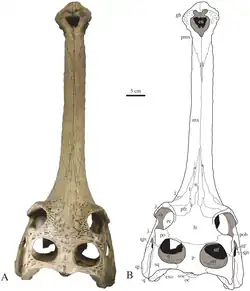 化石種 G. bengawanicus の頭骨 | ||||||||||||||||||||||||||||||||||||
| 分類 | ||||||||||||||||||||||||||||||||||||
| ||||||||||||||||||||||||||||||||||||
| 学名 | ||||||||||||||||||||||||||||||||||||
| Gavialis Oppel, 1811 | ||||||||||||||||||||||||||||||||||||
| 種 | ||||||||||||||||||||||||||||||||||||
|
分布
インドガビアル属は第四紀更新世にインド亜大陸で出現し、第四紀にシヴァ - マラヤルートを介してマレー諸島へ分布を拡大した。インドガビアル属に割り当てられうる他の種には、ウォレス線の東側に位置するスラウェシ島やウッドラーク島から知られているものがいる。インドガビアル属の有史以前の系統は海域を横断でき、西オセアニアほどの遠隔地にも到達できた可能性がある[4]。一方で G. bengawanicus の化石がインドネシア以外にタイ王国から産出しており、海路を介さずともタイを通過して到達できたのではないかとする見解もある[5]。
分類
インドガビアル属は、シバリク山脈で収集されたロンドン自然史博物館所蔵の標本に基づき、2018年に再評価が行われた。G. gangeticus と G. bengawanicus はインドガビアル属に属する数少ない2種であり、G. hysudricus は G. gangeticus のジュニアシノニムとされた。さらに G. leptodus、G. pachyrhynchus、G. curvirostris、G. breviceps はランフォスクスに含まれることが提唱された。G. browni と G. lewisi についてはさらなる改訂が求められる[2]。G. dixoni は独自の属であるドロスクス属として独立した[6]。
G. browni は両目が互いに近くに位置していてかつ前頭骨の幅も狭い点でインドガビアルと区別され[7]、1932年に当時最も基盤的なインドガビアル属とされていた G. dixoni(後のドロスクス)と現生のインドガビアルの中間的な種として記載された[8]。G. browni はドロスクスよりも吻部が長いが、インドガビアルほどではなく、また、歯の本数もインドガビアルより少ない[9]。
系統
以下は分子系統解析を用いた主要な現生ワニ類の類縁関係。インドガビアル属とマレーガビアル属がアリゲーター上科よりも互いに近縁であることが示された[10][11][12][13][14]。
| ワニ目 |
| ||||||||||||||||||||||||||||||||||||||||||||||||






_white_background.jpg.webp)

以下は、より詳細なガビアル科内の系統関係。化石種も含んでいる[13]。
| ガビアル科 |
| ||||||||||||||||||||||||||||||||||||||||||||||||||||||||||||||||||||||||
出典
- “【企画展示】 タイ国立科学博物館 特別展示 「タイからワニがやってきた!」”. 北海道大学総合博物館 (2013年). 2021年7月23日閲覧。
- Martin, J. E. (2018). “The taxonomic content of the genus Gavialis from the Siwalik Hills of India and Pakistan” (英語). Papers in Palaeontology 0. doi:10.1002/spp2.1247.
- Lull, R. S. (1944). “Fossil gavials from north India”. American Journal of Science 242 (8): 417–430. doi:10.2475/ajs.242.8.417.
- Delfino, M.; De Vos, J. (2010). “A revision of the Dubois crocodylians, Gavialis bengawanicus and Crocodylus ossifragus, from the Pleistocene Homo erectus beds of Java”. Journal of Vertebrate Paleontology 30 (2): 427. doi:10.1080/02724631003617910.
- Martin, J. E.; Buffetaut, E.; Naksri, W.; Lauprasert, K. & Claude, J. (2012). “Gavialis from the Pleistocene of Thailand and its relevance for drainage connections from India to Java”. PLOS One 7 (9): e44541. doi:10.1371/journal.pone.0044541. PMC 3445548. PMID 23028557.
- Swinton, W. E. (1937). "The crocodile of Maransart (Dollosuchus dixoni [Owen])". Mémoires du Musée d'Histoire Naturelle de Belgique. 80: 1–44.
- Claude, J.; Naksri, W.; Boonchai, N.; Buffetaut, E.; Duangkrayom, J.; Laojumpon, C.; Jintasakul, P.; Lauprasert, K. et al. (2011). “Neogene reptiles of northeastern Thailand and their paleogeographical significance”. Annales de Paléontologie 97 (3–4): 113. doi:10.1016/j.annpal.2011.08.002.
- Brochu, C. A. (2007). “Systematics and Taxonomy of Eocene Tomistomine Crocodylians from Britain and Northern Europe”. Palaeontology 50 (4): 917–928. doi:10.1111/j.1475-4983.2007.00679.x.
- Mook, C. C. (1932). “A new species of fossil gavial from the Siwalik Beds”. American Museum Novitates 514: 1–5.
- Harshman, J.; Huddleston, C. J.; Bollback, J. P.; Parsons, T. J.; Braun, M. J. (2003). “True and false gharials: A nuclear gene phylogeny of crocodylia”. Systematic Biology 52 (3): 386–402. doi:10.1080/10635150309323. PMID 12775527.
- Gatesy, J.; Amato, G. (2008). “The rapid accumulation of consistent molecular support for intergeneric crocodylian relationships”. Molecular Phylogenetics and Evolution 48 (3): 1232–1237. doi:10.1016/j.ympev.2008.02.009. PMID 18372192.
- Erickson, G. M.; Gignac, P. M.; Steppan, S. J.; Lappin, A. K.; Vliet, K. A.; Brueggen, J. A.; Inouye, B. D.; Kledzik, D. et al. (2012). “Insights into the ecology and evolutionary success of crocodilians revealed through bite-force and tooth-pressure experimentation”. PLOS ONE 7 (3): e31781. Bibcode: 2012PLoSO...731781E. doi:10.1371/journal.pone.0031781. PMC 3303775. PMID 22431965.
- Michael S. Y. Lee; Adam M. Yates (27 June 2018). “Tip-dating and homoplasy: reconciling the shallow molecular divergences of modern gharials with their long fossil”. Proceedings of the Royal Society B 285 (1881). doi:10.1098/rspb.2018.1071.
- Hekkala, E.; Gatesy, J.; Narechania, A.; Meredith, R.; Russello, M.; Aardema, M. L.; Jensen, E.; Montanari, S. et al. (2021-04-27). “Paleogenomics illuminates the evolutionary history of the extinct Holocene “horned” crocodile of Madagascar, Voay robustus” (英語). Communications Biology 4 (1): 1–11. doi:10.1038/s42003-021-02017-0. ISSN 2399-3642.