ウォーボンネット
ウォーボンネット(英語:war bonnets、warbonnets、feather bonnets)とは、北アメリカの先住民であるインディアンの中で非常に栄誉ある地位の男性が身に着ける冠である。戦場の他、儀式の場でも着用された。

シャイアン族の羽根冠
この装備は、アメリカ州の先住民族達が認めた酋長などの権力者や勇者(インディアン・ブレイブ)に人々が贈ったレガリアで、民族の精神的・政治的に非常に重要なアイテムと見なされている[1][2]。そのため、部族の承認なしに身に着けたミュージシャン等は、文化と伝統への侮辱として激しい抗議が行われた[3][4]。先住民以外の指導者にも送られるが論争になることも多い[5]。
各言語の名称
分類
- 羽根の冠
- グレートプレーンズに住むスー族、クロウ族、シハサパ族、シャイアン族などで、勇気・名誉・無私の行為(武勇や政治・外交、コミュニティへの貢献などの偉業)を行った者に送られた。
- 昔から女性が酋長や戦士などになるケースはあったが、近代以前では羽根の冠を身に着けられることはなかった。民族によっては稀ではあるが議論の上で女性のリーダーに送られるようになってきている[5]。
- デザインとして、頭の上に冠のように突き立ったもの、放射状のもの、うしろに広がって足元まで伸びているものなど様々な形式がある。
- よくインディアンの絵で使用されるヘッドバンドに羽根を1-3本程度指すスタイルは森林地帯の数部族のみに見られる日常的な男女の区別なく身に着けられる装備である。
- バッファローの冠
- Buffalo Headdresses (Horned Warbonnets)と呼ばれる。バッファローの角と皮を使ったレガリアである。鳥の羽根を使った物もある。
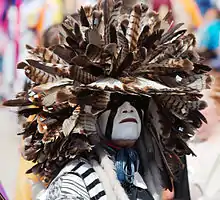

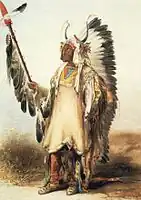 角のあるウォーボンネット
 (参考)南米のマヤ文明の羽根冠。pok-ta-pok前の儀式
.jpeg.webp) (参考)南米のパタクソ族の羽根冠
(参考)南米のパタクソ族の羽根冠
出典
- Life of George Bent: Written From His Letters, by George E. Hyde, edited by Savoie Lottinville, University of Oklahoma Press (1968), hardcover, 390 pages; trade paperback, 280 pages (March 1983), pp 214, 216, 239, 307. ISBN 0-8061-1577-7, 978-0-8061-1577-1.
- The Battle of Beecher Island and the Indian War of 1867–1869, by John H. Monnett, University Press of Colorado (1992), pages 46 to 48. ISBN 0-87081-347-1.
- “'I Didn't Know' Doesn't Cut It Anymore”. Indian Country Today Media Network. 2017年7月6日時点のオリジナルよりアーカイブ。2015年4月20日閲覧。 “On imitation Native headdresses as "the embodiment of cultural appropriation ... donning a highly sacred piece of Native culture like a fashion accessory”
- Keene, Adrienne (April 27, 2010) "But Why Can’t I Wear a Hipster Headdress? Archived May 13, 2016, at the Wayback Machine." at Native Appropriations – Examining Representations of Indigenous Peoples.
- Behind First Nations headdresses: What you should know
- https://sirismm.si.edu/EADpdfs/NMAI.AC.108.pdf
- Louise Fisher,Wayne Leman,Leroy Pine Sr.,Marie Sanchez"Cheyenne Dictionary"2017.
- Raffaella Milandri,Myriam Blasini"Lessico Lakota: Storia, Spiritualità e Dizionario Italiano-Lakota"2019.
- Vincent Collette & Armand McArthur"NAKODA LANGUAGELESSONS"2017.
- John P. Williamson"An English-Dakota Dictionary "1902.
- GoodTracks, Jimm G. "Iowa, Otoe-Missouria Language Dictionary: English / Báxoje-Jiwére-Ñútˀačhi ~ Maʔúŋke. (Revised Edition)". Center for the Study of the Languages of the Plains and Southwest,2007.
- Alan Corbiere"Symbolic,Cultural and Linguistic Meanings"
- Ben Norton"Introduction to Wébaxu Ní -Decorative Alphabet for Omaha–Ponca"2019.
- Rosalyn R. LaPier"Blackfeet Vocabulary Terms for Items of Material Culture"2004.
- Douglas R. Parks, Janet Beltran, Ella P. Waters and Angela Plante"Advanced Arikara Language Lessons sáhniš wakuúnu„ Volume 2"2013.
- Andrew Cowell, with Alonzo Moss, Sr., William C'Hair, Wayne C'Hair Arapahoe Immersion School, and elders of the Northern Arapaho Tribe"Dictionary of the Arapaho Language"2012.
関連項目
- ローチ (冠) - ヤマアラシの毛、ムースの毛、鹿の尻尾の毛、七面鳥の胸毛などで作られた冠。ロッキー山脈の東側でポタワトミ族のほか多くの部族、北アメリカで広く見られる頭飾りである。
- イーグルフェザー法 - ネイティブアメリカンが伝統を維持するために鷹の狩猟を一部の者だけ制限付きで許可する法律
頭の羽根飾り
This article is issued from Wikipedia. The text is licensed under Creative Commons - Attribution - Sharealike. Additional terms may apply for the media files.