オオツパイ
オオツパイ(Large treeshrew)は、ツパイ科ツパイ属の哺乳類である[2]。スマトラ島や近隣の小島、またボルネオ島の低地や丘が原産である[3]。
| オオツパイ | |||||||||||||||||||||||||||
|---|---|---|---|---|---|---|---|---|---|---|---|---|---|---|---|---|---|---|---|---|---|---|---|---|---|---|---|
 | |||||||||||||||||||||||||||
| 保全状況評価[1] | |||||||||||||||||||||||||||
| LEAST CONCERN (IUCN Red List Ver.3.1 (2001))  | |||||||||||||||||||||||||||
| 分類 | |||||||||||||||||||||||||||
| |||||||||||||||||||||||||||
| 学名 | |||||||||||||||||||||||||||
| Tupaia tana (Raffles, 1821) | |||||||||||||||||||||||||||
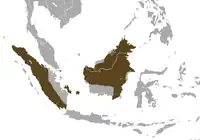 分布域 |
生息地
オオツパイは、ツパイの中で最も陸生の種である。木の上で過ごすこともあるが、通常は採餌のために林床で生活する[4]。野外観察と形態学的痕跡の両方から、主に陸生であると記載される[5][6][7]。一次熱帯雨林に最も多くいるが、湿地林や二次林でも見られる。マーブルキャット、ヒョウ、ウンピョウ等、捕食者となりうる種は多い。
種子散布により、低地熱帯雨林での生態系の維持に貢献している。
記載
オオツパイは、コモンツパイよりも若干大きい[4]。背側の毛は赤茶色で、後部の色は暗く、黒に近い。首から、背中の半分から3分の2程度、色が黒くなる部分まで、黒色の縞模様が走っている。
測定されたサイズは、以下のとおり。
- 体長:165-321 mm
- 尾の長さ:130-220 mm
- 後足:43-57 mm
- 体重:154-305 g
鼻口部は長く、両目の中心から鼻先までの長さは、37 mm以上である[3]。
聴力に優れ、目が大きいため夜間の視力はよい[8]が日中はあまり見えない。
生殖
性的に成熟するのは、両性とも平均で1歳である。メスは、2匹の晩成の子供を産む。縄張りの質が悪かったり食糧の少ない期間は、メスの繁殖力は落ちる[9]。
出典
- Cassola, F. (2016). “Tupaia tana”. IUCN Red List of Threatened Species 2016: e.T41501A22279356. doi:10.2305/IUCN.UK.2016-2.RLTS.T41501A22279356.en 2022年1月26日閲覧。.
- Template:MSW3 Helgen
- Payne, J., Francis, C. M., Phillipps, K. (1985). Field guide to mammals of Borneo. The Sabah Society with World Wildlife Fund Malaysia.
- Yasuma, S., Andau, M., Apin, L., Yu, F.T.Y., and Kimsui, L. (2003). Identification keys to the mammals of Borneo: Insectivora, Scandentia, Rodentia and Chiroptera. Park Management Component BBEC Programme, Sabah.
- Emmon, L. (2000). Tupai: a Field Study of Bornean Treeshrews. University of California Press, Berkeley, Los Angeles.
- Wells, K., Pfeiffer, M., Lakim, M. B., and Kalko, E. K. V. (2006). Movement trajectories and habitat partitioning of small mammals in logged and unlogged rain forest on Borneo. Journal of Animal Ecology 75(5): 1212–1223.
- Sargis, E. J. (2001). A preliminary qualitative analysis of the axial skeleton of tupaiids (Mammalia, Scandentia): functional morphology and phylogenetic implications. Journal of Zoology 253(4): 473–483.
- Harwood, R.. “Geology 102: Humans”. 2010年6月25日時点のオリジナルよりアーカイブ。2009年8月3日閲覧。
- Munshi-South, J. (2008). “Female-biased dispersal and gene flow in a behaviorally monogamous mammal, the large treeshrew (Tupaia tana)”. PLoS One 3 (9): e3228. doi:10.1371/journal.pone.0003228. PMC 2528962. PMID 18797506.
This article is issued from Wikipedia. The text is licensed under Creative Commons - Attribution - Sharealike. Additional terms may apply for the media files.