オリンギト
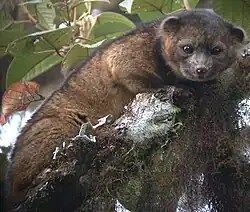
オリンギート(西: Olinguito 学名:Bassaricyon neblina)は、コロンビアとエクアドルの山地に生息するアライグマ科オリンゴ属の哺乳類である。スペイン語で「小さなオリンゴ」を意味する。2013年8月15日に発見が公表された[1][2]。
| オリンギート | |||||||||||||||||||||||||||
|---|---|---|---|---|---|---|---|---|---|---|---|---|---|---|---|---|---|---|---|---|---|---|---|---|---|---|---|
 | |||||||||||||||||||||||||||
| 保全状況評価 | |||||||||||||||||||||||||||
| NEAR THREATENED (IUCN Red List Ver.3.1 (2001))  | |||||||||||||||||||||||||||
| 分類 | |||||||||||||||||||||||||||
| |||||||||||||||||||||||||||
| 学名 | |||||||||||||||||||||||||||
| Bassaricyon neblina Helgen, 2013 |
概要
オリンギートは、オリンゴ属の他の種や形態のよく似たキンカジューから区別される[3][4]。平均体重は約900gで、アライグマ科では最も小さい[1][5][6]。主にイチジク等の果物を食べるが、昆虫や蜜も食べる雑食性で[2]、小さなブルーベリー程の大きさの糞をする[6][7]。オリンギトは単独行動で夜行性と考えられており[2]、あまり人前に姿を現さず、ほぼ樹上で生活する[2][4]。乳腺は1対であり、恐らく1度に1匹の子を産む[2][4][6]。
この種を同定した研究者らは、現地でこの種を指す特有の名前は見つけられなかった[8]。
特徴
オリンギートは、オリンゴ属の他の種よりも小さい[1]。毛皮はより豊かで、歯の配列は異なり、尾は短く、耳は小さい[9]。オリンギートは、標高1500mから2750mのアンデス山脈北部で見つかり[4]、これはオリンゴ属の他の種の生息域よりも高い[7]。
形態的な特徴から、オリンギートは、Bassaricyon neblina neblina、B. n. osborni、B. n. hershkovitzi、B. n. ruberの4つの亜種に分かれる[4]。
2つのオリンギートの亜種と他のオリンゴとの間でのミトコンドリアのシトクロムbのDNAの比較から、オリンギートと他のオリンゴは姉妹群であり、異なる亜属か属に相当するほど離れていることが分かった[4]。この分離は、約350万年前に起こったと考えられ、アメリカ大陸間大交差の際に北アメリカから南アメリカ北西部に侵入してきた直後に分化したことが示唆される[4]。
分布
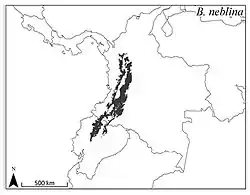
この種は、中央コロンビアから西エクアドルに広がる雲霧林で同定され[6]、野生にいることが確認された[1][4]。すぐの絶滅危惧にあるとは考えられていないが[1]、潜在的な分布域の森林の40%以上は破壊されていると推定されている[1][7]。
発見
2013年8月15日に、国立自然史博物館 (アメリカ)の哺乳類のキュレーターであるKristofer Helgen、ノースカロライナ自然科学博物館のオリンゴ属の専門家Roland Kaysらによって発見が公表された[1][2][10][11][12]。Helgenはフィールド自然史博物館の貯蔵標本から発見し、DNA試験で新種であることを確認した[6]。
ネコ目の新しい哺乳類の種がアメリカで発見されるのは35年ぶりのことだった[1][2]。オリンギートは、新種と認識される前に日常的に目撃され、数十年にわたって公衆の前に展示さえされていた。この動物は、以前は他のオリンゴ属と混同されていた。その一例は、ワシントンのNational Zoological Parkで1年間展示され、多くの動物園を回ったRingerlである[2][9]。Ringerlは別のオリンゴとの交配が試みられ、失敗していたが、異なる種だとは認識されなかった。Ringerlは1976年に死亡した[5]。
出典
- Stromberg, Joseph (2013年8月15日). “For the First Time in 35 Years, A New Carnivorous Mammal Species is Discovered in the American Continents”. Smithsonian Magazine. 2013年8月15日閲覧。
- Roland Kays. Press conference at North Carolina Museum of Natural Sciences. Livestream (video). August 15, 2013
- Koepfli, Klaus-Peter; Gompper, Matthew E.; Eizirik, Eduardo; Ho, Cheuk-Chung; Linden, Leif; Maldonado, Jesus E.; Wayne, Robert K. (2007). “Phylogeny of the Procyonidae (Mammalia: Carnivora): Molecules, morphology and the Great American Interchange”. Molecular Phylogenetics and Evolution 43 (3): 1076–95. doi:10.1016/j.ympev.2006.10.003. PMID 17174109.
- Helgen, K. M.; Pinto, M.; Kays, R.; Helgen, L.; Tsuchiya, M.; Quinn, A.; Wilson, D.; Maldonado, J. (August 15, 2013). “Taxonomic revision of the olingos (Bassaricyon), with description of a new species, the Olinguito”. ZooKeys 324: 1–83. doi:10.3897/zookeys.324.5827.
- Borenstein, Seth (2013年8月15日). “Adorable New Mammal Species Found 'In Plain Sight'”. ABC News 2013年8月15日閲覧。
- O'Brien, Jane (2013年8月15日). “Olinguito: 'Overlooked' mammal carnivore is major discovery”. BBC News. 2013年8月15日閲覧。
- Landau, Elizabeth (2013年8月15日). “New cute furry mammal species discovered”. CNN. 2013年8月15日閲覧。
- 'Teddy bear' carnivore emerges from the mists of Ecuador The Guardian, August 15, 2013
- Sample, Ian. Carnivore 'teddy bear' emerges from the mists of Ecuador. Guardian. Thursday August 15, 2013
- Kim, Meeri (2013年8月16日). “Smithsonian unearths a new species of mammal: The olinguito”. Washington Post 2013年8月16日閲覧。
- “New animal discovered in Andes”. WRAL 2013年8月16日閲覧。
- “A new mammal. Peekaboo”. The Economist (2013年8月17日). 2013年8月15日閲覧。