カナダスピス
カナダスピス(Canadaspis[4])は、約5億年前のカンブリア紀に生息した化石節足動物Hymenocarina類の一属[3]。丈夫な体が円筒状の背甲に覆われる。北アメリカ大陸と中国で見つかった種によって知られる[9][10][11]。
| カナダスピス | ||||||||||||||||||
|---|---|---|---|---|---|---|---|---|---|---|---|---|---|---|---|---|---|---|
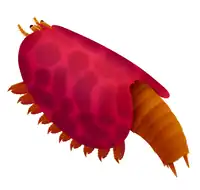 Canadaspis perfecta の復元図 | ||||||||||||||||||
| 保全状況評価 | ||||||||||||||||||
| 絶滅(化石) | ||||||||||||||||||
| 地質時代 | ||||||||||||||||||
| 古生代カンブリア紀第三期 - ウリューアン期(約5億1,800万 - 5億500万年前)[1][2] | ||||||||||||||||||
| 分類 | ||||||||||||||||||
| ||||||||||||||||||
| 学名 | ||||||||||||||||||
| Canadaspis Novozhilov, 1960 [4] | ||||||||||||||||||
| タイプ種 | ||||||||||||||||||
| Canadaspis perfecta (Walcott, 1912) [5][4] | ||||||||||||||||||
| 種 | ||||||||||||||||||
名称
学名「Canadaspis」は、最初の発見地である北アメリカ大陸の国カナダ(Canada)と、ギリシャ語において「盾」を意味する「aspis」の合成語[11]。模式種(タイプ種)Canadaspis perfecta [4]の種小名「perfecta」はラテン語の「perfectus」(完全・完璧)による[11]。
形態
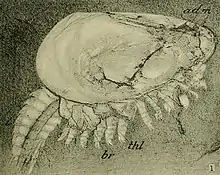
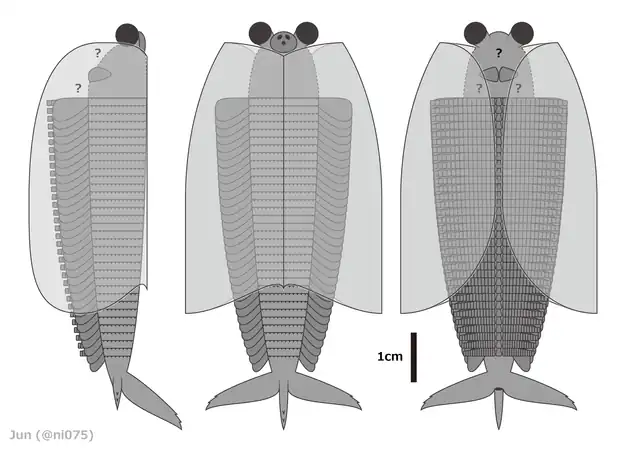
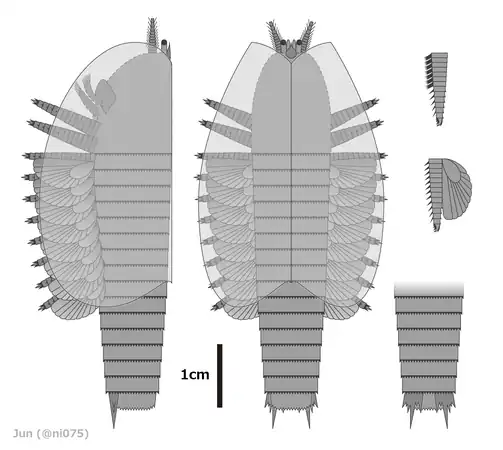 Canadaspis perfecta の全身復元図(左:側面、中:背面、右上:前2対の脚、右中:後8対の脚、右下:腹部腹面)
全長最大約5cm[11]。体の大部分は円筒状の背甲に覆われ、先頭の構造・脚先・腹部のみ露出している。
背甲(carapace)は丸みを帯びた円筒状で、頭部から腹部の直前まで広げて体の背面と左右を覆い被さる。全体的に二枚貝状に分かれ、片割れが楕円形で、蝶番のように背面の正中線が関節となる[11]。
頭部の先頭は、少なくとも眼柄についた1対の小さな眼と、付属肢(関節肢)として10節以上に分かれた1対の短い触角(antenna)をもつことが確定的である[11][3]。両眼の間には1枚の甲皮(anterior sclerite)と、正体が不確かな1対の短い突起物(inter-ocular lobe)がある[3]。かつて、これらの突起物は第1体節由来の第1触角で、それに応じて前述の確定的な触角は第2体節由来の第2触角と解釈された[7]。しかし、他のHymenocarina類との比較により、この突起物は触角ではなく、むしろ眼と同じ先節由来の非付属肢性の構造体と示される[3][12]。この見解を踏まえて、かつて第2体節由来と考えられた確定的な触角の方が第1体節由来の可能性が高い[3][13]。それ以降の頭部構造は更に不確実で、かつて甲殻類的な第3体節由来の大顎(mandible)と第4-5体節由来の小顎(maxilla)をもつと解釈されてきた[11]が、1990年代から2010年代中期にかけてその存在は否定的であった[9]。2022時点ではワプティアと似て、剛毛のある大顎髭をもつ大顎と、短い小顎を1対もつことが再び判明した[3][12][14]。口は頭部の腹面で後ろに向くとされるが、それを覆い被さる上唇(labrum)の有無は不明[9][3]。
頭部以降の胴部は円柱状で、後縁が鋸歯状の胴節を十数節有し、前後で付属肢のある胸部と付属肢をもたない腹部にまとめられる[3]。腹部の末端は太く短い尾節(telson)で、表面に棘が生えて、腹面には最終腹節から突き出した1対の突起物がある[7]。胸部の腹面から突出した10対の付属肢はほぼ同じ大きさの歩脚型で、内肢(endopod)は丈夫な十数節に分かれ、末端には数本の鉤爪、各肢節の内側には内突起(内葉 endite)がある[9]。ただし、前の2対と残りの8対は形態がやや異なる[14]。前の2対は単枝型で、基部数節の内突起は櫛のように先端が枝分かれている[15]。残り8対は二叉型(biramous)で扇形の外肢(exopod)を有し、円形と放射状の筋によって複数のパーツに分かれている[9]。確定的な原節(protopod, basipod)は不明[15]だが、前述の内肢とされる部分のうち基部数節が原節に当たる説もある[16][3][17]。
生態
_-_Canadaspis%252C_sponges%252C_algae.jpg.webp)
カナダスピスはゆるやかな遊泳底生性(nektobenthic, 底生性に近い遊泳性)の海棲動物で[9]、内肢で海底を歩いては堆積物から餌を確保し、外肢で泳ぎながら呼吸をし、体の大部分を覆いかぶさった背甲で外敵から身を守ったと考えられる[11]。
模式種 Canadaspis perfecta はバージェス動物群としてかなり普遍で、2008年時点では約5,000点の化石標本がバージェス頁岩から発見される[18][11]。
分類
| |||||||||||||||||||||||||||||||||||||||
| 2010年代後期以降のカナダスピスの系統的位置[3][19][20][21][22][23][24][12][25][26] |
いくつかの基本体制の共通点(頭部と胸部を覆い被さる二枚貝状の背甲・発達した触角・第2体節付属肢の欠如・大顎・リング状の腹節)を基に、カナダスピスはオダライア、ワプティア、ブランキオカリスなどと共にHymenocarina類(目)に分類される[3]。この類自体の系統位置は議論的で、1990年代から2010年代中期にかけて一般に基盤的な真節足動物と考えられてきた[9][27][28][29][30][31][32][33][13][15]が、2010年代後期以降では大顎の再発見で大顎類と見直されつつある[3][34][35][19][36][20][21][22][37][23][24][12][25][26][14]。
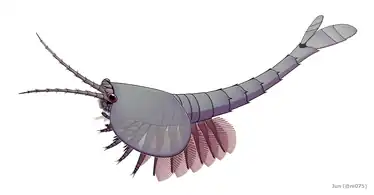
1990年代以前では、カナダスピスはほぼ疑いなく甲殻類と考えられてきた。最初に記載された種 Canadaspis perfecta は記載当初(Walcott 1912)では軟甲類の甲殻類と解釈され、ハイメノカリス(Hymenocaris)の1種 Hymenocaris perfecta として命名され[5]、後に Novozhilov 1960 で新属カナダスピス(Canadaspis)の模式種 Canadaspis perfecta として区別されるようになった[4]。Briggs & Whittington 1978 では、カナダスピスの腹部は7節で、10対の二叉型付属肢のうち前2対を頭部の小顎で残り8対を胸肢とされ、更に頭部は2対の触角と1対の大顎も兼ね備えると解釈された。このような体制(頭部付属肢5対+胸肢8対+腹部7節以下)は軟甲類的で、二枚貝状に分かれた背甲と7節の腹部はそのうちのコノハエビ類に見られる特徴のため、カナダスピスはコノハエビ類に分類された[7]。しかし上述の軟甲類的解釈は1990年代以降から否定的になり、特に Hou & Bergström 1997 では、軟甲類の体制に当てはまらない10節の腹部をもつ種 Canadaspis laevigata が再記載され、Briggs & Whittington 1978 のいくつかの解釈も疑問を掛けられた(大顎の存在は懐疑的・触角とされる部分はどれも単枝型で軟甲類らしからぬ・二叉型付属肢の外肢の形態は甲殻類として異様など)[9]。
下位分類
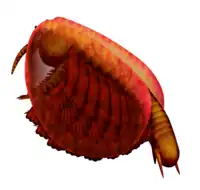
カナダスピス(カナダスピス属 Canadaspis)は次の2種が正式に命名される[11]。
- 本属の模式種(タイプ種)。カナダブリティッシュコロンビア州のバージェス頁岩(バージェス動物群、カンブリア紀ウリューアン期、約5億1,000万 - 5億500万年前[2])から発見される。腹部は7節もつ[11]。
- 中国雲南省の Maotianshan Shale(澄江動物群、カンブリア紀第三期、約5億1,800万年前[1])から発見される。腹部は10節もつ。C. perfecta に比べて背甲はやや小さく、尾節の棘は少ない[9]。
それ以外では、アメリカユタ州の堆積累層 Wheeler Shale(カンブリア紀ウリューアン期)で見つかり、暫定的に Canadaspis cf. perfecta と同定される本属の化石標本も知られている[38][10]。
Simonetta & delle Cave 1975 では Canadaspis ovalis、Canadaspis dictynna と Canadaspis obesa を記載された[6]が、いずれも後に別の既存種のシノニムとされるようになった(Canadaspis ovalis と Canadaspis dictynna は Perspicaris dictynna[39]、Canadaspis obesa は Canadaspis perfecta[7])[11]。
参考文献
- 福田芳生『古生態図集・海の無脊椎動物』川島書店、1996年。ISBN 4761005963。 NCID BN15261218。全国書誌番号:97074102。
- スティーヴン・ジェイ・グールド, 渡辺政隆『ワンダフル・ライフ : バージェス頁岩 (けつがん) と生物進化の物語』早川書房〈ハヤカワ文庫 NF 236〉、2000年。ISBN 4150502366。 NCID BA48365862。全国書誌番号:20054903。
脚注
- Yang, Chuan; Li, Xian-Hua; Zhu, Maoyan; Condon, Daniel J.; Chen, Junyuan (2018-03-15). “Geochronological constraint on the Cambrian Chengjiang biota, South China”. Journal of the Geological Society 175 (4): 659–666. doi:10.1144/jgs2017-103. ISSN 0016-7649.
- Canada, Royal Ontario Museum and Parks (2011年6月10日). “Geological Background - The Burgess Shale” (英語). burgess-shale.rom.on.ca. 2022年3月14日閲覧。
- Aria, Cédric; Caron, Jean-Bernard (2017-05). “Burgess Shale fossils illustrate the origin of the mandibulate body plan” (英語). Nature 545 (7652): 89–92. doi:10.1038/nature22080. ISSN 1476-4687.
- NOVOZHILOV. N. I. 1960. Principles of Paleontology: arthropods, trilobites and crustaceans. In Y. A. Orlov (ed.). Gos. Nauchno-Techn. Izdvo, Moscow.
- WALCOTT, C. D. 1912. Middle Cambrian Branchiopoda, Malacostraca, Trilobita and Merostomata. Smithsonian Miscellaneous Collections, 57: 145-228.
- SIMONETTA, A. M. AND L. DELLE CAVE. 1975. The Cambrian non-trilobite arthropods from the Burgess shale of British Columbia: A study of their comparative morphology, taxonomy and evolutionary significance. Palaeontographia Italica, 69: 1-37.
- Briggs, Derek Ernest Gilmor; Whittington, Harry Blackmore (1978-01-23). “The morphology, mode of life, and affinities of Canadaspis perfecta (Crustacea: Phyllocarida), Middle Cambrian, Burgess Shale, British Columbia”. Philosophical Transactions of the Royal Society of London. B, Biological Sciences 281 (984): 439–487. doi:10.1098/rstb.1978.0005.
- HOU, X. AND J. BERGSTRÖM. 1991. The arthropods of the Lower Cambrian Chengjiang fauna, with relationships and evolutionary significance p. 179-187. In A. M. Simonetta and S. Conway Morris (eds.), The Early Evolution of Metazoa and the Significance of Problematic Taxa. Cambridge University Press, Cambridge.
- Hou, Xianguang. (1997). Arthropods of the Lower Cambrian Chengjiang fauna, southwest China. Bergström, Jan, 1938-. Oslo: Scandinavian University Press. ISBN 82-00-37693-1. OCLC 38305908
- Briggs, Derek E. G.; Lieberman, Bruce S.; Hendricks, Jonathan R.; Halgedahl, Susan L.; Jarrard, Richard D. (2008-03). “Middle Cambrian arthropods from Utah” (英語). Journal of Paleontology 82 (2): 238–254. doi:10.1666/06-086.1. ISSN 0022-3360.
- Canada, Royal Ontario Museum and Parks (2011年6月10日). “Canadaspis - Fossil Gallery - The Burgess Shale” (英語). burgess-shale.rom.on.ca. 2022年3月14日閲覧。
- Izquierdo‐López, Alejandro; Caron, Jean‐Bernard (2021-06-15). “A Burgess Shale mandibulate arthropod with a pygidium: a case of convergent evolution”. Papers in Palaeontology 7 (4): 1877–1894. doi:10.1002/spp2.1366. ISSN 2056-2799.
- Ortega-Hernández, Javier; Janssen, Ralf; Budd, Graham E. (2017-05-01). “Origin and evolution of the panarthropod head – A palaeobiological and developmental perspective” (英語). Arthropod Structure & Development 46 (3): 354–379. doi:10.1016/j.asd.2016.10.011. ISSN 1467-8039.
- Izquierdo-López, Alejandro; Caron, Jean-Bernard (2022-12-07). “The problematic Cambrian arthropod Tuzoia and the origin of mandibulates revisited”. Royal Society Open Science 9 (12): 220933. doi:10.1098/rsos.220933. PMC 9727825. PMID 36483757.
- Yang, Jie; Ortega-Hernández, Javier; Legg, David A.; Lan, Tian; Hou, Jin-bo; Zhang, Xi-guang (2018-02-01). “Early Cambrian fuxianhuiids from China reveal origin of the gnathobasic protopodite in euarthropods” (英語). Nature Communications 9 (1): 470. doi:10.1038/s41467-017-02754-z. ISSN 2041-1723.
- Walossek, D. in Crustaceans and the Biodiversity Crisis, Proceedings of the Fourth International 2184 Crustacean Congress, Amsterdam, The Netherlands Vol. 1 (eds F.R. Schram & J.C. von Vaupel Klein) 3- 2185 27 (Brill Academic Publishers., 1999).
- Fu, Dongjing; Legg, David A.; Daley, Allison C.; Budd, Graham E.; Wu, Yu; Zhang, Xingliang (2022-03-28). “The evolution of biramous appendages revealed by a carapace-bearing Cambrian arthropod”. Philosophical Transactions of the Royal Society B: Biological Sciences 377 (1847): 20210034. doi:10.1098/rstb.2021.0034. PMC 8819368. PMID 35125000.
- Caron, Jean-Bernard; Jackson, Donald A. (2008-02-18). “Paleoecology of the Greater Phyllopod Bed community, Burgess Shale” (英語). Palaeogeography, Palaeoclimatology, Palaeoecology 258 (3): 222–256. doi:10.1016/j.palaeo.2007.05.023. ISSN 0031-0182.
- Vannier, Jean; Aria, Cédric; Taylor, Rod S.; Caron, Jean-Bernard (2018-06). “Waptia fieldensis Walcott, a mandibulate arthropod from the middle Cambrian Burgess Shale”. Royal Society Open Science 5 (6): 172206. doi:10.1098/rsos.172206. PMC 6030330. PMID 30110460.
- Aria, Cédric; Caron, Jean-Bernard (2019-09). “A middle Cambrian arthropod with chelicerae and proto-book gills” (英語). Nature 573 (7775): 586–589. doi:10.1038/s41586-019-1525-4. ISSN 1476-4687.
- Aria, Cédric; Zhao, Fangchen; Zeng, Han; Guo, Jin; Zhu, Maoyan (2020-01-08). “Fossils from South China redefine the ancestral euarthropod body plan”. BMC Evolutionary Biology 20 (1): 4. doi:10.1186/s12862-019-1560-7. ISSN 1471-2148. PMC 6950928. PMID 31914921.
- Ou, Qiang; Vannier, Jean; Yang, Xianfeng; Chen, Ailin; Mai, Huijuan; Shu, Degan; Han, Jian; Fu, Dongjing et al. (2020-05). “Evolutionary trade-off in reproduction of Cambrian arthropods”. Science Advances 6 (18). doi:10.1126/sciadv.aaz3376. ISSN 2375-2548. PMC 7190318. PMID 32426476.
- Zeng, Han; Zhao, Fangchen; Niu, Kecheng; Zhu, Maoyan; Huang, Diying (2020-12). “An early Cambrian euarthropod with radiodont-like raptorial appendages” (英語). Nature 588 (7836): 101–105. doi:10.1038/s41586-020-2883-7. ISSN 1476-4687.
- Anderson, Evan P.; Schiffbauer, James D.; Jacquet, Sarah M.; Lamsdell, James C.; Kluessendorf, Joanne; Mikulic, Donald G. (2021-05). Zhang, Xi‐Guang. ed. “Stranger than a scorpion: a reassessment of Parioscorpio venator, a problematic arthropod from the Llandoverian Waukesha Lagerstätte” (英語). Palaeontology 64 (3): 429–474. doi:10.1111/pala.12534. ISSN 0031-0239.
- Aria, Cédric; Zhao, Fangchen; Zhu, Maoyan (2021-09-01). “Fuxianhuiids are mandibulates and share affinities with total-group Myriapoda” (英語). Journal of the Geological Society 178 (5). doi:10.1144/jgs2020-246. ISSN 0016-7649.
- O’Flynn, Robert J.; Williams, Mark; Yu, Mengxiao; Harvey, Thomas H. P.; Liu, Yu (2022-02). “A new euarthropod with large frontal appendages from the early Cambrian Chengjiang biota” (English). Palaeontologia Electronica 25 (1): 1–21. doi:10.26879/1167. ISSN 1094-8074.
- Budd, Graham E. (2002-05). “A palaeontological solution to the arthropod head problem” (英語). Nature 417 (6886): 271–275. doi:10.1038/417271a. ISSN 1476-4687.
- Legg, David A.; Sutton, Mark D.; Edgecombe, Gregory D.; Caron, Jean-Bernard (2012-12-07). “Cambrian bivalved arthropod reveals origin of arthrodization”. Proceedings of the Royal Society B: Biological Sciences 279 (1748): 4699–4704. doi:10.1098/rspb.2012.1958. PMC 3497099. PMID 23055069.
- Legg, David (2013-05). “Multi-Segmented Arthropods from the Middle Cambrian of British Columbia (Canada)” (英語). Journal of Paleontology 87 (3): 493–501. doi:10.1666/12-112.1. ISSN 0022-3360.
- Legg, David A.; Vannier, Jean (2013-10). “The affinities of the cosmopolitan arthropod Isoxys and its implications for the origin of arthropods” (英語). Lethaia 46 (4): 540–550. doi:10.1111/let.12032.
- Legg, David A.; Sutton, Mark D.; Edgecombe, Gregory D. (2013-09-30). “Arthropod fossil data increase congruence of morphological and molecular phylogenies” (英語). Nature Communications 4 (1): 2485. doi:10.1038/ncomms3485. ISSN 2041-1723.
- Ortega-Hernández, Javier (2014-12-21). “Making sense of ‘lower’ and ‘upper’ stem-group Euarthropoda, with comments on the strict use of the name Arthropoda von Siebold, 1848”. Biological Reviews 91 (1): 255–273. doi:10.1111/brv.12168. ISSN 1464-7931.
- Yang, Jie; Ortega-Hernández, Javier; Lan, Tian; Hou, Jin-bo; Zhang, Xi-guang (2016-06-10). “A predatory bivalved euarthropod from the Cambrian (Stage 3) Xiaoshiba Lagerstätte, South China” (英語). Scientific Reports 6 (1): 27709. doi:10.1038/srep27709. ISSN 2045-2322.
- Edgecombe, Gregory D. (2017-08-21). “Palaeontology: The Cause of Jaws and Claws” (English). Current Biology 27 (16): R807–R810. doi:10.1016/j.cub.2017.07.016. ISSN 0960-9822. PMID 28829968.
- Aria, Cédric; Caron, Jean-Bernard (2017-12-21). “Mandibulate convergence in an armoured Cambrian stem chelicerate”. BMC Evolutionary Biology 17 (1): 261. doi:10.1186/s12862-017-1088-7. ISSN 1471-2148. PMC 5738823. PMID 29262772.
- Giribet, Gonzalo; Edgecombe, Gregory D. (2019-06-17). “The Phylogeny and Evolutionary History of Arthropods” (English). Current Biology 29 (12): R592–R602. doi:10.1016/j.cub.2019.04.057. ISSN 0960-9822. PMID 31211983.
- Edgecombe, Gregory D. (2020-11-02). “Arthropod Origins: Integrating Paleontological and Molecular Evidence”. Annual Review of Ecology, Evolution, and Systematics 51 (1): 1–25. doi:10.1146/annurev-ecolsys-011720-124437. ISSN 1543-592X.
- ROBISON, R. A. AND B. C. RICHARDS. 1981. Larger bivalve arthropods from the Middle Cambrian of Utah. The University of Kansas Paleontological Contributions, 106: 1-28.
- BRIGGS, D. E. G. 1977. Bivalved arthropods from the Cambrian Burgess Shale of British Columbia. Palaeontology, 20: 596-612.