サイクリン依存性キナーゼ4
サイクリン依存性キナーゼ4(サイクリンいぞんせいキナーゼ4、英: Cyclin-dependent kinase 4、略称: CDK4)は、ヒトではCDK4遺伝子にコードされる酵素である。CDK4はサイクリン依存性キナーゼ(CDK)ファミリーに属する。



機能
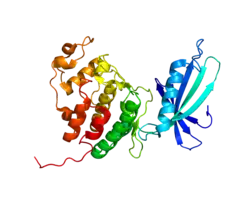
CDK4遺伝子にコードされるタンパク質CDK4は、セリン/スレオニンキナーゼファミリーに属する。このタンパク質は、出芽酵母Saccharomyces cerevisiaeのcdc28、分裂酵母Schizosaccharomyces pombeのcdc2の遺伝子産物と高度に類似している。CDK4はプロテインキナーゼ複合体の触媒サブユニットとして機能し、細胞周期のG1期の進行に重要である。このキナーゼの活性はG1/S期に限定されており、サイクリンDとCDK阻害因子p16INK4aによって制御される。このキナーゼはRbタンパク質のリン酸化を担う[4]。サイクリンD/CDK4複合体はRB1を含むRbタンパク質ファミリーのメンバーをリン酸化して阻害し、G1/S期の移行を調節する。CDK4はG1期の初期にRB1の部分的なリン酸化を行い、RB1のリン酸化によって転写因子E2FはRb/E2F複合体から解離する。E2FはG1期を通じて細胞周期の進行を担う遺伝子群の転写を行う。サイクリンD/CDK4複合体はさまざまな分裂促進・分裂抑制シグナルを統合する主要な因子である。また、細胞周期依存的にSMAD3をリン酸化し、その転写活性を抑制する。サイクリンD/CDK4/CDKN1Bからなる三者複合体は、サイクリンD/CDK4複合体の核への移行と活性のために必要である[5]。
臨床的意義
CDK4遺伝子の変異は、関連タンパク質であるサイクリンD、p16INK4a、Rbと同様、さまざまな種類のがんにおいて腫瘍形成に関係している[4]。CDK4のR24Cの点変異は、悪性黒色腫の患者で最初に同定された。この変異は動物モデルにも導入され、がんを駆動するがん遺伝子としての役割が精力的に研究された。今日では、調節異常をきたしたCDK4は一部のタイプのがんでの治療標的となると考えられており、がんの治療へ向けてさまざまなCDK4阻害剤の臨床試験が行われている[6][7]。
相互作用
CDK4は次に挙げる因子と相互作用することが示されている。
出典
- GRCh38: Ensembl release 89: ENSG00000135446 - Ensembl, May 2017
- Human PubMed Reference:
- Mouse PubMed Reference:
- “Entrez Gene: CDK4 cyclin-dependent kinase 4”. 2020年1月18日閲覧。
- “CDK4 - Cyclin-dependent kinase 4 - Homo sapiens (Human) - CDK4 gene & protein”. www.uniprot.org. 2020年1月17日閲覧。
- Sheppard, K. E.; McArthur, G. A. (2013-10-01). “The Cell-Cycle Regulator CDK4: An Emerging Therapeutic Target in Melanoma” (英語). Clinical Cancer Research 19 (19): 5320–5328. doi:10.1158/1078-0432.CCR-13-0259. ISSN 1078-0432. PMID 24089445.
- Sobhani; D’Angelo; Pittacolo; Roviello; Miccoli; Corona; Bernocchi; Generali et al. (2019-04-06). “Updates on the CDK4/6 Inhibitory Strategy and Combinations in Breast Cancer” (英語). Cells 8 (4): 321. doi:10.3390/cells8040321. ISSN 2073-4409.
- “Approved Drugs > Ribociclib (Kisqali)”. 2017年9月12日閲覧。
- “Large-scale mapping of human protein-protein interactions by mass spectrometry”. Mol. Syst. Biol. 3 (1): 89. (2007). doi:10.1038/msb4100134. PMC 1847948. PMID 17353931.
- “Physical interaction of mammalian CDC37 with CDK4”. J. Biol. Chem. 271 (36): 22030–4. (1996). doi:10.1074/jbc.271.36.22030. PMID 8703009.
- “Interaction between Cdc37 and Cdk4 in human cells”. Oncogene 14 (16): 1999–2004. (1997). doi:10.1038/sj.onc.1201036. PMID 9150368.
- “Mammalian p50Cdc37 is a protein kinase-targeting subunit of Hsp90 that binds and stabilizes Cdk4”. Genes Dev. 10 (12): 1491–502. (1996). doi:10.1101/gad.10.12.1491. PMID 8666233.
- “Cdk6-cyclin D3 complex evades inhibition by inhibitor proteins and uniquely controls cell's proliferation competence”. Oncogene 20 (16): 2000–9. (2001). doi:10.1038/sj.onc.1204375. PMID 11360184.
- “Down-regulation of p21WAF1/CIP1 or p27Kip1 abrogates antiestrogen-mediated cell cycle arrest in human breast cancer cells”. Proc. Natl. Acad. Sci. U.S.A. 97 (16): 9042–6. (2000). doi:10.1073/pnas.160016897. PMC 16818. PMID 10908655.
- “Towards a proteome-scale map of the human protein-protein interaction network”. Nature 437 (7062): 1173–8. (2005). Bibcode: 2005Natur.437.1173R. doi:10.1038/nature04209. PMID 16189514.
- “A skeleton of the human protein interactome”. Cell 122 (6): 830–2. (2005). doi:10.1016/j.cell.2005.09.006. PMID 16179252.
- “Growth suppression by p18, a p16INK4/MTS1- and p14INK4B/MTS2-related CDK6 inhibitor, correlates with wild-type pRb function”. Genes Dev. 8 (24): 2939–52. (1994). doi:10.1101/gad.8.24.2939. PMID 8001816.
- “C/EBPalpha arrests cell proliferation through direct inhibition of Cdk2 and Cdk4”. Mol. Cell 8 (4): 817–28. (2001). doi:10.1016/S1097-2765(01)00366-5. PMID 11684017.
- “Regulation of CDK4 activity by a novel CDK4-binding protein, p34(SEI-1)”. Genes Dev. 13 (22): 3027–33. (1999). doi:10.1101/gad.13.22.3027. PMC 317153. PMID 10580009.
- “Cell cycle. Dams and sluices”. Nature 366 (6456): 634–5. (1993). doi:10.1038/366634a0. PMID 8259207.
- “Calmodulin is essential for cyclin-dependent kinase 4 (Cdk4) activity and nuclear accumulation of cyclin D1-Cdk4 during G1”. J. Biol. Chem. 273 (50): 33279–86. (1998). doi:10.1074/jbc.273.50.33279. PMID 9837900.
- “Identification of CDK4 sequences involved in cyclin D1 and p16 binding”. J. Biol. Chem. 272 (30): 18869–74. (1997). doi:10.1074/jbc.272.30.18869. PMID 9228064.
- “A novel partner for D-type cyclins: protein kinase A-anchoring protein AKAP95”. Biochem. J. 378 (Pt 2): 673–9. (2004). doi:10.1042/BJ20031765. PMC 1223988. PMID 14641107.
- “Developmentally regulated expression of cyclin D3 and its potential in vivo interacting proteins during murine gametogenesis”. Endocrinology 140 (6): 2790–800. (1999). doi:10.1210/endo.140.6.6756. PMID 10342870.
- “Direct inhibition of G(1) cdk kinase activity by MyoD promotes myoblast cell cycle withdrawal and terminal differentiation”. EMBO J. 18 (24): 6983–93. (1999). doi:10.1093/emboj/18.24.6983. PMC 1171761. PMID 10601020.
- “Coupling of the cell cycle and myogenesis through the cyclin D1-dependent interaction of MyoD with cdk4”. EMBO J. 18 (4): 926–33. (1999). doi:10.1093/emboj/18.4.926. PMC 1171185. PMID 10022835.
- “Inhibition of pRb phosphorylation and cell-cycle progression by a 20-residue peptide derived from p16CDKN2/INK4A”. Curr. Biol. 6 (1): 84–91. (1996). doi:10.1016/S0960-9822(02)00425-6. PMID 8805225.
- “The nuclear protein p34SEI-1 regulates the kinase activity of cyclin-dependent kinase 4 in a concentration-dependent manner”. Biochemistry 43 (14): 4394–9. (2004). doi:10.1021/bi035601s. PMID 15065884.
- “Subunit rearrangement of the cyclin-dependent kinases is associated with cellular transformation”. Genes Dev. 7 (8): 1572–83. (1993). doi:10.1101/gad.7.8.1572. PMID 8101826.
関連文献
- Hanks SK (1987). “Homology probing: identification of cDNA clones encoding members of the protein-serine kinase family”. Proc. Natl. Acad. Sci. U.S.A. 84 (2): 388–92. Bibcode: 1987PNAS...84..388H. doi:10.1073/pnas.84.2.388. PMC 304212. PMID 2948189.
- Hall M; Bates S; Peters G (1995). “Evidence for different modes of action of cyclin-dependent kinase inhibitors: p15 and p16 bind to kinases, p21 and p27 bind to cyclins”. Oncogene 11 (8): 1581–8. PMID 7478582.
- Tassan JP; Jaquenoud M; Léopold P et al. (1995). “Identification of human cyclin-dependent kinase 8, a putative protein kinase partner for cyclin C”. Proc. Natl. Acad. Sci. U.S.A. 92 (19): 8871–5. Bibcode: 1995PNAS...92.8871T. doi:10.1073/pnas.92.19.8871. PMC 41069. PMID 7568034.
- Mitchell EL; White GR; Santibanez-Koref MF et al. (1995). “Mapping of gene loci in the Q13-Q15 region of chromosome 12”. Chromosome Res. 3 (4): 261–2. doi:10.1007/BF00713052. PMID 7606365.
- Wölfel T; Hauer M; Schneider J et al. (1995). “A p16INK4a-insensitive CDK4 mutant targeted by cytolytic T lymphocytes in a human melanoma”. Science 269 (5228): 1281–4. doi:10.1126/science.7652577. PMID 7652577.
- Hirai H; Roussel MF; Kato JY et al. (1995). “Novel INK4 proteins, p19 and p18, are specific inhibitors of the cyclin D-dependent kinases CDK4 and CDK6”. Mol. Cell. Biol. 15 (5): 2672–81. doi:10.1128/MCB.15.5.2672. PMC 230497. PMID 7739547.
- Chan FK; Zhang J; Cheng L et al. (1995). “Identification of human and mouse p19, a novel CDK4 and CDK6 inhibitor with homology to p16ink4”. Mol. Cell. Biol. 15 (5): 2682–8. doi:10.1128/MCB.15.5.2682. PMC 230498. PMID 7739548.
- Guan KL; Jenkins CW; Li Y et al. (1995). “Growth suppression by p18, a p16INK4/MTS1- and p14INK4B/MTS2-related CDK6 inhibitor, correlates with wild-type pRb function”. Genes Dev. 8 (24): 2939–52. doi:10.1101/gad.8.24.2939. PMID 8001816.
- Kato JY; Matsuoka M; Strom DK; Sherr CJ (1994). “Regulation of cyclin D-dependent kinase 4 (cdk4) by cdk4-activating kinase”. Mol. Cell. Biol. 14 (4): 2713–21. doi:10.1128/MCB.14.4.2713. PMC 358637. PMID 8139570.
- Khatib ZA; Matsushime H; Valentine M et al. (1993). “Coamplification of the CDK4 gene with MDM2 and GLI in human sarcomas”. Cancer Res. 53 (22): 5535–41. PMID 8221695.
- Serrano M; Hannon GJ; Beach D (1994). “A new regulatory motif in cell-cycle control causing specific inhibition of cyclin D/CDK4”. Nature 366 (6456): 704–7. doi:10.1038/366704a0. PMID 8259215.
- Demetrick DJ; Zhang H; Beach DH (1994). “Chromosomal mapping of human CDK2, CDK4, and CDK5 cell cycle kinase genes”. Cytogenet. Cell Genet. 66 (1): 72–4. doi:10.1159/000133669. PMID 8275715.
- Kato J; Matsushime H; Hiebert SW et al. (1993). “Direct binding of cyclin D to the retinoblastoma gene product (pRb) and pRb phosphorylation by the cyclin D-dependent kinase CDK4”. Genes Dev. 7 (3): 331–42. doi:10.1101/gad.7.3.331. PMID 8449399.
- Zuo L; Weger J; Yang Q et al. (1996). “Germline mutations in the p16INK4a binding domain of CDK4 in familial melanoma”. Nat. Genet. 12 (1): 97–9. doi:10.1038/ng0196-97. PMID 8528263.
- Andersson B; Wentland MA; Ricafrente JY et al. (1996). “A "double adaptor" method for improved shotgun library construction”. Anal. Biochem. 236 (1): 107–13. doi:10.1006/abio.1996.0138. PMID 8619474.
- Knudsen ES; Wang JY (1996). “Differential regulation of retinoblastoma protein function by specific Cdk phosphorylation sites”. J. Biol. Chem. 271 (14): 8313–20. doi:10.1074/jbc.271.14.8313. PMID 8626527.
- Poon RY; Jiang W; Toyoshima H; Hunter T (1996). “Cyclin-dependent kinases are inactivated by a combination of p21 and Thr-14/Tyr-15 phosphorylation after UV-induced DNA damage”. J. Biol. Chem. 271 (22): 13283–91. doi:10.1074/jbc.271.22.13283. PMID 8662825.
- Stepanova L; Leng X; Parker SB; Harper JW (1996). “Mammalian p50Cdc37 is a protein kinase-targeting subunit of Hsp90 that binds and stabilizes Cdk4”. Genes Dev. 10 (12): 1491–502. doi:10.1101/gad.10.12.1491. PMID 8666233.
- Dai K; Kobayashi R; Beach D (1996). “Physical interaction of mammalian CDC37 with CDK4”. J. Biol. Chem. 271 (36): 22030–4. doi:10.1074/jbc.271.36.22030. PMID 8703009.
- Fåhraeus R; Paramio JM; Ball KL et al. (1996). “Inhibition of pRb phosphorylation and cell-cycle progression by a 20-residue peptide derived from p16CDKN2/INK4A”. Curr. Biol. 6 (1): 84–91. doi:10.1016/S0960-9822(02)00425-6. PMID 8805225.
外部リンク
- Cyclin-Dependent Kinase 4 - MeSH・アメリカ国立医学図書館・生命科学用語シソーラス(英語)