スミロドン族
スミロドン族(スミロドンぞく、Smilodontini)は、絶滅したネコ科マカイロドゥス亜科に属する剣歯虎の族。剣歯虎全般がサーベル・トゥースト・キャットと呼ばれるのに対し、ダーク・トゥースト・キャットとも呼ばれる。スミロドン族は南アメリカ・北アメリカ・ヨーロッパ・アジア・アフリカに固有の生物であり、1030万年前の中新世から1万1000年前の更新世までの約1030万年に亘って生息していた[2]。
| スミロドン族 | |||||||||||||||||||||||||||||||||
|---|---|---|---|---|---|---|---|---|---|---|---|---|---|---|---|---|---|---|---|---|---|---|---|---|---|---|---|---|---|---|---|---|---|
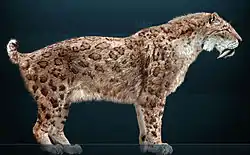 スミロドン | |||||||||||||||||||||||||||||||||
| 地質時代 | |||||||||||||||||||||||||||||||||
| 中新世 - 更新世, 10.3–0.01 Ma | |||||||||||||||||||||||||||||||||
| 分類 | |||||||||||||||||||||||||||||||||
| |||||||||||||||||||||||||||||||||
| 属 | |||||||||||||||||||||||||||||||||
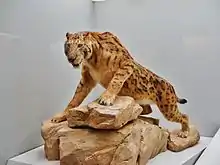
名前が示すようにスミロドンが本族に属しているが、スミロドン族にはその他に3つの属が含まれている。知られている中で最も古い属はかつてパラマカイロドゥスの種と考えられていたプロメガンテレオンである、最後の属はスミロドンであった。これらは全て上顎の犬歯が細長く発達した剣歯虎であり、ずんぐりとした筋肉質な体をしていた。
概説
スミロドン族の属種は細長い上顎の犬歯により一般に識別されるが、属の間では体格も識別の手がかりの1つになる。例えば、プロメガンテレオンとパラマカイロドゥスは樹上性かあるいは高所に登る生態をしていたとみられ、尾が比較的長く、狼爪が大きく、体格は小柄でほっそりとしていた。彼らの上顎の犬歯は体サイズに対して小さいものの、平らでブレード状のエッジはマカイロドゥス亜科と同定されるのに十分である。後の属であるメガンテレオンは、前者2属とさらに走行性の強いリゾスミロドンやスミロドンの生理学的な中間型に位置した。後者2属は地上生活に向いた体格で、比較的大型の獲物を仕留めることに適していた[3]。
分類
- メガンテレオン Croizet & Jobert, 1828
- M. cultridens
- M. ekidoit
- M. hesperus
- M. inexpectatus
- M. microta
- M. nihowanensis
- M. vakhshensis
- M. whitei
- パラマカイロドゥス Pilgrim, 1913
- P. maximiliani
- P. orientalis
- P. transasiaticus
- プロメガンテレオン Kretzoi, 1938
- P. ogygia
- リゾスミロドン Wallace & Hulbert, 2013
- R. fiteae
- スミロドン Lund, 1842
- S. fatalis
- S. gracilis
- S. populator
系統
スミロドン族の系統関係を以下のクラドグラムに示す[4][5][6][7][8]。
| スミロドン族 |
| |||||||||||||||||||||||||||||||||||||||||||||||||||||||||||||||||||||||||||
古生態
他の全てのマカイロドゥス亜科と同様に、スミロドン族はヒョウ亜科のような現生ネコ科動物に見られるよりも効率的で素早い挙動で獲物を仕留めていたとみられている。長い犬歯を使ってスミロドン族は首や腹部といった必要不可欠な部位を狙い[注 1]、頸動脈などの主要な動脈を裂いて死に至らしめていた。長く伸びた裂肉歯は肉にありつく際に骨から肉を剥ぎ取るのに使用されたと推測される[3]。摂食行動については、メガンテレオンの裂肉歯からは茂みの奥か木の中でゆっくりと1頭で肉を食べていたことが、おそらく競争の激しい環境で社会を形成していたスミロドンからは腐肉食動物に肉を奪われることなく可能な限り多くの肉を食べていたことが示唆されている[11]。
脚注
注釈
- 正確な部位については専門家の間で議論が交わされている。
出典
- Stephen C. Wallace. “A New Machairodont from the Palmetto Fauna (Early Pliocene) of Florida, with Comments on the Origin of the Smilodontini (Mammalia, Carnivora, Felidae)”. 2014年5月26日閲覧。
- “†tribe Smilodontini Kretzoi 1929 (cat)”. マッコーリー大学. 2020年8月21日閲覧。
- Anton, Mauricio (2013). Sabertooth
- “Paleobiology Database”. 2012年3月25日時点のオリジナルよりアーカイブ。2011年6月16日閲覧。
- Turner, Alan (1990). “The evolution of the guild of larger terrestrial carnivores during the Plio-Pleistocene in Africa”. Geobios 23 (3): 349–368. doi:10.1016/0016-6995(90)80006-2.
- Martin, L. D.; Babiarz, J. P.; Naples, V. L.; Hearst, J. (2000). “Three Ways To Be a Saber-Toothed Cat”. Naturwissenschaften 87 (1): 41–44. Bibcode: 2000NW.....87...41M. doi:10.1007/s001140050007. PMID 10663132.
- Turner, Alan (1997). The Big Cats and their fossil relatives. New York: Columbia University Press. p. 60. ISBN 978-0-231-10228-5
- Wallace, S. C.; Hulbert, R. C. (2013). Larson, Greger. ed. “A New Machairodont from the Palmetto Fauna (Early Pliocene) of Florida, with Comments on the Origin of the Smilodontini (Mammalia, Carnivora, Felidae)”. PLoS ONE 8 (3): e56173. doi:10.1371/journal.pone.0056173. PMC 3596359. PMID 23516394.
- “Archived copy”. 2016年10月4日時点のオリジナルよりアーカイブ。2016年10月4日閲覧。
- Anton, Mauricio (2013). Sabertooth. Bloomington, Indiana: University of Indiana Press. ISBN 9780253010421
- Antón, Mauricio (2013). Sabertooth. Bloomington, Indiana: University of Indiana Press. p. 185. ISBN 9780253010421