ソラヌム・ピンピネリフォリウム
Solanum pimpinellifoliumは、トマトの野生種である[5][6]。エクアドルとペルー原産であるが、ガラパゴス諸島など至る所に帰化している。小さな果実は食用となり、在来トマトとして家庭菜園で一般的に育てられているが[7]、一般的に栽培されているトマト種Solanum lycopersicumのように栽培化されたものではなく、野生種であると考えられている[8]。2012年にゲノム配列が明らかにされた[9]。
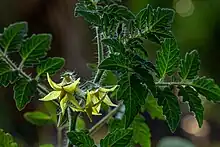
| Solanum pimpinellifolium | ||||||||||||||||||||||||
|---|---|---|---|---|---|---|---|---|---|---|---|---|---|---|---|---|---|---|---|---|---|---|---|---|
.jpg.webp) | ||||||||||||||||||||||||
| 分類 | ||||||||||||||||||||||||
| ||||||||||||||||||||||||
| 学名 | ||||||||||||||||||||||||
| Solanum pimpinellifolium L.[1] | ||||||||||||||||||||||||
| シノニム | ||||||||||||||||||||||||
|
Lycopersicon pimpinellifolium (L.) Mill.[2] | ||||||||||||||||||||||||
| 和名 | ||||||||||||||||||||||||
| カラントトマト | ||||||||||||||||||||||||
| 英名 | ||||||||||||||||||||||||
| currant tomato[3]、pimp[4] |
交配での利用
本種は一般的な栽培化トマトと交配される[10]。一年生、二年生、多年生の品種が存在する[11]。
トマトとの近縁さ[12]とトマトと自由に交配できる能力から、トマトの品種への耐病性形質の導入のためや、果実の形状や大きさといったトマトの形質の遺伝的制御の研究などに使われる[11]。本種はリコピン、ビタミンC、フェノール酸類をS. lycopersicumよりも多く含み、抗酸化能もより高い[13]。ゲノムのサイズは900 Mbであり、トマトとの差は0.6%である。トマトと730万年前に分岐したジャガイモとの差はどちらも8%である[9][14]。
栽培化トマトの祖先種と考えられ、栽培トマトの限定的な遺伝子プールを補助する価値がある。農業発展のため、野生のカラントトマトは自生地域であるペルー北部やエクアドル南部でははやらなくなってきている。加えて、種子収集が生物の多様性に関する条約に伴う問題によって妨げられている[4]。
出典
- https://www.uniprot.org/taxonomy/4084, Uniprot Taxonomy, Species Solanum pimpinellifolium (Currant tomato) (Lycopersicon pimpinellifolium), Retrieved January 28, 2011.
- "Solanum pimpinellifolium". Germplasm Resources Information Network (GRIN). Agricultural Research Service (ARS), United States Department of Agriculture (USDA).
- "Solanum pimpinellifolium". Natural Resources Conservation Service PLANTS Database. USDA. 2015年11月17日閲覧。
- “Why is This Wild, Pea-Sized Tomato So Important?”. 2022年4月18日閲覧。
- “New nomenclature for Lycopersicon”. Sol Genomics. 2022年4月19日閲覧。
- David M. Spooner, Iris E. Peralta, Sandra Knapp (2005). Comparison of AFLPs with other markers for phylogenetic inference in wild tomatoes [Solanum L. section Lycopersicon (Mill.) Wettst.[. 54. pp. 43-61. doi:10.2307/25065301.
- http://www.tomatocasual.com/2008/04/18/smallest-tomato-the-currant-tomato-and-other-small-wonders, Tomato Casual: Smallest Tomato: The Currant Tomato and other Small Wonders, Retrieved February 18, 2013.
- Bai, Y.; Lindhout, P. (2007). “Domestication and breeding of tomatoes: what have we gained and what can we gain in the future?”. Annals of Botany 100 (5): 1085–1094. doi:10.1093/aob/mcm150. PMC 2759208. PMID 17717024.
- The Tomato Genome Consortium (31 May 2012). “The tomato genome sequence provides insights into fleshy fruit evolution”. Nature 485 (7400): 635–641. Bibcode: 2012Natur.485..635T. doi:10.1038/nature11119. PMC 3378239. PMID 22660326.
- http://solgenomics.net/chado/organism.pl?organism_id=770, Sol Genomics, Species: Solanum pimpinellifolium, Retrieved January 28, 2011.
- http://www.nhm.ac.uk/research-curation/research/projects/solanaceaesource/taxonomy/description-detail.jsp?spnumber=4614, Natural History Museum, Solanaceae Source, Solanum pimpinellifolium L., Cent. Pl. 1: 8. 1755. Type: Cultivated in Uppsala, Anon. (lectotype, LINN 248.15 [BH neg. 6802], designated by Knapp & Jarvis 1990), Retrieved January 28, 2011.
- Caicedo, AL; Schaal, BA (Jul 2004). “Population structure and phylogeography of Solanum pimpinellifolium inferred from a nuclear gene.”. Mol Ecol 13 (7): 1871–82. doi:10.1111/j.1365-294X.2004.02191.x. PMID 15189210.
- Gürbüz Çolak, Nergiz (March 2020). “Mapping of quantitative trait loci for antioxidant molecules in tomato fruit: Carotenoids, vitamins C and E, glutathione and phenolic acids”. Plant Science 292: 110393. doi:10.1016/j.plantsci.2019.110393. PMID 32005398.
- “Taking Tomatoes Back to Their Tasty Roots”. NPR.org
This article is issued from Wikipedia. The text is licensed under Creative Commons - Attribution - Sharealike. Additional terms may apply for the media files.