ダモト王国
ダモト王国 (アムハラ語: ዳሞት)は現在のエチオピア西部にあった中世の王国[1]。 領土は青ナイル川の南に位置していた[2]。 ダモト王国はショワ・スルタン国(シェワとも呼ばれる)に朝貢することを強要するほどの強力な国だった。また、ダモト王国は、王国を征服するために送られたザグウェ朝の軍隊を壊滅させた。 ダモトはいくつかのムスリムとキリスト教徒の領土を征服した[3]。 ムスリムの国であるショワとイクノ・アムラクに統治された新たなキリスト教徒の国、エチオピア帝国はダモト王国の地域における影響力に対抗するため、同盟を結んだ[4]。
ダモト王国 | |||||||
|---|---|---|---|---|---|---|---|
| 900年–1317年 | |||||||
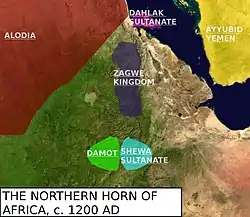 西暦1200年頃のダモト王国とその隣国 | |||||||
| 首都 |
ダモト | ||||||
| 共通語 | ゴンガ語,ガファト語,その他のオモ語派 | ||||||
| 宗教 | ペイガニズム | ||||||
| 統治体制 | 君主制 | ||||||
| モタラミ | |||||||
| 歴史 | |||||||
• 確立 | 900年 | ||||||
• 滅亡 | 1317年 | ||||||
| |||||||
.svg.png.webp)
歴史
独立国としてのダモト王国の歴史は、14世紀、皇帝アムダ・セヨンによるこの地域の征服によって終わり、その後もソロモン朝の影響下にあった[5]。ダモト王国は元来、アバイ川の南、ムゲル川の西に位置していたが[6]、オロモによる攻撃の圧力を受け、ダモト王国の支配者は1574年から1606年の間にアバイ川の北、ゴジャム南部へと再定住を余儀なくされた[7]。
「モタラミ」の称号を持つ王たちは、テクレ・ハイマノトの聖人伝によると、マルダレデと呼ばれる街に住んでいた[8]。ダモト王国は縮小し、国名はウォライタ王国となった。ダモト王国の領域は東にムゲル川を超えて、 ジャンマ川までへと広がっていた[6]。
脚注
- Shinn, David (2013). Historical Dictionary of Ethiopia. Scarecrow Press. p. 111. ISBN 9780810874572
- Shillington, Kevin (4 July 2013). Encyclopedia of African History 3-Volume Set. Routledge. ISBN 9781135456696
- Bounga, Ayda (2014). The kingdom of Damot: An Inquiry into Political and Economic Power in the Horn of Africa (13th c.). Annales D'ethiopie. p. 262
- Hassen, Mohammed. Oromo of Ethiopia. University of London. p. 4
- Quirin, James (1992). The evolution of the Ethiopian Jews: a history of the Beta Israel (Falasha) to 1920. University of Pennsylvania Press. p. 43. ISBN 9780812231168
- G.W.B. Huntingford, Historical Geography of Ethiopia from the first century AD to 1704 (London: British Academy, 1989), p. 69
- The dates for this movement are discussed by Huntingford in his Historical Geography, at pp. 143f
- Bouanga 2014, pp. 33–37.
参考文献
- Bouanga, Ayda (2013) (フランス語). Le Damot dans l'histoire de l'Ethiopie (XIIIe-XXe siècles) : recompositions religieuses, politiques et historiographiques. Université Panthéon-Sorbonn
- Bouanga, Ayda (2014). “Le royaume du Damot : enquête sur une puissance politique et économique de la Corne de l'Afrique (XIIIe siècle)” (フランス語). Annales d'Ethiopie 29: 27–58. doi:10.3406/ethio.2014.1557.
This article is issued from Wikipedia. The text is licensed under Creative Commons - Attribution - Sharealike. Additional terms may apply for the media files.