ダルトン極小期
ダルトン極小期(ダルトンきょくしょうき、Dalton Minimum)は、1790年から1830年まで続いた[1]、太陽活動が低かった期間である。イギリスの気象学者ジョン・ドルトンに因んで名付けられた。マウンダー極小期やシュペーラー極小期と同様に、ダルトン極小期は、地球の気温が平均より低かった時期と一致している。この期間、気温の変動は約1°Cであった[2]。
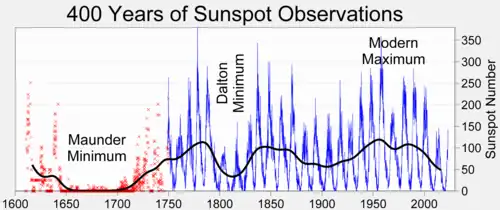
400年間の黒点の数
この期間に気温が平均よりも低かった正確な原因は分かっていない。最近の論文では、火山活動の上昇が気温の低下傾向の大きな原因の1つとなったと主張されている[3]。
1816年の夏のない年は、ダルトン極小期の間に起こり、この年の気温低下の主原因は、インドネシアのタンボラ山の大爆発であった。
脚注
- Komitov and Kaftan. Archibald says 1796 to 1820, p. 32.
- File:Temperaturreihe Deutschland.png, red line, 1795 to 1815
- Wagner and Zorita, as well as Wilson.
出典
- Komitov Boris and Vladimir Kaftan(2004) "The Sunspot Activity in the Last Two Millenia on the Basis of Indirect and Instrumental Indexes: Time Series Models and Their Extrapolations for the 21st Century", in Proceedings of the International Astronomical Union, 2004, pp. 113-114.
- Wagner, Sebastian and Eduardo Zorita 2005) "The influence of volcanic, solar and CO2 forcing on the temperatures in the Dalton Minimum(1790–1830): a model study", Climate Dynamics v. 25, pp. 205–218, doi 10.1007/s00382-005-0029-0.
- Wilson, Robert M.(nd) "Volcanism, Cold Temperature, and Paucity of Sunspot Observing Days(1818-1858): A Connection?", The SAO/NASA Astrophysics Data System, accessed February 2009.
関連文献
A detailed analysis with the auroral and solar data has been given by Wilfried Schröder, N. N. Shefov in a paper in Ann. Geophys. 2004. Also details can be found in Wilfried Schröder, Das Phänomen des Polarlichts(The Aurora in Time), Darmstadt, Wissenschaftliche Buchgeselllschaft 1984, and Science Edition, Bremen, 2000.
This article is issued from Wikipedia. The text is licensed under Creative Commons - Attribution - Sharealike. Additional terms may apply for the media files.