許容因子
許容因子(英: tolerance factor)は、結晶構造の安定性とゆがみの指標である[1]。許容係数、寛容性因子、寛容係数、トレランスファクターとも呼ばれる[2]。
もともとはペロブスカイト構造(ABO3)を説明するものであるが、現在はイルメナイト型構造にも用いられる[3]。 あるいは、あるイオンに対して結晶構造の適合性を計算することができる[4]。
ペロブスカイトの許容因子は、1926年にヴィクトール・ゴルトシュミットが述べた[5]。
定義式
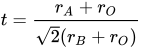
許容因子 は、 イオン半径の比から計算される無次元数である[1]。

| rAはAサイトの陽イオンの半径 | rBはBサイトの陽イオンの半径 | rOは陰イオン(通常は酸素)の半径 |
理想的な立方晶ペロブスカイト構造では、単位格子の格子定数 a は、次の式で求められる[1]。
| rAはAサイトの陽イオンの半径 | rBはBサイトの陽イオンの半径 | rOは陰イオン(通常は酸素)の半径 |

ペロブスカイト構造
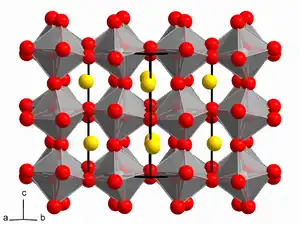
ペロブスカイト構造は、許容因子の値によって次のような構造を取ることが経験的に知られている。
| 許容因子(t) | 構造 | 説明 | 例 | 結晶格子の例 |
|---|---|---|---|---|
| > 1 [4] | 六方晶または正方晶 | Aサイトのイオンが大きい。または、Bサイトのイオンが小さい。 | - | |
| 0.9-1 | 立方晶 | Aサイト、Bサイトのイオンは理想的な大きさである。 | 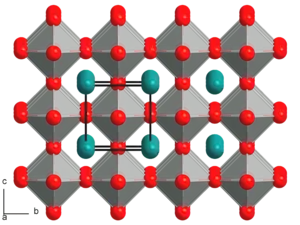 | |
| 0.71-0.9 | 直方晶または菱面体晶 | Aサイトのイオンが小さく、Bサイトの隙間に収まらない。 |
|
 |
| <0.71 | ペロブスカイト以外の構造 | Aサイト、Bサイトのイオン半径が近い。 |
|
- |
参考文献
- Parkin, editors-in-chief, Helmut Kronmller, Stuart; Mats Johnsson; Peter Lemmens (2007). Handbook of magnetism and advanced magnetic materials ([Online-Ausg.] ed.). Hoboken, NJ: John Wiley & Sons. ISBN 978-0-470-02217-7 2012年5月17日閲覧。
- “寛容係数 | 科学技術用語情報 | J-GLOBAL 科学技術総合リンクセンター”. 2020年5月15日閲覧。
- Liu, XiangChun; Hong, Rongzi; Tian, Changsheng (24 April 2008). “Tolerance factor and the stability discussion of ABO3-type ilmenite”. Journal of Materials Science: Materials in Electronics 20 (4): 323–327. doi:10.1007/s10854-008-9728-8.
- Schinzer. “Distortion of Perovskites”. 2012年5月17日閲覧。
- Goldschmidt, Victor M. (1926). “Die Gesetze der Krystallochemie”. Die Naturwissenschaften 21: 477–485. doi:10.1007/bf01507527.
This article is issued from Wikipedia. The text is licensed under Creative Commons - Attribution - Sharealike. Additional terms may apply for the media files.