ナプキンリング問題
幾何学においてナプキンリング問題(napkin-ring problem)は、球の周りの決まった高さの「バンド」、つまり球の中心に円柱の形の穴を空けた後に残る部分の体積を求めることに関係する。この体積は元の球の半径にはよらず、結果生じるバンドの高さにのみ依存することは直感に反する事実である。


この問題は球から円柱を取り除いた後に残るバンドが、ナプキンリングの形に似ているためこのように呼ばれる。
説明
直円柱の軸が半径Rの球の中心を通り、hが球の内側にある円柱部分の高さ(軸に平行な方向な距離として定義される)を表すと仮定する。「バンド」は円柱の外側にある球の部分である。バンドの体積はhに依存するが、Rに依存しない。

球の半径Rを小さくすると、hを一定に保つためには円柱の直径も小さくなる必要がある。すると、バンドが太くなり体積が増える。しかし、円周も短くなり体積が減る。この2つの効果が互いに相殺しあう。極端な例で可能な限り小さい球の場合、円柱は消え(半径は0になる)、高さhは球の直径に等しくなる。この場合、バンドの体積は球の体積であり、上記の式と一致する。
この問題に関する初期の研究は和算家の関孝和により行われた。Smith & Mikami (1914)によると、関はこの立体を「弧環」と呼んだ[1] 。
解法
球の半径をとし、円柱(トンネル)の高さをとする。


ピタゴラスの定理より、円柱の半径は

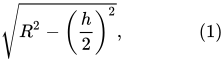
となる。「赤道」より上の高さyでの球の水平断面の半径は
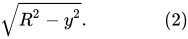
である。高さyの平面を持つバンドの断面は、(2)で与えられる半径の大きい円の内側と(1)で与えられる半径の小さい円の外側の領域である。よって、断面積は大きい円の面積から小さい円の面積を引いたものとなる。

半径Rは最後の結果には出てこない。よってy ≤ h/2 ≤ Rである限り高さyにおける水平断面積はRによらない。バンドの体積は

であり、これもRによらない。
これはカヴァリエリの原理の適用したものである。実際、断面積は体積が
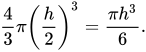
となる半径h/2の球の断面積と等しい。
脚注
- David Eugene Smith & Yoshio Mikami『日本数学史 A History of JAPANESE MATHEMATICS』、77頁。2020年2月13日閲覧。
関連項目
- en:Visual calculus この種の問題を解決する直感的な方法で、元々は弦の長さのみを与えられたときのアニュラスの面積を求めるのに適用された。
- en:String girdling Earth 球や円の半径が直感に反して無関係である他の問題
レファレンス
- Devlin, Keith (2008), The Napkin Ring Problem, Mathematical Association of America, オリジナルの11 August 2011時点におけるアーカイブ。
- Devlin, Keith (2008), Lockhart's Lament, Mathematical Association of America, オリジナルの11 August 2011時点におけるアーカイブ。
- Gardner, Martin (1994), “Hole in the Sphere”, My best mathematical and logic puzzles, Dover Publications, p. 8
- Jones, Samuel I. (1912), Mathematical Wrinkles for Teachers and Private Learners, Norwood, MA: J. B. Cushing Co. Problem 132 asks for the volume of a sphere with a cylindrical hole drilled through it, but does not note the invariance of the problem under changes of radius.
- Levi, Mark (2009), “6.3 How Much Gold Is in a Wedding Ring?”, The Mathematical Mechanic: Using Physical Reasoning to Solve Problems, Princeton University Press, pp. 102–104, ISBN 978-0-691-14020-9. Levi argues that the volume depends only on the height of the hole based on the fact that the ring can be swept out by a half-disk with the height as its diameter.
- Lines, L. (1965), Solid geometry: With Chapters on Space-lattices, Sphere-packs and Crystals, Dover. Reprint of 1935 edition. A problem on page 101 describes the shape formed by a sphere with a cylinder removed as a "napkin ring" and asks for a proof that the volume is the same as that of a sphere with diameter equal to the length of the hole.
- Pólya, George (1990), Mathematics and Plausible Reasoning, Vol. I: Induction and Analogy in Mathematics, Princeton University Press, pp. 191–192. Reprint of 1954 edition.
- Smith, David E.; Mikami, Yoshio (1914), A History of Japanese Mathematics, Open Court Publishing Company, pp. 121–123. Republished by Dover, 2004, ISBN 0-486-43482-6. Smith and Mikami discuss the napkin ring problem in the context of two manuscripts of Seki on the mensuration of solids, Kyuseki and Kyuketsu Hengyo So.
外部リンク
- Weisstein, Eric W. "Spherical Ring". mathworld.wolfram.com (英語).