ニルギリラングール
ニルギリラングール(Nilgiri langur[3])は、南インドの西ガーツ山脈にあるニルギリ丘陵で見られるオナガザル科コロブス亜科のサルである。生息域には、カルナータカ州コダグやタミル・ナードゥ州のKodayar丘陵、またケーララ州やタミル・ナードゥ州の他の多くの丘陵地帯も生息域に含まれる。体の毛皮は光沢のある黒色で、手は金茶色である。大きさと尾の長さはハヌマンラングールと似ている。メスは太腿の内側に白い斑点がある。通常、9から10匹の群れを作る[1]。食糧は果物、芽、葉等である。生息地破壊や、毛皮や媚薬としての効果を持つと信じられている肉を狙う密漁のため、危急種に分類されている[4]。
| ニルギリラングール | |||||||||||||||||||||||||||||||||
|---|---|---|---|---|---|---|---|---|---|---|---|---|---|---|---|---|---|---|---|---|---|---|---|---|---|---|---|---|---|---|---|---|---|
_by_N._A._Naseer.jpg.webp) | |||||||||||||||||||||||||||||||||
| 保全状況評価[1] | |||||||||||||||||||||||||||||||||
| VULNERABLE (IUCN Red List Ver.3.1 (2001))  | |||||||||||||||||||||||||||||||||
| 分類 | |||||||||||||||||||||||||||||||||
| |||||||||||||||||||||||||||||||||
| 学名 | |||||||||||||||||||||||||||||||||
| Semnopithecus. johnii (J. Fischer, 1829) | |||||||||||||||||||||||||||||||||
| シノニム | |||||||||||||||||||||||||||||||||
| |||||||||||||||||||||||||||||||||
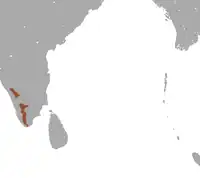 分布域 |
分類
ニルギリラングールの分類については議論がある。伝統的には、頭蓋の形や新生児の毛皮の色等の形態的類似性に基づいてラングール属に分類されてきた。しかし、DNAやその他の証拠により、ニルギリラングールやカオムラサキラングールは、ハヌマンラングールとより近縁で、ハヌマンラングール属に分類されることが示唆された[5][6][7][8][3][9]。
記載
頭部を含めた体長は、オスで78-80cm、メスで58-60cmであり、尾の長さは68.5-96.5cmである。オスの体重は9.1-14.8kg、メスの体重は10.9-12kgである[4]。妊娠期間ははっきり分かっていないが、近縁のハヌマンラングールと同じ200日程度と考えられている[4]。
出典
- Singh, M.; Kumara, H.N.; Kumar, A. (2020). “Semnopithecus johnii”. IUCN Red List of Threatened Species 2020: e.T44694A17958623. doi:10.2305/IUCN.UK.2020-2.RLTS.T44694A17958623.en 2021年11月19日閲覧。.
- Groves, C. P. (2005). Wilson, D. E.; Reeder, D. M. eds. Mammal Species of the World (3rd ed.). Baltimore: Johns Hopkins University Press. pp. 178. OCLC 62265494. ISBN 0-801-88221-4
- “Semnopithecus johnii”. ITIS Report. ITIS. 2020年1月18日閲覧。
- “Indian National Studbook of Nilgiri Langur (Trachypithecus johnii)”. Wildlife Institute of India, Dehradun and Central Zoo Authority, New Delhi (2011年). 2022年1月29日閲覧。
- Wilson, Don E.; Mittermeier, Russell A.; Rylands, Anthony B. (2012). “Introduction”. Handbook of the Mammals of the World, Volume 3: Primates (1st ed.). Lynx Edicions. ISBN 978-8496553897 2018年8月30日閲覧。
- Osterholz, Martin; Walter, Lutz; Roos, Christian (2008). “Phylogenetic position of the langur genera Semnopithecus and Trachypithecus among Asian colobines, and genus affiliations of their species groups”. BMC Evolutionary Biology 8 (58): 58. doi:10.1186/1471-2148-8-58. PMC 2268674. PMID 18298809.
- Brandon–Jones, D. (2004). “Asian Primate Classification”. International Journal of Primatology 25 (1): 97–164. doi:10.1023/B:IJOP.0000014647.18720.32.
- Xiao Ping Wang (27 April 2012). “Phylogenetic Relationships among the Colobine Monkeys Revisited: New Insights from Analyses of Complete mt Genomes and 44 Nuclear Non-Coding Markers”. PLOS ONE 7 (4): e36274. Bibcode: 2012PLoSO...736274W. doi:10.1371/journal.pone.0036274. PMC 3338693. PMID 22558416.
- Karanth, K. Praveen (2008). “Molecular phylogeny and biogeography of langurs and leaf monkeys of South Asia (Primates: Colobinae)”. Molecular Phylogenetics and Evolution 46 (2): 683–694. doi:10.1016/j.ympev.2007.11.026. PMID 18191589 2018年8月30日閲覧。.
This article is issued from Wikipedia. The text is licensed under Creative Commons - Attribution - Sharealike. Additional terms may apply for the media files.