ハナカケトラザメ
ハナカケトラザメ Scyliorhinus canicula はトラザメ属に属するサメの一種。
| ハナカケトラザメ | |||||||||||||||||||||
|---|---|---|---|---|---|---|---|---|---|---|---|---|---|---|---|---|---|---|---|---|---|
 | |||||||||||||||||||||
| 保全状況評価[1] | |||||||||||||||||||||
| LEAST CONCERN (IUCN Red List Ver.3.1 (2001))  | |||||||||||||||||||||
| 分類 | |||||||||||||||||||||
| |||||||||||||||||||||
| 学名 | |||||||||||||||||||||
| Scyliorhinus canicula (Linnaeus, 1758) | |||||||||||||||||||||
| 英名 | |||||||||||||||||||||
| Small-spotted catshark lesser spotted dogfish | |||||||||||||||||||||
 分布 |
形態
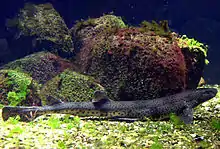
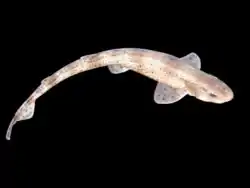
最大で1m・2kg程度になる[4]。小型で体は細く、頭部は丸い。2基の背鰭は体の後方にあり、尾鰭の方向を向いている。皮膚は粗く、紙やすりのような質感である[5]。鼻孔は吻の腹面にあり、曲がった溝が口まで続く。腹面は明るい灰白色。背面は灰褐色から黄褐色で、暗褐色から黒の無数の小さい斑点がある。雌より雄の方が歯が大きい。西アフリカの雄個体は、顎が強くて大きく、よく石灰化している。これは、繁殖行動への適応や、摂餌傾向によって説明できると考えられる[6]。
生態
繁殖
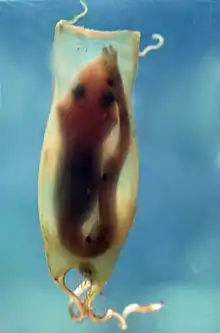
卵生である。卵は角質の卵殻に包まれ、長い巻きひげを持つ。ほとんどは浅海の大型海藻に産み付けられるが、深い場所にあるヤギ類などの無脊椎動物に産み付けられる場合もある。大きさは4×2 cm程度で、6 cmを超えることはない[7]。この卵殻はヨーロッパの沿岸で普通に見られる。孵化までの期間は水温に影響されるが、5-11ヶ月。出生時は9-10cmである。産卵は年中行われるが[7]、地域によって異なる季節的パターンがある。例えば、フランスの地中海岸では3-6月と10月、ブリテン島周辺では春と8-10月、チュニジア沿岸では春から始まり、夏にピークとなって秋に減少する[8]。雄は37.1-48.8 cm、雌は36.4-46.7 cmで性成熟する[9]。
摂餌
主に十脚類と魚を食べるが、他にも軟体動物・棘皮動物・多毛類・甲殻類・ホシムシ・ホヤなど様々な動物を日和見的に捕食する[3]。成長とともに餌の好みは変化し、幼体は小型甲殻類を好むが、成長するとヤドカリや軟体動物を好むようになる。利用できる獲物が増えることから、夏季に最も摂餌活動が活発になることが観察されている。雌雄間での摂餌傾向の差は見られない[3]。行動学的研究では、'scale rasping'という摂餌行動が観察されている。これは、皮膚にある歯のような構造によって尾の辺りに接触した獲物を引っ掛け、頭部を急速に回して噛み千切るものである。体が細長いことも、このような捕食方法を可能としている要因となる。また、皮膚の棘は捕食者や寄生虫、摩擦などから体を保護する機能もある[10]。
人との関わり
モデル生物
本種は次の理由から、発生学におけるモデル生物として適していると考えられている。
脚注
- Ellis, J., Mancusi, C., Serena, F., Haka, F., Guallart, J., Ungaro, N., Coelho, R., Schembri, T. & MacKenzie, K. (2009). "Scyliorhinus canicula". IUCN Red List of Threatened Species. Version 2014.3. International Union for Conservation of Nature.
- Froese, Rainer and Pauly, Daniel, eds. (2006). "Scyliorhinus canicula" in FishBase. April 2006 version.
- Rodriguez-Cabello, C., Sanchez, F., Olaso, I. 2007. Distribution patterns and sexual segregations of Scyliorhinus canicula (L.) in the Cantabrian Sea. Journal of Fish Biology. 70: 1568-1586
- Wilson, Don E.; Burnie, David (2001). Animal: The Definitive Visual Guide to the World's Wildlife. New York City: Dorling Kindersley Publishing. pp. 624. ISBN 0-7894-7764-5
- McNeill, Ian. "Habitas :: National Museums Northern Ireland." Habitas :: National Museums Northern Ireland. N.p., n.d. Web. 16 Dec. 2010. <http://www.habitas.org.uk>
- Erdogan, Z., Koc, H., Cakir, D. 2004. Sexual Dimorphism in the Small-Spotted Catshark, Scyliorhinus Canicula (L., 1758), From the Edremit Bay (Turkey). Ser. his. nat, 262: 4-18.
- Ellis, J.R., Shackley, S.E. 1997. The reproductive biology of Scyliorhinus canicula in the Bristol Channel, U.K. Journal of Fish Biology, 51: 361-372
- Capae, C., Reynaud, C.,Vergne, Y., Quignard, J. 2008. Biological observations on the smallspotted catshark Scyliorhinus canicula (Chondrichthyes: Scyliorhinidae) off the Languedocian coast (southern France, northern Mediterranean). Pan-American Journal of Aquatic Sciences, 3: 282-289
- Ivory, P., Jeal, F., Nolan, C.P. 2005. Age determination, growth and reproduction in the lesser-spotted dogfish, Scyliorhinus canicula (L.). J. Northw. Atl. Fish. Sci., 35: 89-106.
- Southall, E.J., Sims, D.W. 2003. Shark skin: a function in feeding. Proceedings of the Royal Society of London Series B-Biological Sciences, 270: 47-49.
- Ballard, W., Mellinger, J., Lechenault, H. 2005. A series of normal stages for development of Scyliorhinus canicula the lesser spotted dogfish (Chondrichthyes: Scyliorhinidae). Journal of Experimental Zoology. 267: 318-336
- Mazan, S., Sauka-Splengler, T. 2004. "Gastrulation in the chondrichthyan, the dogfish Scyliorhinus canicula." Gastrulation: from cells to embryo. Ed. Claudio D. Stern. Cold Spring Harbor Laboratory Press. New York, NY, 151-155 pp.
- GIibson, C., Valenti, S. V., Fowler, S. L., Fordham, S. V. 2006. The Conservation Status of Northeast Atlantic Chondrichthyans; Report of the IUCN Shark Specialist Group Northeast Atlantic Regional Red List Workshop. VIII + 76pp. IUCN SSC Shark Specialist Group.