ハマー族
ハマー族あるいはハマル族(英語: Hamar, Hamer; アムハラ語: ሀመር)はエチオピア南西部に住むオモ諸語を話す集団である。
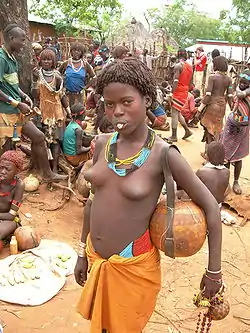 トゥルミ付近のハマー族の女性(2006年) | |
| 総人口 | |
|---|---|
| 4万6532人 | |
| 居住地域 | |
| エチオピア南部諸民族州 | |
| 言語 | |
| ハマー語(Hamer; 別名: Hamer-Banna[1]) | |
| 宗教 | |
| イスラム教 | |
概要
ハマー族は南部諸民族州(SNNPR)のデブブ・オモ地域(Debub Omo Zone)内、オモ川流域のハマル地区(en:Hamer (woreda))に住んでいる。
文化
ハマー族の多くは肥沃な谷を利用した牧畜業を営んでいるため、文化的に牛に高い価値を置く。男性の通過儀礼として並んだ牛の背中を越えるというものがあり、この試練を乗り越えることができた者は Maza〈成熟した者〉と呼ばれるようになり、花嫁候補たちの中から1人選んで妻とする権利を得る[4]。
脚注
- Lewis, M. Paul; Simons, Gary F.; Fennig, Charles D., eds. (2015). "Hamer-Banna". Ethnologue: Languages of the World (18th ed.). Dallas, Texas: SIL International.
- 2007 Ethiopian census, first draft, Ethiopian Central Statistical Agency (accessed 6 May 2009)
- Hudson, Grover. 75 Ethiopian Languages: 19 Cushitic, 20 Nilosaharan, 23 Omotic, 12 Semitic, and 1 Unclassified, 2005.
- Wharton, Jane (2015年2月22日). “The making of a man: Inside a bull jumping ceremony with Ethiopia's Hamer tribe”. Express (London) 2020年11月18日閲覧。
- Burke, Dave (2017年5月11日). “The women who are whipped… to show their LOVE”. Mail Online. 2022年11月19日閲覧。
- Quest.com, Africa (2016年1月10日). “ムチ打ち&全裸で牛ジャンプ!?エチオピア・ハマル族の成人儀式が衝撃的すぎて閲覧禁止レベル!”. 2022年11月19日閲覧。
- Do the Hamar have a Concept of Honor?, Ivo Strecker, University of Mainz, “アーカイブされたコピー”. 2011年7月25日時点のオリジナルよりアーカイブ。2010年2月19日閲覧。
- “The Hamar and Karo Tribes: The Search for Mingi”. Films Media Group. 2019年11月20日閲覧。
関連文献
- Lydall, Jean, and Ivo Strecker (1979). The Hamar of Southern Ethiopia. In three volumes: v. 1.: Work journal; v. 2: Baldambe explains; v. 3: Conversations in Dambaiti. Arbeiten aus dem Institut fur Volkerkunde der Universitat zu Göttingen, Bd. 12-14. Hohenschaftlarn: Klaus Renner Verlag. ISBN 3-87673-063-5 (v. 1); ISBN 3-87673-064-3 (v. 2); ISBN 3-87673-065-1 (v. 3).
- Giansanti, Gianni (2004). Vanishing Africa. Text and photographs by Gianni Giansanti; ethnographic introductions by Paolo Novaresio. Translated from Italian. With audio CD. Vercelli, Italy: White Star. ISBN 88-544-0006-8.
- Strecker, Ivo A. (1988). The Social Practice of Symbolization: An Anthropological Analysis. Monographs on Social Anthropology, no. 60. London; Atlantic Highlands, New Jersey: Athlone Press. ISBN 0-485-19557-7.
フィルモグラフィ
- 1973 - Rivers of Sand by Robert Gardner color, 83 min
- 1994 - Sweet Sorghum: An Ethnographer's Daughter Remembers Life in Hamar, Southern Ethiopia: a film by Ivo Strecker and Jean Lydall and their daughter Kaira Strecker. A production of IWF. Watertown, Massachusetts: Documentary Educational Resources, [released c. 1997]. VHS. Presenter/narrator, Kaira Strecker; producer, Rolf Husmann.
- 1996 release - "The Hamar Trilogy." A series of three films by Joanna Head and Jean Lydell; distributed by Filmakers Library, NYC. Titles in the series are: The Women Who Smile, Two Girls Go Hunting and Our Way of Loving.
- 2001 - Duka's Dilemma: A Visit to Hamar, Southern Ethiopia. A film by Jean Lydall and Kaira Strecker. Watertown, Massachusetts: Documentary Educational Resources, released in 2004. DVD. Camera, sound, and editing, Kaira Strecker; anthropology and production, Jean Lydall.
- 2001 - The Last Warriors: The Hamar and Karo Tribes: Searching for Mingi. A Trans Media production; Southern Star. Princeton, New Jersey: Films for the Humanities & Sciences. VHS. From The Last Warriors: Seven Tribes on the Verge of Extinction. Series producer/executive producer, Michael Willesee, Jr.; writer/director, Ben Ulm. ISBN 0-7365-3606-X.
ディスコグラフィ
- 2003 - Nyabole: Hamar – Southern Ethiopia. CD. Museum collection Berlin series. Recorded between 1970 and 1976 and originally published on LP 1978. Mainz, Germany: Wergo.
外部リンク
関連項目
This article is issued from Wikipedia. The text is licensed under Creative Commons - Attribution - Sharealike. Additional terms may apply for the media files.