ハーディ=リトルウッドの不等式
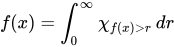
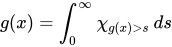
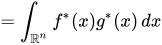
数学の解析学の分野において、ゴッドフレイ・ハロルド・ハーディとジョン・エデンサー・リトルウッドの名にちなむハーディ=リトルウッドの不等式(ハーディ=リトルウッドのふとうしき、英: Hardy-Littlewood inequality)とは、f と g が n 次元ユークリッド空間 Rn 上で定義される非負の可測 実函数で、無限大で消失するものであるときに成り立つ次の不等式のことをいう。











関連項目
- 再配分不等式
- チェビシェフの和の不等式
- ローレンツ空間
脚注
- Lieb, Elliott; Loss, Michael (2001). Analysis. Graduate Studies in Mathematics. 14 (2nd ed.). American Mathematical Society. ISBN 978-0821827833
- Burchard, Almut. A Short Course on Rearrangement Inequalities
This article is issued from Wikipedia. The text is licensed under Creative Commons - Attribution - Sharealike. Additional terms may apply for the media files.