バニリン酸
バニリン酸(バニリンさん、4-ヒドロキシ-3-メトキシ安息香酸)はジヒドロキシ安息香酸の誘導体の一種であり、バニロイド類の一種でもある。化学式はC8H8O4。バニリンの酸化により得られる。また、フェルラ酸からバニリンを製造する際の中間体として存在する[3][4]。
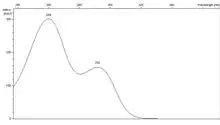
バニリン酸の紫外可視スペクトル
| バニリン酸[1] | |
|---|---|
 | |
4-ヒドロキシ-3-メトキシ安息香酸 | |
別称 4-Hydroxy-m-anisic acid, Vanillate | |
| 識別情報 | |
| CAS登録番号 | 121-34-6 |
| PubChem | 8468 |
| ChemSpider | 8155 |
| 日化辞番号 | J5.337F |
| KEGG | C06672 |
| ChEBI | |
| ChEMBL | CHEMBL120568 |
| |
| |
| 特性 | |
| 化学式 | C8H8O4 |
| モル質量 | 168.14 g/mol |
| 外観 | 白色ないし淡黄色の粉末または結晶 |
| 匂い | 特異臭 |
| 融点 |
210–213℃ |
| 危険性 | |
| 主な危険性 | 刺激性 |
| NFPA 704 |
 0
1
0
|
| 半数致死量 LD50 | 2,691 mg/kg以上(マウス、腹腔内投与) 5,000mg/kg(ラット、腹腔内投与)[2] |
| 特記なき場合、データは常温 (25 °C)・常圧 (100 kPa) におけるものである。 | |
自然界での存在
漢方薬としても使われるトウキ (Angelica sinensis) の根に多く含まれることが知られている[5]。アサイー油にも豊富に含まれる(1,616 +/- 94 mg/kg)[6]。研究の結果、麦味噌や泡盛の香りを特徴づける成分であることが分かってきている[7][8]。
脚注
- “Vanillic acid (4-hydroxy-3-methoxybenzoic acid)”. chemicalland21.com. 2009年1月28日閲覧。
- 製品安全データシート(東京化成工業)
- Lesage-Meessen L, Delattre M, Haon M, Thibault JF, Ceccaldi BC, Brunerie P, Asther M (October 1996). “A two-step bioconversion process for vanillin production from ferulic acid combining Aspergillus niger and Pycnoporus cinnabarinus”. J. Biotechnol. 50 (2–3): 107–13. doi:10.1016/0168-1656(96)01552-0. PMID 8987621.
- Civolani C, Barghini P, Roncetti AR, Ruzzi M, Schiesser A (June 2000). “Bioconversion of ferulic acid into vanillic acid by means of a vanillate-negative mutant of Pseudomonas fluorescens strain BF13”. Appl. Environ. Microbiol. 66 (6): 2311–7. doi:10.1128/AEM.66.6.2311-2317.2000. PMC 110519. PMID 10831404.
- Duke, JA (1992). Handbook of phytochemical constituents of GRAS herbs and other economic plants. CRC Press, 999 edition. ISBN 978-0849338656
- Pacheco-Palencia LA, Mertens-Talcott S, Talcott ST (Jun 2008). “Chemical composition, antioxidant properties, and thermal stability of a phytochemical enriched oil from Acai (Euterpe oleracea Mart.)”. J. Agric. Food Chem. 56 (12): 4631–6. doi:10.1021/jf800161u. PMID 18522407.
- みそサイエンス(亀兵商店)
- 泡盛コラム(日本トランスオーシャン航空)
- P. G. Pietta, P. Simonetti, C. Gardana, A. Brusamolino, P. Morazzoni and E. Bombardelli (1998). “Catechin metabolites after intake of green tea infusions”. BioFactors 8 (1-2): 111–118. doi:10.1002/biof.5520080119. PMID 9699018.
This article is issued from Wikipedia. The text is licensed under Creative Commons - Attribution - Sharealike. Additional terms may apply for the media files.