ヒゲナシヨタカ属
ヒゲナシヨタカ属(ひげなしよたかぞく、学名 Eurostopodus)は、鳥類ヨタカ目ヨタカ科の1属である。
| ヒゲナシヨタカ属 | ||||||||||||||||||||||||
|---|---|---|---|---|---|---|---|---|---|---|---|---|---|---|---|---|---|---|---|---|---|---|---|---|
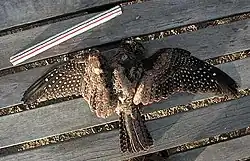 オオヒゲナシヨタカ | ||||||||||||||||||||||||
| 分類 | ||||||||||||||||||||||||
| ||||||||||||||||||||||||
| 学名 | ||||||||||||||||||||||||
| Eurostopodus Gould, 1838 | ||||||||||||||||||||||||
| 英名 | ||||||||||||||||||||||||
| Eared Nightjars | ||||||||||||||||||||||||
| 種 | ||||||||||||||||||||||||
|
5種 |
系統と分類
ヒナゲシヨタカ属は、ヨタカ科の中で最初に分岐した基底群である[1][2]。従来ヒゲナシヨタカ属に含められていたミミヨタカ類2種は別系統であり、ミミヨタカ属 Lyncornis に分離された[3][2][4]。
| ヨタカ科 |
| ||||||||||||
ただし、他のヨタカ科とは別系統だとする説[5]もある(この説でのヒゲナシヨタカ属の位置づけは不明)。
分類上は、ヨタカ科の中で(ミミヨタカ類と共に)ヒゲナシヨタカ亜科 Eurostopodinae を構成する説や、ヨタカ科から分離してヒゲナシヨタカ科 Eurostopodidae とする説がある。
Sibley分類では(ミミヨタカ類と共に)ヨタカ小目(広義のヨタカ科に相当)ヒゲナシヨタカ科とされ、ヨタカ科(狭義)の姉妹群とされていた。
種
国際鳥類学会議 (IOC) によると5種が属す[4]。ただし参考として、ミミヨタカ属2種も打ち消し線付きで記す。
- Eurostopodus argus, Spotted Eared Nightjar, ヒゲナシヨタカ
- Eurostopodus mystacalis, White-throated Eared Nightjar, オオヒゲナシヨタカ
- Eurostopodus diabolicus, Satanic Eared Nightjar, セレベスヒゲナシヨタカ
- Eurostopodus papuensis, Papuan Eared Nightjar, パプアヒゲナシヨタカ
- Eurostopodus archboldi, Mountain Eared Nightjar, ミヤマヒゲナシヨタカ
Lyncornis temminckii, Malaysian Eared Nightjar, ミミヨタカLyncornis macrotis, Great Eared Nightjar, オオミミヨタカ
出典
- Han, Kin‐Lan (2006), “Molecular systematics of nightjars and nighthawks (Caprimulgidae)”, M.S. thesis, University of Maryland
- Han, Kin‐Lan; et al. (2010), “A multi-gene estimate of phylogeny in the nightjars and nighthawks (Caprimulgidae)”, Molecular Phylogenetics and Evolution 55 (2), doi:10.1016/j.ympev.2010.01.023
- Cleere, Nigel; Nurney, David (1998), Nightjars: A Guide to the Nightjars, Frogmouths, Potoos, Oilbird and Owlet-nightjars of the World, Pica/Christopher Helm, pp. 174–184, ISBN 1873403488
- Gill, F.; Donsker, D., eds. (2011), “Nightjars”, IOC World Bird Names, version 2.8
- Larsen, C.; et al. (2007), “A molecular phylogeny of the nightjars (Aves: Caprimulgidae) suggests extensive conservation of primitive morphological traits across multiple lineages”, Molecular Phylogenetics and Evolution 42: 789–796
This article is issued from Wikipedia. The text is licensed under Creative Commons - Attribution - Sharealike. Additional terms may apply for the media files.