ピメロドゥス科
ピメロドゥス科 Pimelodidae はナマズ目に属する淡水魚の科の一つ。
| ピメロドゥス科 | |||||||||||||||||||||
|---|---|---|---|---|---|---|---|---|---|---|---|---|---|---|---|---|---|---|---|---|---|
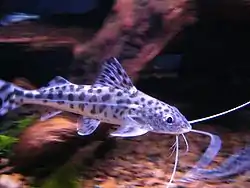 | |||||||||||||||||||||
| 分類 | |||||||||||||||||||||
| |||||||||||||||||||||
| 学名 | |||||||||||||||||||||
| Pimelodidae Swaison, 1838 | |||||||||||||||||||||
| シノニム | |||||||||||||||||||||
|
Pimelodontidae | |||||||||||||||||||||
| 英名 | |||||||||||||||||||||
| long-whiskered catfishes |
分類
分類体系は大幅な整理の中途にあるが、およそ30属に90種が記載されている[2]。Hypophthalmus 属はかつて別科 (Hypophthalmidae) とされていた[3]。
かつて亜科として含まれていたPseudopimelodinaeはプセウドピメロドゥス科 Pseudopimelodidae に、Rhamdiinaeはヘプタプテルス科 Heptapteridaeに分割されている[3]。また、かつて本科に属したConorhynchos conirostris は現在では所属不明種とされている[4]。分子系統解析では、これらの分類群が本科と併せてPimelodoideaという単系統群を構成することが示されている[5]。
Merodontotus 属とGoslinia 属はBrachyplatystoma 属[6]、Paulicea 属はZungaro 属[3]のシノニムとされている。
ほとんどの属において、属レベルでの単系統性は確立されていない[7]。各属間の関係については研究途上にあるが、以下のようなグループに分けられている[8]。
- Steindachneridion
- Leiarius
- Perrunichthys
- Phractocephalus - レッドテールキャットフィッシュ
- neopimelodines
- sorubimines
- Pimelabditus
- calophysines
- pimelodines
形態・生態
非常に大型になる種を含み、ピライーバ Brachyplatystoma filamentosum は最大で3メートルに達する。3対の触鬚を持ち、上顎の触鬚は体と同程度の長さに達する。他のナマズ類と同様に鱗はない。脂鰭はよく発達する[3]。
多くの種は成長につれて体色や体形が大きく変化する[9]。Brachyplatystoma属の幼魚は遊泳性で、触鬚と鰭条が非常に長く伸び、胸鰭の棘に装飾的な構造を持つ。Pseudoplatystoma属、Sorubim属、Sorubimichthys属などの他の大型ピメロドゥス科魚類では、幼魚は岸に近い植生の多い場所に生息し、保護色となる体色や大きな尾鰭と胸鰭を持つなどの特徴を有する[10]。
中南米に分布する[2]。濾過摂食を行う遊泳性の種も存在するが、多くは底生魚である[3]。親が稚魚を世話することはない[4]。
出典
- Garavello, Julio Cesar (2005). “Revision of genus Steindachneridion (Siluriformes: Pimelodidae)” (PDF). Neotropical Ichthyology 3 (4): 607–623. doi:10.1590/S1679-62252005000400018.
- Buitrago-Suárez, Uriel Angel; Burr, Brooks M. (2007). “Taxonomy of the catfish genus Pseudoplatystoma Bleeker (Siluriformes: Pimelodidae) with recognition of eight species” (PDF). Zootaxa 1512: 1–38 2009年6月24日閲覧。.
- Nelson, Joseph, S. (2006). Fishes of the World. John Wiley & Sons, Inc.. ISBN 0-471-25031-7
- Froese, Rainer, and Daniel Pauly, eds. (2007). "Pimelodidae" in FishBase. Mar 2007 version.
- Sullivan, JP; Lundberg JG; Hardman M (2006). “A phylogenetic analysis of the major groups of catfishes (Teleostei: Siluriformes) using rag1 and rag2 nuclear gene sequences”. Mol Phylogenet Evol 41 (3): 636–62. doi:10.1016/j.ympev.2006.05.044. PMID 16876440.
- Lundberg, John G.; Akama, Alberto (2005). Buth, D.. ed. “Brachyplatystoma capapretum: a New Species of Goliath Catfish from the Amazon Basin, with a Reclassification of Allied Catfishes (Siluriformes: Pimelodidae)” (PDF). Copeia 2005 (3): 492–516. doi:10.1643/CI-04-036R1.
- Ribeiro, Frank R.V.; Lucena, Carlos A. S.; Lucinda, Paulo H. F. (2008). “Three new Pimelodus species (Siluriformes: Pimelodidae) from the rio Tocantins drainage, Brazil”. Neotropical Ichthyology 6 (3): 455–464. doi:10.1590/S1679-62252008000300019.
- Lundberg, John G., John P. Sullivan, and Michael Hardman (2011). “Phylogenetics of the South American catfish family Pimelodidae (Teleostei: Siluriformes) using nuclear and mitochondrial gene sequences”. Proceedings of the Academy of Natural Sciences of Philadelphia 161 (1): 153-189. doi:10.2307/41446000.
- Lundberg, John G.; Nass, Pedro; Mago-Leccia, Francisco (1989). “Pteroglanis manni Eigenmann and Pearson, a Juvenile of Sorubimichthys planiceps (Agassiz), with a Review of the Nominal Species of Sorubimichthys (Pisces: Pimelodidae)”. Copeia 1989 (2): 332–344. doi:10.2307/1445429. JSTOR 1445429.
- Lundberg, John G.; Berra, Tim M.; Friel, John P. (March 2004). “First description of small juveniles of the primitive catfish Diplomystes (Siluriformes: Diplomystidae)” (PDF). Ichthyol. Explor. Freshwaters 15 (1): 71–82. オリジナルの16 July 2014時点におけるアーカイブ。 2014年7月14日閲覧。.