フタアシトカゲ科
フタアシトカゲ科(Dibamidae)は有鱗目の科。長く円筒形の胴体をもち、手足の明らかな欠如が特徴[2]。メスは完全に脚がなく、オスは小さな後脚のみがあり、交尾の際にパートナーを掴む[2][3]。しっかりと融合した頭蓋骨を持ち、翼状の歯と外耳を欠く。 目は大きく縮小し、鱗で覆われている[3]。
| フタアシトカゲ科 | |||||||||||||||||||||
|---|---|---|---|---|---|---|---|---|---|---|---|---|---|---|---|---|---|---|---|---|---|
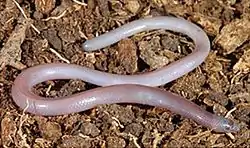 Anelytropsis papillosus | |||||||||||||||||||||
| 分類 | |||||||||||||||||||||
| |||||||||||||||||||||
| 和名 | |||||||||||||||||||||
| フタアシトカゲ科[1] |
小さな虫食性のトカゲであり、長く、細い体は地中を掘り進むのに適応している[4]。通常は、他の多くの爬虫類に典型的な革状の殻ではなく、硬く石灰化した殻を持つ卵を1つ産む[3][5]。
2属があり、Dibamus属は23種が東南アジア、インドネシア、フィリピン、ニューギニア西部に生息し、単型のAnelytropsis属はメキシコに生息する[6]。最近の系統解析からは、フタアシトカゲ科は他の全てのトカゲ・ヘビと姉妹群を成す[7][8][9]か、またはヤモリ下目と最も近縁でこの2群のクレードが他の有鱗類とクレードを成す[10]。漸新世のモンゴルで見つかっているHoeckosaurusは本科唯一の化石記録である[11]。
種
AnelytropsisとDibamusの2属がある[2]。 Reptile Database[6]によると、Anelytropsisは単型であり、Dibamusには23種が含まれる。
- Anelytropsis属[12]
- Anelytropsis papillosus
- Dibamus属[13]
- Dibamus alfredi
- Dibamus bogadeki
- Dibamus booliati
- Dibamus bourreti
- Dibamus celebensis
- Dibamus dalaiensis
- Dibamus deharvengi
- Dibamus dezwaani
- Dibamus floweri
- Dibamus greeri
- Dibamus ingeri
- Dibamus kondaoensis
- Dibamus leucurus
- Dibamus montanus
- Dibamus nicobaricum
- Dibamus novaeguineae
- Dibamus seramensis
- Dibamus smithi
- Dibamus somsaki
- Dibamus taylori
- Dibamus tebal
- Dibamus tiomanensis
- Dibamus vorisi
モンゴル中央部のValley of Lakesから産出した漸新世前期の化石の記載から、絶滅した単型の属Hoeckosaurusが最近提唱されている[11]。
脚注
- マーク・オシー 著、冨水明 和訳監修 『トカゲ大全』, 2021年, MPJ.
- Vitt, Laurie J.; Caldwell, Janalee P. (2014). Herpetology : an introductory biology of amphibians and reptiles (4th ed.). Amsterdam. ISBN 9780123869197. OCLC 839312807
- Greer, Allen E. (1985). “The Relationships of the Lizard Genera Anelytropsis and Dibamus”. Journal of Herpetology 19 (1): 116–156. doi:10.2307/1564427. ISSN 0022-1511. JSTOR 1564427.
- Pough, F. Harvey (2015-11-18). Herpetology (Fourth ed.). Sunderland, Massachusetts, USA. ISBN 9781605352336. OCLC 908397943
- Cogger, Harold G.; Zweifel, Richard George, eds (1998). Encyclopedia of Reptiles & Amphibians (2nd ed.). San Diego, CA. ISBN 0121785602. OCLC 39559811
- “The Reptile Database”. reptile-database.reptarium.cz. 2019年2月8日閲覧。
- Tonini, João Filipe Riva; Beard, Karen H.; Ferreira, Rodrigo Barbosa; Jetz, Walter; Pyron, R. Alexander (2016-12-01). “Fully-sampled phylogenies of squamates reveal evolutionary patterns in threat status”. Biological Conservation. Advancing reptile conservation: Addressing knowledge gaps and mitigating key drivers of extinction risk 204: 23–31. doi:10.1016/j.biocon.2016.03.039. ISSN 0006-3207.
- Portik, Daniel M; Wiens, John J (2020-08-14). Faircloth, Brant. ed. “Do Alignment and Trimming Methods Matter for Phylogenomic (UCE) Analyses?” (英語). Systematic Biology 70 (3): 440–462. doi:10.1093/sysbio/syaa064. ISSN 1063-5157. PMID 32797207.
- Vidal, Nicolas; Hedges, S. Blair (2009-02-01). “The molecular evolutionary tree of lizards, snakes, and amphisbaenians” (英語). Comptes Rendus Biologies. La théorie de Darwin revisitée par la biologie d'aujourd'hui / Darwin's theory revisited by today's biology 332 (2): 129–139. doi:10.1016/j.crvi.2008.07.010. ISSN 1631-0691. PMID 19281946.
- Reeder, Tod W.; Townsend, Ted M.; Mulcahy, Daniel G.; Noonan, Brice P.; Wood, Perry L.; Sites, Jack W.; Wiens, John J. (2015-03-24). Wilf, Peter. ed. “Integrated Analyses Resolve Conflicts over Squamate Reptile Phylogeny and Reveal Unexpected Placements for Fossil Taxa” (英語). PLOS ONE 10 (3): e0118199. Bibcode: 2015PLoSO..1018199R. doi:10.1371/journal.pone.0118199. ISSN 1932-6203. PMC 4372529. PMID 25803280.
- Čerňanský, Andrej (2019-10-25). “The first potential fossil record of a dibamid reptile (Squamata: Dibamidae): a new taxon from the early Oligocene of Central Mongolia”. Zoological Journal of the Linnean Society 187 (3): 782–799. doi:10.1093/zoolinnean/zlz047. ISSN 0024-4082.
- “Anelytropsis papillosus”. The Reptile Database. 2019年2月8日閲覧。
- “Search results | The Reptile Database”. reptile-database.reptarium.cz. 2019年2月8日閲覧。
外部リンク
- MorphoSurce, Dibamidae skull 3D CT-Scans
- iNaturalist, dibamid observations
- The Reptile Database
This article is issued from Wikipedia. The text is licensed under Creative Commons - Attribution - Sharealike. Additional terms may apply for the media files.