フロログルシノール
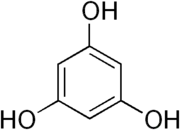
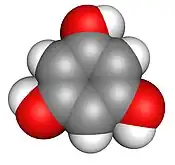
フロログルシノール(phloroglucinol)は、互変異性体を持った、天然にも存在する有機化合物の1つである。多官能性であるため、有機合成における中間体として有用であり、医薬品や爆薬の合成原料に使われる。
| フロログルシノール | |
|---|---|
 | |
 | |
Benzene-1,3,5-triol | |
別称 phloroglucine, 1,3,5-trihydroxybenzene, 1,3,5-benzenetriol, or cyclohexane-1,3,5-trione | |
| 識別情報 | |
| CAS登録番号 | 108-73-6  |
| PubChem | 359 |
| KEGG | C02183 D00152 |
| RTECS番号 | UX1050000 |
| |
| 特性 | |
| 化学式 | C6H6O3 |
| モル質量 | 126.11 g/mol |
| 精密質量 | 126.031694 |
| 外観 | 白色の固体 |
| 融点 |
218-220 °C |
| 水への溶解度 | 1 g/100 mL |
| 危険性 | |
| EU分類 |  有害 (Xn) 有害 (Xn) |
| 特記なき場合、データは常温 (25 °C)・常圧 (100 kPa) におけるものである。 | |
互変異性

フロログルシノールはフェノール型である1,3,5-トリヒドロキシベンゼンと、ケトン型である1,3,5-シクロヘキサトリオン(フロログルシン)の2種の互変異性体が存在し、それぞれpHに依存した化学平衡の関係にある[1]。
所在
フロログルシノール類は、植物や細菌などにより生合成される[2]。例えば、そのアシル誘導体はオシダ属の1種であるドリオプテリス・アルグタ の葉状体に存在する[3]。また、褐藻類からもフロログルシノール誘導体は単離されており[4][5]、タンニンの1種であるフロロタンニンを合成する褐藻も知られている[6]。
フロログルシノールは、そのフェノン誘導体からフロレチンヒドロラーゼによって加水分解されることでも得られる[7]。
単離
フロログルシノールは、果樹の樹皮から初めて単離された。なお、常圧におけるフロログルシノール2水和物の結晶の融点は116-117 °Cだが、無水和物の融点は218-220 °Cと高い。沸騰はせず、昇華性を持つ。
合成および反応
フロログルシノールの合成法は幾つか知られているが、代表的なのはトリニトロベンゼンを経由した合成法である[8]。
通常、アニリン誘導体は水酸化物イオンに対して不活性であるため、この合成法は注目に値する。これは、トリアミノベンゼンがイミン体との互変異性を有することで加水分解を受け易くなっていることに起因する。
フロログルシノールは、ヒドロキシルアミンとの反応ではケトンのように振る舞い、トリス(オキシム)を生成する。また、ベンゼントリオール(Ka1 = 3.56 × 10⁻⁹, Ka2 1.32×10⁻⁹)としても振る舞い、3つのヒドロキシル基をメチル化させると1,3,5-トリメトキシベンゼンが生成される[8]。

利用
フロログルシノールはジアゾ染料と結合して速やかに黒色を与えるため、主に印刷のカップリング剤に使われる。
出典
- Degui Wang, Knut Hildenbrand, Johannes Leitich, Heinz-Peter Schuchmann, and Clemens von Sonntag (1993). “pH-Dependent Tautomerism and pKa Values of Phloroglucinol (1,3,5-Trihydroxybenzene), Studied by 13C NMR and UV Spectroscopy”. Zeitschrift für Naturforschung B 48 (4): 478-482. doi:10.1515/znb-1993-0413.
- Achkar J, Xian M, Zhao H, and Frost J (2005). “Biosynthesis of phloroglucinol”. J. Am. Chem. Soc. 127 (15): 5332-5333. doi:10.1021/ja042340g. PMID 15826166.
- C. Michael Hogan. 2008. Coastal Woodfern (Dryopteris arguta), GlobalTwitcher, ed. N. StrombergArchived 2011-07-11 at the Wayback Machine.
- Yoshihito Okada, Akiko Ishimaru, Ryuichiro Suzuki, and Toru Okuyama (2004). “A New Phloroglucinol Derivative from the Brown Alga Eisenia bicyclis: Potential for the Effective Treatment of Diabetic Complications”. J. Nat. Prod. 67 (1): 103–105. doi:10.1021/np030323j. PMID 14738398.
- Adrian J. Blackman, Glen I. Rogers, and John K. Volkman (1988). “Phloroglucinol Derivatives from Three Australian Marine Algae of the Genus Zonaria”. J. Nat. Prod. 51 (1): 158-160. doi:10.1021/np50055a027.
- Toshiyuki Shibata, Shigeo Kawaguchi, Yoichiro Hama, Masanori Inagaki, Kuniko Yamaguchi, and Takashi Nakamura. “Local and chemical distribution of phlorotannins in brown algae”. Journal of Applied Phycology 16 (4): 291-296. doi:10.1023/B:JAPH.0000047781.24993.0a.
- Minamikawa T, Jayasankar NP, Bohm BA, Taylor IE, and Towers GH (1970). “An inducible hydrolase from Aspergillus niger, acting on carbon-carbon bonds, for phlorrhizin and other C-acylated phenols”. Biochem. J. 116 (5): 889-897. PMC 1185512. PMID 5441377.
- Helmut Fiege, Heinz-Werner Voges, Toshikazu Hamamoto, Sumio Umemura, Tadao Iwata, Hisaya Miki, Yasuhiro Fujita, Hans-Josef Buysch, Dorothea Garbe, Wilfried Paulus "Phenol Derivatives" in Ullmann's Encyclopedia of Industrial Chemistry, Wiley-VCH, Wienheim, 2005. DOI: 10.1002/14356007.a19_313. Published online: 15 June 2002.
- “Intermediate Pharmaceutical Ingredients - Flopropione” (PDF). Univar Canada. 2009年4月24日閲覧。
- “Synthesis of trinitrophloroglucinol”. The United States Patent and Trademark Office (1984年). 2009年4月24日閲覧。
- “Phloroglucinol Summary Report” (PDF). EMEA. 2007年7月10日時点のオリジナルよりアーカイブ。2009年4月24日閲覧。
- Chassany O et al. (2007). “Acute exacerbation of pain in irritable bowel syndrome: efficacy of phloroglucinol/trimethylphloroglucinol. A randomized, double-blind, placebo-controlled study.”. Alimentary pharmacology & therapeutics 1 (25): 1115–23. PMID 17439513
- “PHLOROGLUCINOL”. Biam (1999年). 2009年4月24日閲覧。 (in French)