出生力因子
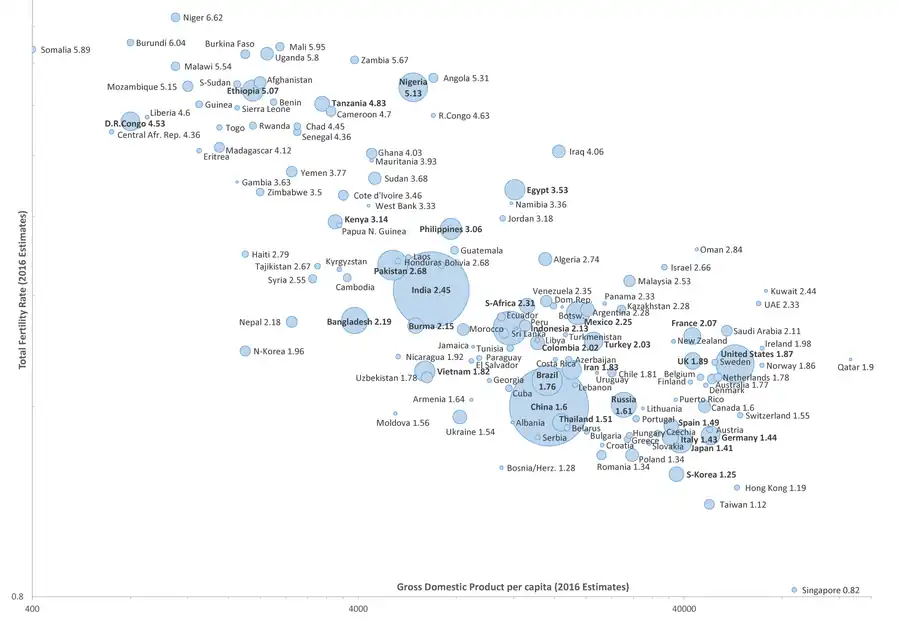
出生力因子(しゅっしょうりょくいんし、Fertility factor)とは、個人が持つであろう子供の数の決定要因のこと。出生力因子は、大多数が正または負の相関関係であり、特定の因果関係ではない。
出生力の増加に一般的に関連する要因には、子供を持つ意思[1]、非常に高度なジェンダー平等の先進社会[2]、宗教観[3]、価値観の世代間継承[4]、結婚[5]、同居[6]、母体[7]、ソーシャルサポート[8]、地方居住[9]、政府の家族支援[10]、低知能(IQ)[11]、食糧の生産増加[12]などか含まれる。
出生力の低下に一般的に関連する要因には、収入の増加[13]、価値観・動向の変化[14]、教育[15][16]、女性の就職増加[17]、人口統制[18]、年齢[19]、避妊[20]、パートナーの出産不同意[21]、非常に低いジェンダー平等[22]、不妊[23]、公害[24]、肥満[25]などがある。
出生率の増加要因
出生率の低下要因
脚注
- “Fertility in Advanced Societies: A Review of Research: La fécondité dans les sociétés avancées: un examen des recherches”. European Journal of Population 29 (1): 1–38. (February 2013). doi:10.1007/s10680-012-9277-y. PMC 3576563. PMID 23440941.
- “Fertility in Advanced Societies: A Review of Research: La fécondité dans les sociétés avancées: un examen des recherches”. European Journal of Population 29 (1): 1–38. (February 2013). doi:10.1007/s10680-012-9277-y. PMC 3576563. PMID 23440941.
- “Religiosity and Fertility in the United States: The Role of Fertility Intentions”. Social Forces; A Scientific Medium of Social Study and Interpretation 86 (3): 1163–1188. (2008). doi:10.1353/sof.0.0000. PMC 2723861. PMID 19672317.
- “Fertility in Advanced Societies: A Review of Research: La fécondité dans les sociétés avancées: un examen des recherches”. European Journal of Population 29 (1): 1–38. (February 2013). doi:10.1007/s10680-012-9277-y. PMC 3576563. PMID 23440941.
- “Fertility of men and women aged 15-44 years in the United States: National Survey of Family Growth, 2006-2010” (primary research report). National Health Statistics Reports (Division of Vital Statistics, National Center for Health Statistics) (51): 1–28. (April 2012). PMID 22803225.
- Fent, Thomas; Diaz, Belinda Aparicio; Prskawetz, Alexia (2013). “Family policies in the context of low fertility and social structure”. Demographic Research 29 (37): 963–998. doi:10.4054/DemRes.2013.29.37.
- “Wealth modifies relationships between kin and women's fertility in high-income countries”. Behavioral Ecology 25 (4): 834–842. (2014). doi:10.1093/beheco/aru059. ISSN 1045-2249.
- “Fertility in Advanced Societies: A Review of Research: La fécondité dans les sociétés avancées: un examen des recherches”. European Journal of Population 29 (1): 1–38. (February 2013). doi:10.1007/s10680-012-9277-y. PMC 3576563. PMID 23440941.
- “Fertility in Advanced Societies: A Review of Research: La fécondité dans les sociétés avancées: un examen des recherches”. European Journal of Population 29 (1): 1–38. (February 2013). doi:10.1007/s10680-012-9277-y. PMC 3576563. PMID 23440941.
- “Fertility in Advanced Societies: A Review of Research: La fécondité dans les sociétés avancées: un examen des recherches”. European Journal of Population 29 (1): 1–38. (February 2013). doi:10.1007/s10680-012-9277-y. PMC 3576563. PMID 23440941.
- Shatz, Steven M. (March 2008). “IQ and fertility: A cross-national study”. Intelligence 36 (2): 109–111. doi:10.1016/j.intell.2007.03.002.
- “Human population numbers as a function of food supply”. Russel Hopfenburg, David Pimentel, Duke University, Durham, NC, USA;2Cornell University, Ithaca, NY, USA. 2023年6月10日閲覧。
- “Fertility in Advanced Societies: A Review of Research: La fécondité dans les sociétés avancées: un examen des recherches”. European Journal of Population 29 (1): 1–38. (February 2013). doi:10.1007/s10680-012-9277-y. PMC 3576563. PMID 23440941.
- The ESHRE Capri Workshop Group (2010). “Europe the continent with the lowest fertility” (review). Human Reproduction Update 16 (6): 590–602. doi:10.1093/humupd/dmq023. PMID 20603286.
- “Fertility in Advanced Societies: A Review of Research: La fécondité dans les sociétés avancées: un examen des recherches”. European Journal of Population 29 (1): 1–38. (February 2013). doi:10.1007/s10680-012-9277-y. PMC 3576563. PMID 23440941.
- Pradhan, Elina (2015年11月24日). “Female Education and Childbearing: A Closer Look at the Data” (英語). Investing in Health. 2019年3月11日閲覧。
- Bloom, David; Canning, David; Fink, Günther; Finlay, Jocelyn (2009). “Fertility, female labor force participation, and the demographic dividend”. Journal of Economic Growth 14 (2): 79–101. doi:10.1007/s10887-009-9039-9.
- Feng, Wang; Yong, Cai; Gu, Baochang (2012). “Population, Policy, and Politics: How Will History Judge China's One-Child Policy?”. Population and Development Review 38: 115–29. doi:10.1111/j.1728-4457.2013.00555.x.
- “The variability of female reproductive ageing”. Human Reproduction Update 8 (2): 141–54. (2002). doi:10.1093/humupd/8.2.141. PMID 12099629.
- “Fertility in Advanced Societies: A Review of Research: La fécondité dans les sociétés avancées: un examen des recherches”. European Journal of Population 29 (1): 1–38. (February 2013). doi:10.1007/s10680-012-9277-y. PMC 3576563. PMID 23440941.
- “Fertility in Advanced Societies: A Review of Research: La fécondité dans les sociétés avancées: un examen des recherches”. European Journal of Population 29 (1): 1–38. (February 2013). doi:10.1007/s10680-012-9277-y. PMC 3576563. PMID 23440941.
- “Fertility in Advanced Societies: A Review of Research: La fécondité dans les sociétés avancées: un examen des recherches”. European Journal of Population 29 (1): 1–38. (February 2013). doi:10.1007/s10680-012-9277-y. PMC 3576563. PMID 23440941.
- “ART fact sheet (July 2014)”. European Society of Human Reproduction and Embryology. 2016年3月4日時点のオリジナルよりアーカイブ。2023年6月10日閲覧。
- “Exposure to air pollution seems to negatively affect women's fertility”. 2023年6月10日閲覧。
- “Impact of obesity on infertility in women”. Journal of the Turkish German Gynecological Association 16 (2): 111–7. (1 June 2015). doi:10.5152/jtgga.2015.15232. PMC 4456969. PMID 26097395.
- 山田昌弘 (June 2021). "第5章". 「人口動態と経済・社会の変化に関する研究会」報告書 (Report). 財務総合政策研究所.
- “Regression Analysis of Collinear Data using r-k Class Estimator: Socio-Economic and Demographic Factors Affecting the Total Fertility Rate (TFR) in India” (primary research article). Journal of Data Science 11 (2): 323–342. (2013). doi:10.6339/JDS.2013.11(2).1030.
- “Country Comparison :: Population size”. The World Factbook. Central Intelligence Agency. 2007年6月13日時点のオリジナルよりアーカイブ。2017年5月30日閲覧。
- “China's Generation of Only Children Wants the Same for Their Kids”. Foreign Policy. Foreign Policy. 2022年1月28日閲覧。
- “Country Comparison :: GDP - per capita (PPP)”. The World Factbook. Central Intelligence Agency. 2007年6月13日時点のオリジナルよりアーカイブ。2017年5月30日閲覧。
- “Country Comparison :: Population size”. The World Factbook. Central Intelligence Agency. 2007年6月13日時点のオリジナルよりアーカイブ。2017年5月30日閲覧。
- “Country Comparison :: GDP - per capita (PPP)”. The World Factbook. Central Intelligence Agency. 2007年6月13日時点のオリジナルよりアーカイブ。2017年5月30日閲覧。
参考文献
- “Fertility in Advanced Societies: A Review of Research: La fécondité dans les sociétés avancées: un examen des recherches”. European Journal of Population 29 (1): 1–38. (February 2013). doi:10.1007/s10680-012-9277-y. PMC 3576563. PMID 23440941.
This article is issued from Wikipedia. The text is licensed under Creative Commons - Attribution - Sharealike. Additional terms may apply for the media files.