動物のニューロンの数の一覧
動物のニューロンの数の一覧(どうぶつのニューロンのかずのいちらん)では二つのリストを掲載している。ひとつは神経系全体または脳全体におけるニューロン(神経細胞)の数のリストである。もうひとつは大脳皮質のニューロン数についての代表的動物のリストである。ここに掲載されている数値は、各動物の脳(もしくは大脳皮質)の平均体積に、各動物における神経細胞の密度を乗じて得られた推定値である。(全数が正確にカウントされているのはC. elegansの 302 のみである。)
.png.webp)
.png.webp)
概要
ニューロンは、その環境からの刺激を感知し、それに応じて振る舞うことができるように、動物の神経系に情報を伝達する細胞。必ずしも全ての動物がニューロンを持っているわけではなく、たとえばセンモウヒラムシや海綿動物は完全に神経細胞を欠いている。
ニューロンは、脊椎動物の脳や、昆虫の神経節のような構造を形成する。
神経系のニューロンの総数
シナプスの数、ニューロンの数は、センチュウ以外すべて推定である。
| 名前 | 脳を含む全神経系のニューロンの総数 | シナプスの数 | 詳細 | 情報源 | |
|---|---|---|---|---|---|
| 海綿動物 | 0 | 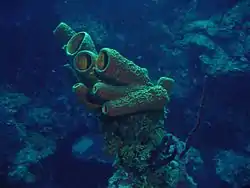 |
[1] | ||
| センモウヒラムシ | 0 | 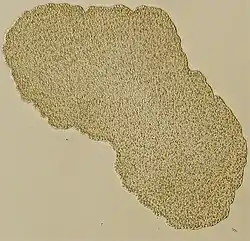 |
[2] | ||
| C. elegans (線虫) | 302 | ~7,500 | モデル生物のひとつ。神経細胞同士の接続関係(コネクトーム)が完全に分かっている唯一の生物(2013年時点)。 | 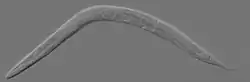 |
[3] |
| ヒドラ | 5,600 | 学名:Hydra vulgaris (H. attenuate) | 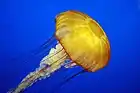 |
[5] | |
| ハコクラゲ | 8,700-17,500 | 成体のミツデリッポウクラゲ (学名:Tripedalia cystophora, 直径8mm) - ただし四つのロパリウムそれぞれにある1000個ずつのニューロンは除いた数字 | 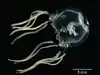 |
[6] | |
| ヒル | 10,000 | 医療用ヒル(Medicinal leech) | 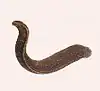 |
[7] | |
| カタツムリ | 11,000 | 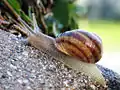 |
[8] | ||
| ジャンボアメフラシ | 18,000 | 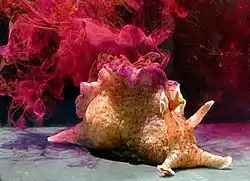 |
[9] | ||
| ナメクジウオ | 20,000 | 中枢神経系のみの数字 | 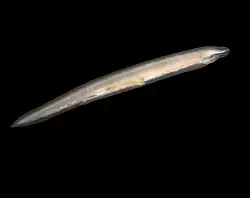 |
[10] | |
| キイロショウジョウバエ | 250,000 | <1×10⁷ | .jpg.webp) |
[12] | |
| 幼生のゼブラフィッシュ() | 100,000 | 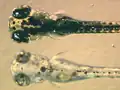 |
[14] | ||
| ロブスター | 100,000 |  |
[15] | ||
| アリ | 250,000 | 種によって異なる | 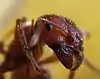 |
[16] | |
| ミツバチ | 960,000 | ~1×10⁹ | 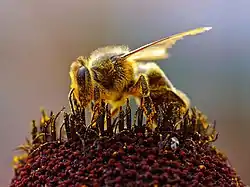 |
[18] | |
| ゴキブリ | 1,000,000 | 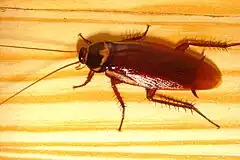 |
[19] | ||
| 成体のゼブラフィッシュ | ~10,000,000 | 細胞数 (ニューロン+その他) | 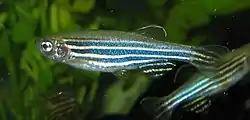 |
[20] | |
| カエル | 16,000,000 | _crop.jpg.webp) |
[21] | ||
| イブシトガリネズミ | 36,000,000 |  |
[22] | ||
| ブラリナトガリネズミ | 52,000,000 | 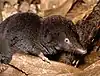 |
[22] | ||
| ハツカネズミ | 71,000,000 | ~1×10¹² | 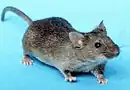 |
[23] | |
| ゴールデンハムスター | 90,000,000 | 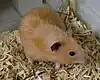 |
[23] | ||
| ホシバナモグラ | 131,000,000 | 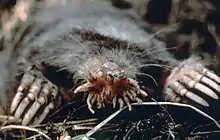 |
[22] | ||
| ドブネズミ | 200,000,000 | ~4.48×10¹¹ | 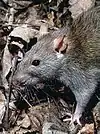 |
[24] | |
| トウブモグラ | 204,000,000 | 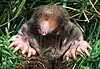 |
[22] | ||
| モルモット | 240,000,000 | .jpg.webp) |
[23] | ||
| ツパイ | 261,000,000 | コモンツパイ(学名:Tupaia glis) | 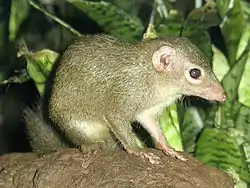 |
[25] | |
| タコ | 500,000,000 | 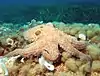 |
[26] | ||
| コモンマーモセット | 636,000,000 | 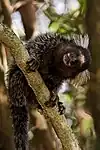 |
[25] | ||
| ネコ | 760,000,000 | ~1×10¹³ | 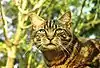 |
[27] | |
| アグーチ | 857,000,000 | 英名: Black-rumped agouti (学名:Dasyprocta prymnolopha) | .jpg.webp) |
[23] | |
| ガラゴ | 936,000,000 | 種: Northern greater galago(学名:Otolemur garnettii) | .jpg.webp) |
[25] | |
| ヨザル | 1,468,000,000 | 英名:Three-striped night monkey (学名:Aotus trivirgatus) |  |
[25] | |
| カピバラ | 1,600,000,000 | 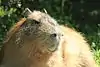 |
[23] | ||
| コモンリスザル | 3,246,000,000 | 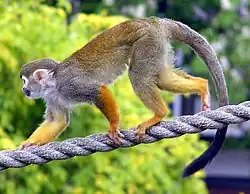 |
[25] | ||
| フサオマキザル | 3,691,000,000 | _4.jpg.webp) |
[25] | ||
| アカゲザル | 6,376,000,000 | 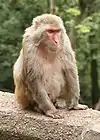 |
[25] | ||
| ヒト | 86,000,000,000 | ~1.5×10¹⁴ | シナプス数は平均的な成人のもの
概算でいうと、ニューロン(つまり細胞)の数は1000億 シナプス数、すなわちニューロンがつくっている接続の数は150兆 |
 |
[28][29][30] |
| アフリカゾウ | 257,000,000,000 | 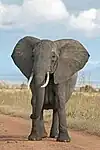 |
[31][32] |
大脳皮質のニューロンの総数
哺乳類のみが大脳皮質を持っているので、このリストには哺乳類しかない。
| 名前 | 大脳皮質の
ニューロン数 |
詳細 | Image | Source |
|---|---|---|---|---|
| マウス | 4,000,000 | ハツカネズミ属のハツカネズミ | 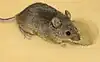 |
[8] |
| ラット | 18,000,000 | クマネズミ属、種不明 | 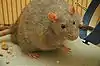 |
[33] |
| ハリネズミ | 24,000,000 | ハリネズミ亜科、属種不明 | 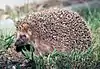 |
[33] |
| オポッサム | 27,000,000 | オポッサム科、属種不明 | 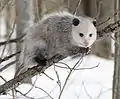 |
[33] |
| イヌ | 530,000,000 | イエイヌ(学名:Canis lupus familiaris) | 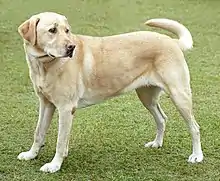 |
[8][35] |
| ネコ | 250,000,000 | ヨーロッパヤマネコ (学名:Felis catus)もしくはイエネコ(学名:Felis silvestris catus) | |
[8][35] |
| メガネザル | 310,000,000 | メガネザル属、種不明 | 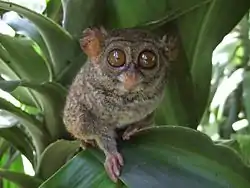 |
[36] |
| リスザル | 430,000,000 | リスザル属、種不明 | 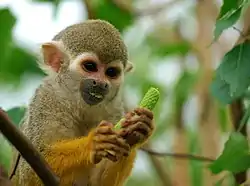 |
[37] |
| ブタ | 425,000,000 | 学名:Sus scrofa | 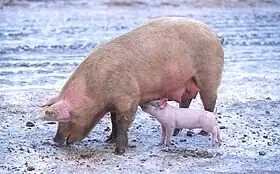 |
[38] |
| アライグマ | 453,000,000 | .jpg.webp) |
[39] | |
| アカゲザル | 480,000,000 | アカゲザル | |
[33] |
| オマキザル | 650,000,000 | オマキザル属、種不明 | 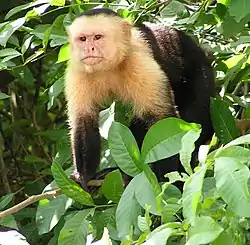 |
[37] |
| ウマ | 1,200,000,000 | 狭義の「ウマ」(学名:Equus ferus caballus) | 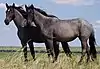 |
[22] |
| オナガザル | 2,500,000,000 | オナガザル属、種不明 | 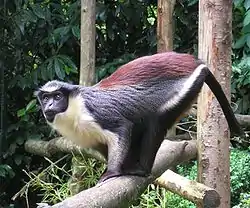 |
[36] |
| ゴリラ | 4,300,000,000 | ゴリラ、種不明 |  |
[37] |
| チンパンジー | 6,200,000,000 | チンパンジー属、種不明 | 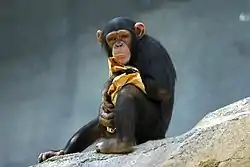 |
[8] |
| オキゴンドウ | 10,500,000,000 | オキゴンドウ | 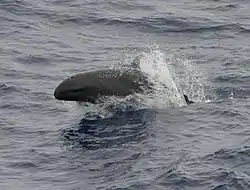 |
[22] |
| アフリカゾウ | 11,000,000,000 | アフリカゾウ属、種不明 |  |
[22] |
| ナガスクジラ | 15,000,000,000 | ナガスクジラ | 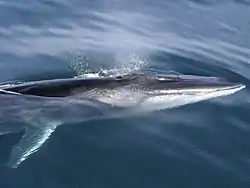 |
[40] |
| ヒト | 21,000,000,000 | 平均的な成人
新皮質の神経細胞の平均数は、女性の脳は190億、男性の脳は230億との推計がある。 |
|
[30] |
| ヒレナガゴンドウ | 37,200,000,000 | ある種のイルカは、ヒトを含む哺乳動物の中で、いちばん多くの新皮質ニューロンをもっているという推計がある。 | 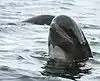 |
[42] |
参考文献
- Sherwood L, Klandorf H and Yancey P (2012) Animal Physiology: From Genes to Organisms Cengage Learning, p. 150.
- Schierwater B (December 2005). “My favorite animal, Trichoplax adhaerens”. BioEssays 27 (12): 1294–1302. doi:10.1002/bies.20320. PMID 16299758.
- White, J. G (1986-11-12). “The Structure of the Nervous System of the Nematode Caenorhabditis Elegans”. Philosophical Transactions of the Royal Society B 314 (1165): 1–340. doi:10.1098/rstb.1986.0056. ISSN 0962-8436. PMID 22462104 2012年3月22日閲覧。.
- 塚田祐基、森郁恵「Caenorhabditis elegans」『脳科学辞典』2013年1月25日、doi:10.14931/bsd.1044、2016年10月30日閲覧。
- Bode, H. (1973). “Quantitative analysis of cell types during growth and morphogenesis in Hydra”. Wilhelm Roux Archiv für Entwicklungsmechanik der Organismen 171 (4): 269–285. doi:10.1007/BF00577725. ISSN 0949-944X.
- Garm, A. (2007). “The ring nerve of the box jellyfish Tripedalia cystophora”. Cell and Tissue Research 329 (1): 147–157. doi:10.1007/s00441-007-0393-7. ISSN 0302-766X.
- “Glia in the leech central nervous system: physiological properties and neuron-glia relationship”. J. Neurophysiol. 27: 290–320. (1964). PMID 14129773.
- “Evolution of the brain and intelligence”. Trends Cogn. Sci. (Regul. Ed.) 9 (5): 250–7. (May 2005). doi:10.1016/j.tics.2005.03.005. PMID 15866152.
- “A quantitative analysis of the development of the central nervous system in juvenile Aplysia californica”. J Neurobiol. 20 (1): 25–47. (1989). doi:10.1002/neu.480200104. PMID 2921607.
- Roth, Gerhard (3 June 2013). The Long Evolution of Brains and Minds. Springer Science & Business Media. p. 121. ISBN 978-94-007-6259-6 2015年12月9日閲覧。
- Aniszewski, Tadeusz (25 April 2015). Alkaloids: Chemistry, Biology, Ecology, and Applications. Elsevier Science. p. 316. ISBN 978-0-444-59462-4 2015年12月9日閲覧。
- Lagercrantz, Hugo; Hanson, M. A.; Ment, Laura R. et al., eds (7 January 2010). The Newborn Brain: Neuroscience and Clinical Applications. Cambridge University Press. p. 3. ISBN 978-1-139-48558-6 2015年12月9日閲覧。
- Nass, Richard; Przedborski, Serge (28 April 2011). Parkinson's Disease: molecular and therapeutic insights from model systems. Academic Press. p. 325. ISBN 978-0-08-055958-2 2015年12月9日閲覧。
- Scientists Capture All The Neurons Firing Across A Fish's Brain On Video Popular Science, 19 March 2013.
- “Anatomy & Biology”. The Lobster Institute. University of Maine. 2016年3月19日閲覧。
- John and Sarah Tefl. “Interesting Facts About Ants”. 2010年12月23日閲覧。
- “Ant Fun Facts”. 2010年12月23日閲覧。
- “Cognitive architecture of a mini-brain: the honeybee”. Trends Cogn. Sci. 5 (2): 62–71. (February 2001). doi:10.1016/S1364-6613(00)01601-6. PMID 11166636.
- “A Strange Approach to Social Interaction, and Butterflies”. Anthropology.net (2007年1月10日). 2007年1月13日時点のオリジナルよりアーカイブ。2010年11月26日閲覧。
- “Generation and long-term persistence of new neurons in the adult zebrafish brain: A quantitative analysis.”. Neuroscience 146 (2): 679–696. (2007). doi:10.1016/j.neuroscience.2007.01.071.
- “Frog Brain Neuron Number”. 2015年7月15日閲覧。
- Hofman, Michel A.; Falk, Dean (2 March 2012). Evolution of the Primate Brain: From Neuron to Behavior. Elsevier. p. 425. ISBN 978-0-444-53860-4
- “Cellular scaling rules for rodent brains.”. Proc Natl Acad Sci USA 103 (32): 12138–12143. (2006). doi:10.1073/pnas.0604911103.
- “Isotropic fractionator: a simple, rapid method for the quantification of total cell and neuron numbers in the brain.”. J Neurosci 25 (10): 2518–2521. (2005). doi:10.1523/jneurosci.4526-04.2005.
- “Cellular scaling rules for primate brains.”. Proc Natl Acad Sci USA 104 (9): 3562–3567. (2007). doi:10.1073/pnas.0611396104. PMC 1805542. PMID 17360682.
- “Brain Facts and Figures”. 2015年7月15日閲覧。
- Ananthanarayanan, Rajagopal; Esser, Steven K.; Simon, Horst D.; Modha, Dharmendra S. (2009). “The cat is out of the bag: cortical simulations with 109 neurons, 1013 synapses”. Proceedings of the Conference on High Performance Computing Networking, Storage and Analysis - SC '09. pp. 1–12. doi:10.1145/1654059.1654124. ISBN 978-1-60558-744-8
- Azevedo, Frederico A.C. (2009). “Equal numbers of neuronal and nonneuronal cells make the human brain an isometrically scaled-up primate brain”. The Journal of Comparative Neurology 513 (5): 532–541. doi:10.1002/cne.21974. PMID 19226510.
- Herculano-Houzel, S. (20 June 2012). “The remarkable, yet not extraordinary, human brain as a scaled-up primate brain and its associated cost”. Proceedings of the National Academy of Sciences 109 (Supplement_1): 10661–10668. doi:10.1073/pnas.1201895109. PMC 3386878. PMID 22723358.
- TOWER DB. (1954). “Structural and functional organization of mammalian cerebral cortex; the correlation of neurone density with brain size; cortical neurone density in the fin whale (Balaenoptera physalus L.) with a note on the cortical neurone density in the Indian elephant.”. The Journal of Comparative Neurology 101 (1): 19–51. doi:10.1002/cne.901010103. PMID 13211853.
- “The Elephant Brain in Numbers.”. 2018年1月27日閲覧。
- “Searching For The Elephant's Genius Inside the Largest Brain on Land”. Scientificamerica (2014年2月26日). 2018年1月27日閲覧。
- Fasolo, Aldo (30 November 2011). The Theory of Evolution and Its Impact. Springer. p. 182. ISBN 978-88-470-1973-7
- “An efficient method for estimating the total number of neurons in rat brain cortex”. J. Neurosci. Methods 31 (2): 93–100. (February 1990). doi:10.1016/0165-0270(90)90153-7. PMID 2181205.
- Research suggests that dogs really are smarter than cats | Daily Mail Online
- Quarton, Gardner C.; Melnechuk, Theodore; Schmitt, Francis O. (1967). The neurosciences. Rockefeller University Press. p. 732. GGKEY:DF21HXQKLNX
- Hofman, Michel A.; Falk, Dean (2 March 2012). Evolution of the Primate Brain: From Neuron to Behavior. Elsevier. p. 424. ISBN 978-0-444-53867-3
- “LEARNING FROM PIG BRAINS”. 2015年7月15日閲覧。
- Lambert, K. G. (2014). “Behind the Mask: Neurobiological indicants of emotional resilience and cognitive function in wild raccoons (Procyon lotor)”. Society for Neuroscienc.
- Mammals, Food and Agriculture Organization of the United Nations Working Party on Marine (1978-01-01). Mammals in the Seas: Report. Food & Agriculture Org.. ISBN 9789251005132
- Evolutionary Cognitive Neuroscience. (2009). p. 139.
- “Quantitative relationships in delphinid neocortex.”. Front Neuroanat 8: 132. (2014). doi:10.3389/fnana.2014.00132. PMC 4244864. PMID 25505387.
This article is issued from Wikipedia. The text is licensed under Creative Commons - Attribution - Sharealike. Additional terms may apply for the media files.