卵化石
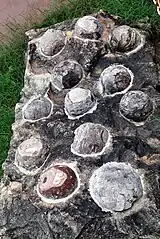
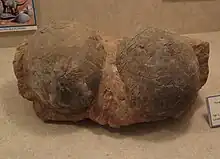
卵化石(らんかせき)とは、古代の動物が産卵した卵が化石化したものである。卵化石は動物の生理学上のプロセスの証拠として、生痕化石の典型として考えられている。まれな状況下では、卵化石は、内部に成長した胚の化石が保存されている場合もあり、その場合、それらは体化石に含まれている。多種多様な動物群が産卵した卵化石の記録は古生代に始まり、その記録は現在保存されている。例としては、アンモナイトのような無脊椎動物だけでなく、魚類、両生類、爬虫類のような脊椎動物が含まれている。爬虫類には、中生代の地層から発掘された多くの恐竜の卵が含まれている。それぞれの卵化石を産卵した生物は、しばしば不明であるため、科学者たちは、リンネが考案したリンネ式分類法から切り離し、後にそのリンネ式分類法を模倣した分類システムで卵を分類した。このパラタクソノミ(parataxonomy)はveterovataと呼ばれている。
歴史
初めて学名をつけられた oospecies は、Oolithes bathonicaeであり、J.バックマンによって暫定的につけられた。バックマンは、その卵の集合は、テレオサウルスによって産卵されたものであると考えていた。しかし、現代の科学者たちは、これらの卵を産卵した爬虫類の種類を決定することがもはや不可能であると考えている[1][2]。 1859年、初めて科学的に文献に記録された恐竜の卵化石は、Father Jean-Jacques Poechであり、南フランスにてカトリック祭司が発見し、アマチュア博物学者が命名した。しかしそのアマチュア博物学者は、それらが巨大な鳥が産卵した物と考えていた[3]。
初めて科学的に認識された恐竜の卵化石は、1923年にアメリカ自然史博物館のクルーらによって偶然発見された。彼らは、モンゴルにて初期の人類の証拠を探していた最中に発見した。卵の発見は、世界中でマウントされ続け、複数の競合する分類体系の発展につながった。1975年、中国の古生物学者である趙資奎は、産卵した母親を仮説していくよりむしろ物理的な形質に基づいて卵を分類するという伝統的なリンネ式システムを基にしたparataxonomyを発展させたシステムにより卵化石を分類するという画期的な方法で分類を始めた。趙が考案した卵の新しい分類方法は、言語の壁のために西洋の科学者らには採用されなかった。しかし、1990年代初頭、ロシアの古生物学者であるコンスタンチンミハイロフが英語の科学文献にて趙の分類方法に注目した[3]。
多様性
無脊椎動物
無脊椎動物の卵化石は、化石記録から知られてる。なかでもそれらは古代の頭足類が産卵したものである。アンモナイトの卵は、最もよく知られた頭足類の卵化石である。最も保存状態によいアンモナイトの卵化石が、イングランドのジュラ紀のキムメリッジ粘土層の中で保存されていた。しかし、頭足類の卵は、柔らかくゼラチン状の卵はすぐに分解してしまうので、化石化する機会がほとんどなかったので化石記録は乏しい。中生代、頭足類のもう一つの主要なグループであるベレムナイト類は、卵化石として記録された文献がまったくない。これは、化石記録が実際に存在しなかったのではなく、科学者がそれらを適切に調査されなかったかもしれない[4]。
分類学
卵化石はveterovataと呼ばれるパラタクソノミ(parataxonomy)システムに沿って分類されている。生物の系統学的分類体系に、oofamilies、oogenera、oospecies(総称してootaxaと知られている)[2][10]の3つの大きなカテゴリーがある。 oogeneraとoofamiliesの名前は、慣習的に「石の卵」を意味する語根 「oolithus」が含まれているが、いつもこの規則に従っているとは限らない。それらは、以下のいくつかの基本的なタイプに分かれている:Testudoid、Geckoid、Crocodiloid、Dinosauroid-spherulitic、Dinosauroid-prismatic、Ornithid
Veterovataは、常に産卵した動物の分類を反映するのではないことに留意すべきである[3]。
パラタクソノミ
Veterovataのoogenus レベルのパラタクソノミ(parataxonomy)は、Testudoidについては、Lawver and Jackson (2014)[11]、Geckonoid の卵については、Hirsch (1996)[12]、その他の特に注記されていないものについてはMikhailov et al. (1996)による[2]。
Testudoid
- Spheruflexibilis 形態型
- Spherurigidis 形態型
Geckonoid
- Geckonoid 形態型
- Oofamily Gekkoolithidae
Crocodiloid
- Oofamily Krokolithidae
Dinosauroid-spherulitic
- Placoolithus
- Sphaerovum
- Stromatoolithus
- Tacuarembovum
- Oofamily Cairanoolithidae
- Oofamily Stalicoolithidae[17]
- Oofamily Spheroolithidae
.jpg.webp)
- Oofamily Phaceloolithidae
- Oofamily Ovaloolithidae
- Oofamily Megaloolithidae
- Oofamily Similifaveoloolithidae[20]
- Oofamily Faveoloolithidae
- Oofamily Youngoolithidae[21]
- Oofamily Dendroolithidae
- Oofamily Dictyoolithidae
- Oofamily Polyclonoolithidae
Dinosauroid-prismatic
- Pseudogeckoolithus[19]
- Oofamily Arriagadoolithidae[23]
- Oofamily Prismatoolithidae
Ornithoid
- Ornithoid-ratite 形態型
- Ageroolithus[19]
- Diamantornis
- Ornitholithus
- Reticuloolithus[28]
- Struthiolithus
- Tristraguloolithus[29]
- Tubercuoolithus[24]
- Oofamily Elongatoolithidae
- Oofamily Laevisoolithidae
- Oofamily Medioolithidae
- Oofamily Montanoolithidae[35]
- Oofamily Oblongoolithidae[3]
- Ornithoid-prismatic Morphotype
脚注
- J. Buckman. 1860. On some fossil reptilian eggs from the Great Oolite of Cirencester. Quarterly Journal of the Geological Society of London 16:107-110
- Konstantin E. Mikhailov, Emily S. Bray & Karl E. Hirsch (1996). “Parataxonomy of fossil egg remains (Veterovata): basic principles and applications”. Journal of Vertebrate Paleontology 16 (4): 763–769. doi:10.1080/02724634.1996.10011364. JSTOR 4523773.
- Carpenter, Kenneth (1999). Eggs, Nests, and Baby Dinosaurs: A Look at Dinosaur Reproduction (Life of the Past), Indiana University Press; ISBN 0-253-33497-7.
- Etches, S., Clarke, J. and Callomon, J. 2009. Ammonite eggs and ammonitellae from the Kimmeridge Clay Formation (Upper Jurassic) of Dorset, England. Lethaia, 42: 204–217.
- Cloutier, R. 2010. The fossil record of fish ontogenies: insights to developmental patterns and processes. Semin Cell Dev Biology 21: 400–413.
- Godfrey, S.J. (1995). "Fossilized Eggs from the Pennsylvanian of Illinois." Ichnos: an international journal for plant and animal traces. 4(1):71-75.
- Capasso, L.L., A. Pallizzi, L. Milia, and R. D'Anastasio. (2013) "Archaeoovulus palenae, n. gn., n. sp. (Icnofossilia): a fossil amphibious ootheca from the pre-evaporitic Messinian site of Capo di Fiume, Palena (Abruzzo)." Atti della Societa Toscana di Scienze Naturali Residente in Pisa Memorie Serie A, 120: 25-38.
- Ellis, Richard, (2003) Sea Dragons - Predators of the Prehistoric Oceans. University Press of Kansas. ISBN 0-7006-1269-6.
- O'Keefe, F.R.; Chiappe, L.M. (2011). “Viviparity and K-selected life history in a Mesozoic marine plesiosaur (Reptilia, Sauropterygia)”. Science 333 (6044): 870–873. doi:10.1126/science.1205689. PMID 21836013.
- Olga Amo, Gloria Cuenca–Bescós & José Ignacio Canudo (1999). José Ignacio Canudo & Gloria Cuenca-Bescós, ed. "Vertebrate eggshell fragments from the Lower Cretaceous (Lower Barremian) of Camino Canales (Galve Bassin, Province of Teruel, NE Spain)" (PDF). IV European Workshop on Vertebrate Palaeontology. Albarracín, Spain: Universidad de Zaragoza.
- Lawver, D.R., and F.D. Jackson. (2014). "A Review of the Fossil Record of Turtle Reproduction: Eggs, Embryos, Nests and Copulating Pairs." Bulletin of the Peabody Museum of Natural History 55(2):215–236.
- Hirsch , K.F. (1996). "Parataxonomic Classification of Fossil Chelonian and Gecko Eggs." Journal of Vertebrate Paleontology. 16(4):752-762.
- Jackson, F. D., Jin, X., Varricchio, D. J., Azuma, Y., & Jiang, Y. (2008). The first in situ turtle clutch from the Cretaceous Tiantai Basin, Zhejiang Province, China. Journal of Vertebrate Paleontology, 28(2), 319-325.
- Wang, Q., X. Wang, Z. Zhao, J. Zhang, and S. Jiang. (2013). "New turtle egg fossil from the Upper Cretaceous of the Laiyang Basin, Shandong Province, China." Anais da Academia Brasileira de Ciências 85(1):103-111.
- Oliveira, C.E.M.; Santucci, R.M.; Andrade, M.B.; Fulfaro, V.J.; Basílo, J.A.F.; Benton, M.J. (2011). “Crocodylomorph eggs and eggshells from the Adamantina Formation (Bauru Group), Upper Cretaceous of Brazil”. Palaeontology 54 (2): 309–321. doi:10.1111/j.1475-4983.2010.01028.x.
- Sellés, A. G., & Galobart, À. (2015). Reassessing the endemic European Upper Cretaceous dinosaur egg Cairanoolithus. Historical Biology, (ahead-of-print), 1-14.
- Wang Q, Wang X L, Zhao Z K, and Jiang Y G. (2012). "A new oofamily of dinosaur egg from the Upper Cretaceous of Tiantai Basin, Zhejiang Province, and its mechanism of eggshell formation" Chinese Science Bulletin. 57: 3740-3747. doi: 10.1007/s11434-012-5353-2
- Moreno-Azanza, M., J.I. Canudo, and J.M. Gasca. (2014) "Spheroolithid eggshells in the Lower Cretaceous of Europe. Implications for eggshell evolution in ornithischian dinosaurs." Cretaceous Research 51: 75-87.
- M. Vianey-Liaud and N. López-Martínez. 1997. Late Cretaceous dinosaur eggshells from the Tremp basin, southern Pyrenees, Lleida, Spain. Journal of Paleontology 71(6):1157-1171
- Wang Qiang, Zhao Zi-kui, Wang Xiao-lin, and Jiang Yan-gen. (2011) "New ootypes of dinosaur eggs from the Late Cretaceous in Tiantai Basin, Zhejiang Province, China." Vertebrata PalAsiatica 49(4):446-449.
- Zhang, S. K. (2010). “A parataxonomic revision of the Cretaceous faveoloolithid eggs of China”. Vertebrata PalAsiatica 48 (3): 203–219 2015年10月3日閲覧。.
- Xie, J.-F., Zhang, S.-K., Jin, X.-S., Li, D.-Q., and Zhou, L.-Q. (2016) "A new type of dinosaur eggs from Early Cretaceous of Gansu Province, China." Vertebrata PalAsiatica, 54(1):1-10.
- F. L. Agnolin, J. E. Powell, F. E. Novas and M. Kundrát. 2012. "New alvarezsaurid (Dinosauria, Theropoda) from uppermost Cretaceous of north-western Patagonia with associated eggs." Cretaceous Research 35(1):33-56
- F. D. Jackson and D. J. Varricchio. 2010. Fossil eggs and eggshell from the lowermost Two Medicine Formation of western Montana, Sevenmile Hill locality. Journal of Vertebrate Paleontology 30(4):1142-1156
- N. López-Martínez and E. Vicens. 2012. A new peculiar dinosaur egg, Sankofa pyrenaica oogen. nov. oosp. nov. from the Upper Cretaceous coastal deposits of the Aren Formation, South-Central Pyrenees, Lleida, Catalonia, Spin. Palaeontology 55(2):325-339
- E. S. Bray. 1999. Eggs and eggshell from the Upper Cretaceous North Horn Formation, central Utah. In D. D. Gillette (ed.), Vertebrate Paleontology in Utah, Utah Geological Survey Miscellaneous Publication 99-1:361-375
- Moreno-Azanza, M.; Canudo, J.I.; Gasca, J.M. (2014). “Unusual theropod eggshells from the Early Cretaceous Blesa Formation of the Iberian Range, Spain”. Acta Paleontologica Polonica 59 (4): 843–854.
- D. K. Zelenitsky and W. J. Sloboda. 2005. Eggshells. In P. J. Currie and E. B. Koppelhus (eds.), Dinosaur Provincial Park: A Spectacular Ancient Ecosystem Revealed. Indiana University Press, Bloomington 398-404
- D. K. Zelenitsky, L. V. Hills, and P. J. Currie. 1996. Parataxonomic classification of ornithoid eggshell fragments from the Oldman Formation (Judith River Group; Upper Cretaceous), southern Alberta. Canadian Journal of Earth Sciences 33:1655-1667
- Q. Wang, X.-L. Wang, Z.-K. Zhao and Y.-G. Jiang. 2010. A new oogenus of Elongatoolithidae from the Upper Cretaceous Chichengshan Formation of Tiantai Basin, Zhejiang Province. Vertebrata PalAsiatica 48(2):111-118
- X. Jin, Y. Azuma, F. D. Jackson and D. J. Varricchio. 2007. Giant dinosaur eggs from the Tiantai basin, Zhejiang province, China. Canadian Journal of Earth Sciences 44:81-88
- Q. Wang, Z. Zhao, X. Wang, N. Li, and S. Zou. (2013) A new form of Elongatoolithidae, Undulatoolithus pengi oogen. et oosp. nov. from Pingxiang, Jiangxi, China. Zootaxa 3746(1):194-200
- Garcia, G., T. Rodolphe, H. Cappetta, B. Marandat, I. Bentaleb, A. Benabdallah and M. Vianey-Liaud. (2003). "First Record of Dinosaur Eggshels and Teeth from The North-West African Maastrichtian (Morocco)." Palaeovertebrata, Montpellier, 32 (2-4): 59-69,
- Jackson, Frankie D.; Varricchio, David J.; Corsini, Joseph A. (2013). “Avian Eggs from the Eocene Willwood and Chadron Formations of Wyoming and Nebraska”. Journal of Vertebrate Paleontology 33 (5): 1190–1201. doi:10.1080/02724634.2013.769445.
- D. K. Zelenitsky and F. Therrien. 2008. Unique maniraptoran egg clutch from the Upper Cretaceous Two Medicine Formation of Montana reveals theropod nesting behaviour. Palaeontology 51(6):1253-1259
- Varricchio, D.J., and D.E. Barta. (2015). "Revisiting Sabath's 'Larger Avian Eggs' from the Gobi Cretaceous." Acta Palaeontologica Polonica. 60(1):11-25.
- Moreno-Azanza, Miguel; Ignacio Canudo, Jose; Manuel Gasca, Jose (2015). “Enigmatic Early Cretaceous ootaxa from Westerm Europe with signals of extrinsic eggshell degradation”. Cretaeous Research 56: 617–627. doi:10.1016/j.cretres.2015.06.019.
- Tanaka, K., Zelenitsky, D. K., Saegusa, H., Ikeda, T., DeBuhr, C. L., & Therrien, F. (2016). Dinosaur eggshell assemblage from Japan reveals unknown diversity of small theropods. Cretaceous Research, 57, 350-363.
- Zhang, S., X. Jin, J.K. O'Conner, M. Wang, and J. Xie. (2015). "A new egg with avian egg shape from the Upper Cretaceous of Zhejiang Province, China." Historical Biology 27(5):595-602.
- Mikhailov, K.E. (1997). Fossil and recent eggshell in amniotic vertebrates: Fine structure, comparative morphology and classification. Special Papers in Palaeontology 56. The Palaeontological Association. London. (page 58).