塩嚢細胞
塩嚢細胞(えんのうさいぼう;epidermal bladder cell; EBC)とは、塩生植物の一部が持つ、塩類の蓄積のために特殊に発達した表皮細胞のことである。アカザ科、メセンブリアンテマ科、カタバミ科の植物などに見られる。
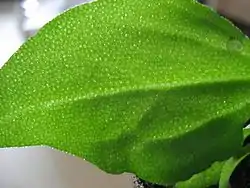
アイスプラント。表面に結晶のように見えるのが塩嚢細胞
塩類集積土壌や海岸付近など土壌中の塩類濃度が高い土壌に生育する塩生植物の中には、体内に入ってきた塩類を隔離するために発達した特殊な表皮細胞を持つものがある。塩嚢細胞はその一種で、トライコーム(葉の表面に生えた単細胞突起体)の一種である。通常直径は500μm程度。大きな液胞を持つことが特徴で、水、塩類のほか、フラボノイドやベタシアニンなどの化合物をその液胞に貯蔵していることが知られている[1][2][3][4]。
引用文献
- P. Adams, D. E. Nelson, S. Yamada, W. Chmara, R. G. Jensen, H. J. Bohnert, H. Griffiths (1998). “Growth and development of Mesembryanthemum crystallinum (Aizoaceae)”. New Phytologist 138 (2): 171 - 190. doi:10.1046/j.1469-8137.1998.00111.x.
- E. Steudle, U. Lüttge and Ulrich Zimmermann (1975). “Water relations of the epidermal bladder cells of the halophytic species Mesembryanthemum crystallinum: Direct measurements of hydrostatic pressure and hydraulic conductivity”. Planta 126: 229-246. doi:10.1007/BF00388965.
- P. Adams, J. C. Thomas, D. M. Vernon, H. J. Bohnert and R. G. Jensen (1992). “Distinct cellular and organismic responses to salt stress”. Plant & Cell Physiology 33 (8): 1215-1223.
- T. Vogta, M. Ibdaha, J. Schmidta, V. Wrayb, M. Nimtzb, D. Strack (1999). “Light-induced betacyanin and flavonol accumulation in bladder cells of Mesembryanthemum crystallinum”. Phytochemistry 52 (4): 583-592. doi:10.1016/S0031-9422(99)00151-X.
- J. Rygol, U. Zimmermann and A. Balling (1989). “Water relations of individual leaf cells of Mesembryanthemum crystallinum plants grown at low and high salinity”. Journal of Membrane Biology 107 (3): 203-212. doi:10.1007/BF01871935.
This article is issued from Wikipedia. The text is licensed under Creative Commons - Attribution - Sharealike. Additional terms may apply for the media files.