声門
声門(せいもん、英: glottis)とは、左右の声帯とそれらの間の空間(声門裂)とをまとめていう[1]。
| 声門 | |
|---|---|
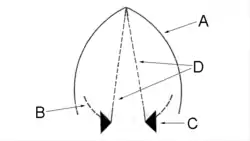 声門の模式図(C=披裂軟骨、D=声帯) | |
 声門の様々な状態 | |
| 英語 | Glottis |
| 器官 | 呼吸器 |
| MeSH | Glottis |
構造
機能
声門裂を空気が流れることで声帯が振動し、音が産み出される。その振動音の音質を「声」と呼ぶ。
声帯振動は、母音および有声子音にとって不可欠な要素である。左右の声帯が離れていれば、その間を空気が流れても振動が起きることはない。無声子音の産出時の状態がこれである。
声門だけが関わって産出される音声を「声門音」という。英語には h で綴られる無声声門摩擦音があるほか、多くの英語方言では音素 /t/ (方言によっては /k/ や /p/ も)の異音として声門閉鎖(左右の声帯を互いに押し付けることでできる)が用いられる。いくつかの言語では声門閉鎖音を音素としてもつ。
オーストラリアの楽器ディジュリドゥーの熟達した奏者たちは、楽器のもつ音色の全域を出すために声門の開き具合を制限している[3]。
声門は、バルサルバ効果においても重要な役割を果たす。
運動
声門面積
声門裂全体の大きさ(面積)を声門面積(英: Glottal Area)という。有声音の発生時には対になる声帯が離反・接近を繰り返すことで声門面積が拡大・縮小を繰り返す。
病理
声門閉鎖不全
声門閉鎖不全は声門が正常に閉鎖せず左右の声帯に隙間が出来る症状である[11]。
画像
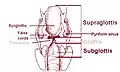 喉頭
喉頭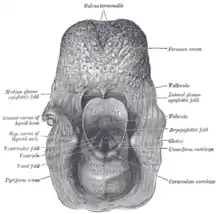 喉頭の入り口部分(背後から見た図)
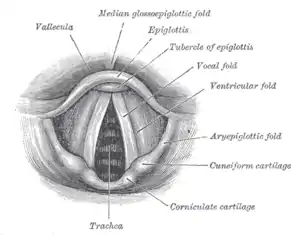 喉頭の入り口部分
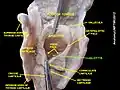 声門(緑の矢印)
脚注
- Glottis - eMedicine Dictionary
- "喉頭前庭ヒダの下方には, 左右の声帯ヒダによってつくられる声門裂 rima glottidis という, やや狭い三角形の裂隙がみえる" グレイ解剖学 第2版. p.1005.
- Tarnopolsky, Alex and Fletcher, Neville and Hollenberg, Lloyd and Lange, Benjamin and Smith, John and Wolfe, Joe (2005). “The vocal tract and the sound of a didgeridoo”. Nature (Nature Publishing Group) 436 (7047): 39. doi:10.1038/43639a.
- "声帯突起の部位が閉鎖せず声門軟骨間部から声門膜間部にかけて後方を底とした三角形の声門閉鎖不全がみられるものとに大別される. 後者は, Posterior Glottal Chink (PGC) と呼ばれ(柴.溝尻.野崎(1995))
- "Observation of the glottis during phonation has suggested that the presence of a posterior glottal opening that persists throughout a vibratory cycle is common for female speakers, but occurs much less frequently among male speakers (So¨dersten and Lindestad, 1990)." Hanson, Helen M and Chuang, Erika S (1999). “Glottal characteristics of male speakers: Acoustic correlates and comparison with female data”. The Journal of the Acoustical Society of America (Acoustical Society of America) 106 (2): 1064-1077. doi:10.1121/1.427116.
- "前後位相差 ... longitudinal phase difference" (山内彰人(2016)).
- "anterior–posterior phase difference ... the mode of glottal opening in the anterior–posterior (A–P) direction" Murtola & Alku. (2020). Indicators of anterior–posterior phase difference in glottal opening measured from natural production of vowels. The Journal of the Acoustical Society of America 148, EL141.
- Murtola & Alku. (2020). Indicators of anterior–posterior phase difference in glottal opening measured from natural production of vowels. The Journal of the Acoustical Society of America 148, EL141.
- "ジッパー様運動と呼ばれる後方先行型開大期前後位相差と前方先行型閉小期前後位相差の組み合わせ(山内彰人(2016))
- "ジッパー様運動 ... が若年女性の特徴であった。 ... n=17 後方先行 100%"(山内彰人(2016))
- "声門閉鎖不全:左右の声帯に隙間が出来る" 公益財団法人難病医学研究財団. 声帯溝症. 難病情報センター.
参考文献
- 柴裕子, 溝尻源太郎, 野崎智嗣「声帯結節の発声機能」『音声言語医学』第36巻第2号、日本音声言語医学会、1995年、184-191頁、doi:10.5112/jjlp.36.184。
- 山内彰人『高速度デジタル撮像を用いた声帯振動の標準的評価法の開発とデータベースの作成』 東京大学〈博士(医学) 12601乙第18213号〉、2016年。doi:10.15083/00075025。CRID 1110564260221613696。
関連項目
This article is issued from Wikipedia. The text is licensed under Creative Commons - Attribution - Sharealike. Additional terms may apply for the media files.