最寄りの地球型太陽系外惑星の一覧
発見されている太陽系外惑星(不完全)
この一覧は不完全である。現在33の系外惑星が含まれており、そのうち11星は母星となる恒星のハビタブルゾーン内に位置していると推測される。
太陽系から50光年の距離までにおよそ2,000の星がある[4](そのうち64個は太陽のような黄-オレンジ色のスペクトル分類がG型の星である[5])。4000 Kより低温の星の約15%が、地球サイズの大きさでハビタブルゾーン内の惑星を持つと推測される[6]。
2013年11月4日、ケプラーの観測データに基づいたところ、天の川銀河内に太陽のような星と赤色矮星のハビタブルゾーン内を公転している地球サイズの惑星が400億個ある可能性が報告されている[7][8]。これらの推定された惑星のうち110億個は太陽のような星を公転しているかもしれない[9]。このような惑星の中で最も近いものは12光年の距離の可能性がある[7][8]。
2016年8月24日、太陽系から最も近い星であるプロキシマ・ケンタウリ(ケンタウルス座α星C)のハビタブルゾーンで、岩石からなる惑星が発見されたことが発表された。プロキシマ・ケンタウリbと呼ばれるこの惑星は、質量は地球の1.3倍であり、公転周期は11.2地球日である。[10]しかしながらプロキシマ・ケンタウリの赤色矮星としての分類:低いstellar flux、自転と公転の同期の高い可能性、小さいハビタブルゾーン、大きい恒星の変動、これらにより軌道上の系外惑星のハビタビリティは疑問視されている。もう1つの有力候補は4.37光年離れた地球に最も近い太陽のような星系であるケンタウルス座α星である。ケンタウルス座α星AやBの周りに居住可能な惑星を見つけられる可能性は約85%と推定されている[11]。ケンタウルス座α星はブレークスルー・スターショットやMission Centaurなどいくつかの系外惑星発見ミッションのターゲットになっており、後者は2016年のドキュメンタリー映画"The Search for Earth Proxima"に記録されている[12]。
表
| 名 | イメージ | M⊕ | R⊕ | g | Ts | a | e | [s] | D |
|---|---|---|---|---|---|---|---|---|---|
| プロキシマ・ケンタウリb |  |
≥1.27 | ~1.1 | 234 K -39℃ |
0.05 | <0.35 | [13] | 4.22 | |
| プロキシマ・ケンタウリc | ~7 | 39 K -234℃ |
~1.489 | ~0.04 | 4.22 | ||||
| ロス128b |  |
≥1.40 | 213 ~ 301 K -60 ~ 38 ℃ |
0.0496 | 0.116 | [14] | 11.03 | ||
| ルイテンb | ≥2.89 | ≥1.35 | 259 K -14 °C |
0.091 | 0.10 | 12.20 | |||
| ティーガーデン星b | ≥1.05 | 0.0252 | 0+0.16 −0 |
[15] | 12.5 | ||||
| ティーガーデン星c | ≥1.11 | 0.0443 | 0+0.16 −0 |
[15] | 12.5 | ||||
| ウォルフ1061 b | ≥1.36 | ≥1.44 | 13.8 | ||||||
| ウォルフ1061 c | ≥4.3 | ≥1.64 | [16] | 13.8 | |||||
| ウォルフ1061 d | ≥5.21 | ≥2.04 | 13.8 | ||||||
| グリーゼ876d[17] |  |
6.8 | 650 K 377 ℃[18] |
0.021 | 0.21 | [19] | 15 | ||
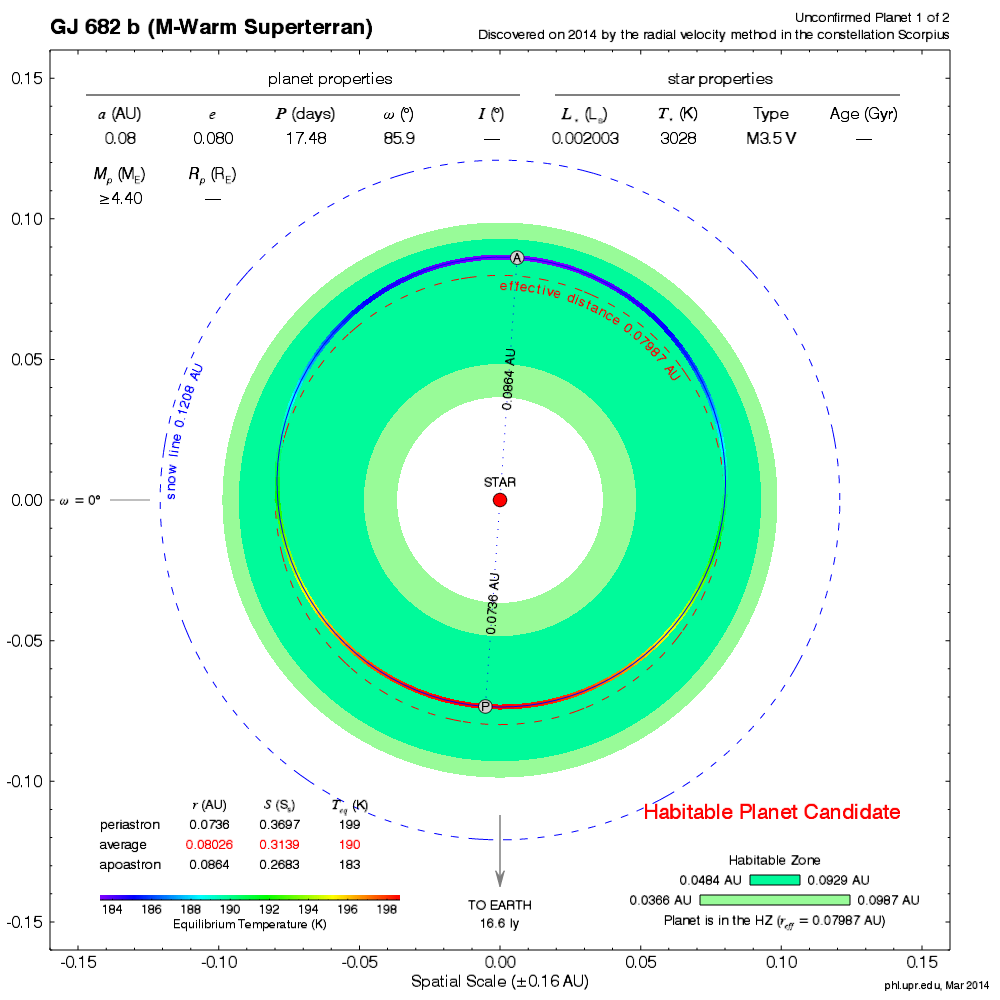
| グリーゼ682b | ≥2 | [6][20][16] | 16 | ||||||
| グリーゼ832c |  |
≥5.4 | 295 K 22 ℃ |
0.162 | 0.03 | [21][22] | 16.16 | ||
| エリダヌス座82番星b | ≥2.7 | 660 K 387 ℃[1] |
0.1207 | 0 | [2] | 19.71 | |||
| エリダヌス座82番星c | ≥2.4 | 508 K 235 ℃[1] |
0.2036 | 0 | [2] | 19.71 | |||
| エリダヌス座82番星d | ≥4.8 | 388 K 115 ℃[1] |
0.3499 | 0 | [2] | 19.71 | |||
| グリーゼ581e |  |
≥1.7 | 0.029 | 0 | [23] | 20 | |||
| グリーゼ581c [24] | .jpg.webp) |
≥5.6 | 0.072 | 0 | [23] | 20 | |||
| グリーゼ581d [25] |  |
≥5.6 | 2.34[26] | 1.27[26] | 233 K -41 ℃[26] |
0.218 | 0 | [23] | 20 |
| HD 219134 b | 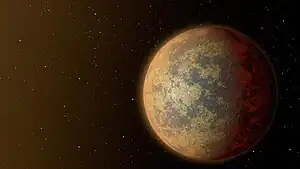 |
4.5 | 1.6 | 700 K 427 ℃ |
[27] | 21 | |||
| グリーゼ667Cb | 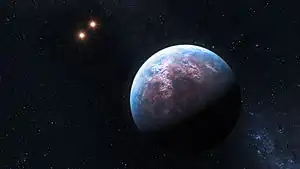 |
6.30 | 1.44 | 445 K 172 ℃ |
0.05 | 0.09 | [26] | 22 | |
| グリーゼ667Cc[28][29] | 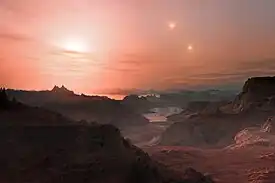 |
3.8 | 1.32 | 302 K 29 ℃ |
0.13 | 0.34 | [26] | 22 | |
| おとめ座61番星b[30] | 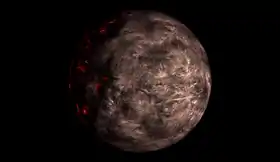 |
≥5.1 | 0.050 | 0.12 | [31] | 28 | |||
| HD 85512 b[32] | .jpg.webp) |
≥3.6 | 1.74[26] | 1.33[26] | 351 K 78 ℃[26] |
0.26 | 0.11 | [33] | 36 |
| グリーゼ180b | ≥2.3 | 312 K 39 ℃ |
[21] | 38 | |||||
| TRAPPIST-1b |  |
[34] | 39.5 | ||||||
| TRAPPIST-1c | 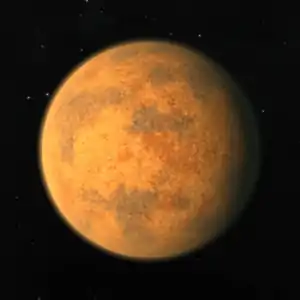 |
[34] | 39.5 | ||||||
| TRAPPIST-1d | 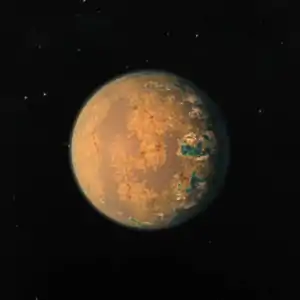 |
282.1 K 9 ℃[26] |
[34] | 39.5 | |||||
| TRAPPIST-1e | 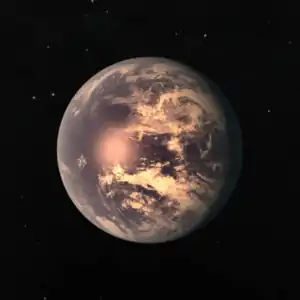 |
246.1 K -27.1 ℃[26] |
[34] | 39.5 | |||||
| TRAPPIST-1f | 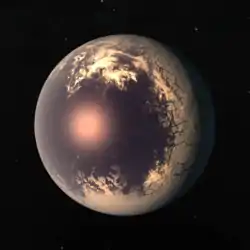 |
219 K -54 ℃[26] |
[34] | 39.5 | |||||
| TRAPPIST-1g | 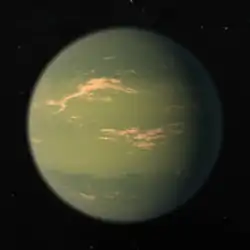 |
198.6 K -75 ℃[26] |
[34] | 39.5 | |||||
| TRAPPIST-1h | 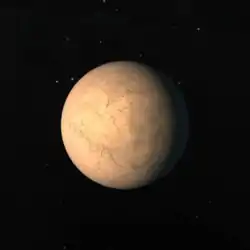 |
169 K -104 ℃[26] |
[34] | 39.5 | |||||
| かに座55番星e | 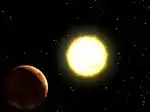 |
8.6 | 0.016 | 0.17 | [35] | 40 | |||
| HD 40307 b[36] | ≥4.2 | 0.047 | 0.2 | [36] | 42 | ||||
| HD 40307 c | ≥6.8 | 0.081 | 0.06 | [36] | 42 | ||||
| HD 40307 d [37] | .jpg.webp) |
≥9.2 | 0.134 | 0.07 | [36] | 42 | |||
| HD 40307 e | ≥3.5 | 0.1886 | 0.15 | [3] | 42 | ||||
| HD 40307 f | ≥5.2 | 385 K 112 ℃ |
0.247 | 0.02 | [3] | 42 | |||
| HD 40307 g | ≥7.1 | 284 K 11 ℃[38] |
0.600 | 0.29 | [3] | 42 |
注: 表のほとんどの惑星の組成についての科学的コンセンサスはない。「メインソース」の情報源は、組成の可能性を裏付ける。
2012年9月、グリーゼ163の周りを周回する2つの惑星を発見した[39]ことが発表された[40][41]。その惑星の1つであるグリーゼ163cは、地球の質量の約6.9倍で、やや暑く、ハビタブルゾーン内にあると考えられていたが、おそらく地球型惑星ではない[40][41]。2016年5月、極低温の矮星TRAPPIST-1の3つの地球のような惑星の発見が発表された。
2022年グリーゼ832cの存在を示す視線速度の変動が主星の恒星活動に由来していることを示す特徴がみられたことから、グリーゼ832cの存在が否定されることとなった。この研究を受けて、NASA Exoplanet Archive はグリーゼ832cの現況を「Confirmed(確認)」から「False Positive Planet(偽陽性)」に格下げし、正式に確認された太陽系外惑星の一覧から除外した。[42]
統計
| 距離 | ハビタブルゾーン内 | 全て |
|---|---|---|
| < 10光年 | 0 (2?) | 2系 |
| < 20光年 | 8 | 17 |
| < 30光年 | 8 | 22 |
| < 40光年 | 10 | 24 |
| < 50光年 | 11 | 31 |
注: ほとんどの場合、系外惑星の大気組成と大気圧は不明なため、表面温度はコンピュータモデルと専門家の意見に基づいて推定される。
脚注
- Pepe, F. et al. (2011), “The HARPS search for Earth-like planets in the habitable zone: I – Very low-mass planets around HD20794, HD85512 and HD192310”, Astronomy & Astrophysics 534: A58, arXiv:1108.3447, Bibcode: 2011A&A...534A..58P, doi:10.1051/0004-6361/201117055
- Schneider, Jean, “Star: HD 20794”, Extrasolar Planets Encyclopaedia (Paris Observatory) 2011年12月5日閲覧。
- Tuomi, Anglada-Escude, Gerlach, Jones, Reiners, Rivera, Vogt, Butler, Mikko, Guillem, Enrico, Hugh R. R., Ansgar, Eugenio J., Steven S., R. Paul; Anglada-Escude, Guillem; Gerlach, Enrico; Jones, Hugh R. R.; Reiners, Ansgar; Rivera, Eugenio J.; Vogt, Steven S.; Paul Butler, R. (2012). “Habitable-zone super-Earth candidate in a six-planet system around the K2.5V star HD 40307”. Astronomy & Astrophysics 549: A48. arXiv:1211.1617v1. Bibcode: 2013A&A...549A..48T. doi:10.1051/0004-6361/201220268.
- “Stars within 50 light years”. 2015年10月3日閲覧。
- “G stars within 100 light-years”. 2015年10月3日閲覧。
- Tuomi, Mikko; Jones, Hugh R. A.; Barnes, John R.; Anglada-Escudé, Guillem; Jenkins, James S. (2014). “Bayesian search for low-mass planets around nearby M dwarfs. Estimates for occurrence rate based on global detectability statistics”. Monthly Notices of the Royal Astronomical Society 441 (2): 1545–1569. arXiv:1403.0430. Bibcode: 2014MNRAS.441.1545T. doi:10.1093/mnras/stu358.
- Overbye, Dennis (2013年11月4日). “Far-Off Planets Like the Earth Dot the Galaxy”. New York Times 2013年11月5日閲覧。
- Petigura, Eric A.; Howard, Andrew W.; Marcy, Geoffrey W. (October 31, 2013). “Prevalence of Earth-size planets orbiting Sun-like stars”. 米国科学アカデミー紀要 110 (48): 19273–19278. arXiv:1311.6806. Bibcode: 2013PNAS..11019273P. doi:10.1073/pnas.1319909110. PMC 3845182. PMID 24191033 2013年11月5日閲覧。.
- Khan, Amina (2013年11月4日). “Milky Way may host billions of Earth-size planets”. Los Angeles Times 2013年11月5日閲覧。
- Anglada-Escudé, Guillem (August 24, 2016). “A terrestrial planet candidate in a temperate orbit around Proxima Centauri”. Nature 536 (7617): 437–40. arXiv:1609.03449. Bibcode: 2016Natur.536..437A. doi:10.1038/nature19106. PMID 27558064.
- “Miniature Space Telescope Could Boost the Hunt for "Earth Proxima"”. Scientific American (2016年7月20日). 2018年11月15日閲覧。
- “The Search for Earth Proxima”. The Atlantic (2016年7月21日). 2018年11月15日閲覧。
- Anglada-Escudé, Guillem; Amado, Pedro J.; Barnes, John; Berdiñas, Zaira M.; Butler, R. Paul; Coleman, Gavin A. L.; de la Cueva, Ignacio; Dreizler, Stefan et al. (25 August 2016). “A terrestrial planet candidate in a temperate orbit around Proxima Centauri” (英語). Nature 536 (7617): 437–440. arXiv:1609.03449. Bibcode: 2016Natur.536..437A. doi:10.1038/nature19106. ISSN 0028-0836. PMID 27558064.
- Bonfils, Xavier et al. (2017). “A temperate exo-Earth around a quiet M dwarf at 3.4 parsecs”. Astronomy and Astrophysics. arXiv:1711.06177. Bibcode: 2018A&A...613A..25B. doi:10.1051/0004-6361/201731973.
- Zechmeister, M.; Dreizler, S.; Ribas, I.; Reiners, A.; Caballero, J. A. (2019). “The CARMENES search for exoplanets around M dwarfs. Two temperate Earth-mass planet candidates around Teegarden's Star”. Astronomy & Astrophysics. arXiv:1906.07196. Bibcode: 2019arXiv190607196Z. doi:10.1051/0004-6361/201935460. ISSN 0004-6361.
- http://phl.upr.edu/projects/habitable-exoplanets-catalog/data
- Fogg, M. J.; Nelson, R. P. (2005). “Oligarchic and giant impact growth of terrestrial planets in the presence of gas giant planet migration”. Astronomy and Astrophysics 441 (2): 791–806. arXiv:astro-ph/0507180. Bibcode: 2005A&A...441..791F. doi:10.1051/0004-6361:20053453.
- Rivera, E. et al. (2005). “A ~7.5 M⊕ Planet Orbiting the Nearby Star, GJ 876”. The Astrophysical Journal 634 (1): 625–640. arXiv:astro-ph/0510508. Bibcode: 2005ApJ...634..625R. doi:10.1086/491669.
- Eugenio J. Rivera, Gregory Laughlin, R. Paul Butler, Steven S. Vogt, Nader Haghighipour, Stefano Meschiari (2010). "The Lick-Carnegie Exoplanet Survey: A Uranus-mass Fourth Planet for GJ 876 in an Extrasolar Laplace Configuration".
- http://www.hpcf.upr.edu/~abel/phl/tuomi/hec_orbit_GJ_682_b.png
- “HEC: Data of Potentially Habitable Worlds - Planetary Habitability Laboratory @ UPR Arecibo”. 2015年10月3日閲覧。
- “A Nearby Super-Earth with the Right Temperature but Extreme Seasons - Planetary Habitability Laboratory @ UPR Arecibo”. 2015年10月3日閲覧。
- Vogt, S. S. (2010). “The Lick-Carnegie Exoplanet Survey: A 3.1 M_Earth Planet in the Habitable Zone of the Nearby M3V Star Gliese 581”. The Astrophysical Journal 723: 954–965. arXiv:1009.5733. Bibcode: 2010ApJ...723..954V. doi:10.1088/0004-637x/723/1/954.
- Valencia; Sasselov, Dimitar D.; O'Connell, Richard J. (2006). “Radius and Structure Models of the First Super-Earth Planet”. The Astrophysical Journal 656 (1): 545–551. arXiv:astro-ph/0610122. Bibcode: 2007ApJ...656..545V. doi:10.1086/509800.
- von Bloh, W.; Bounama, C.; Cuntz, M.; Franck, S. (2007). “The Habitability of Super-Earths in Gliese 581”. Astronomy & Astrophysics 476 (3): 1365–1371. arXiv:0705.3758. Bibcode: 2007A&A...476.1365V. doi:10.1051/0004-6361:20077939.
- The Habitable Exoplanets Catalog. The values are just the best estimates and are subject to change.
- http://phys.org/news/2015-07-astronomers-star-super-earths.html
- Bonfils; Delfosse; Udry; Forveille; Mayor; Perrier; Bouchy; Gillon et al. (2011). “The HARPS search for southern extra-solar planets XXXI. The M-dwarf sample”. Astronomy 549: A109. arXiv:1111.5019. Bibcode: 2013A&A...549A.109B. doi:10.1051/0004-6361/201014704.
- “A Potential Habitable Exoplanet in a Nearby Triple Star System - Planetary Habitability Laboratory @ UPR Arecibo”. 2015年10月3日閲覧。
- Vogt, Steven; Wittenmyer; Paul Butler; Simon O'Toole; Henry; Rivera; Stefano Meschiari; Gregory Laughlin et al. (2009). “A Super-Earth and two Neptunes Orbiting the Nearby Sun-like star 61 Virginis”. The Astrophysical Journal 708: 1366–1375. arXiv:0912.2599v1. Bibcode: 2010ApJ...708.1366V. doi:10.1088/0004-637X/708/2/1366.
- Vogt, Steven (2009). \"A Super-Earth and two Neptunes Orbiting the Nearby Sun-like star 61 Virginis
- Kaltenegger, L; Udry, S; Pepe, F (2011). A Habitable Planet around HD 85512?. 1108. pp. 3561. arXiv:1108.3561. Bibcode: 2011arXiv1108.3561K.
- Kaltenegger, L.; Udry, S.; Pepe, F. (2011). A Habitable Planet around HD 85512?
- Gillon, M; Triaud, AH; Demory, BO; Jehin, E; Agol, E; Deck, KM; Lederer, SM; de Wit, J et al.. “Seven temperate terrestrial planets around the nearby ultracool dwarf star TRAPPIST-1” (PDF). Nature 542: 456–460. arXiv:1703.01424. Bibcode: 2017Natur.542..456G. doi:10.1038/nature21360. PMC 5330437. PMID 28230125.
- Rebekah; et al (2010). “Radial velocity planets de-aliased. A new, short period for Super-Earth 55 Cnc e”. The Astrophysical Journal 722: 937–953. arXiv:1005.4050. Bibcode: 2010ApJ...722..937D. doi:10.1088/0004-637x/722/1/937.
- M. Mayor; S. Udry; C. Lovis; F. Pepe; D. Queloz; W. Benz; J.-L. Bertaux; F. Bouchy et al. (2009). “The HARPS search for southern extra-solar planets. XIII. A planetary system with 3 Super-Earths (4.2, 6.9, & 9.2 Earth masses)”. Astronomy and Astrophysics 493 (2): 639–644. arXiv:0806.4587. Bibcode: 2009A&A...493..639M. doi:10.1051/0004-6361:200810451.
- Barnes, R., Jackson, B., Raymond, S., West, A., Greenberg, R. (2009). “The HD 40307 Planetary System: Super-Earths or Mini-Neptunes?”. The Astrophysical Journal 695 (2): 1006–1011. arXiv:0901.1698. Bibcode: 2009ApJ...695.1006B. doi:10.1088/0004-637X/695/2/1006.
- “HEC: Data of Potential Habitable Worlds”. University of Puerto Rico at Arecibo (Planetary Habitability Laboratory) (2012年11月12日). 2018年11月15日閲覧。
- Staff (2012年9月20日). “LHS 188 -- High proper-motion Star”. Centre de données astronomiques de Strasbourg(Strasbourg astronomical Data Center). 2012年9月20日閲覧。
- Méndez, Abel (2012年8月29日). “A Hot Potential Habitable Exoplanet around Gliese 163”. University of Puerto Rico at Arecibo (Planetary Habitability Laboratory). 2012年9月20日閲覧。
- Redd, Nola Taylor (2012年9月20日). “Newfound Alien Planet a Top Contender to Host Life”. Space.com. 2012年9月20日閲覧。
- “2022 Exoplanet Archive News” (英語). exoplanetarchive.ipac.caltech.edu. 2024年2月25日閲覧。