花虫綱
花虫綱(かちゅうこう、Anthozoa)は刺胞動物門の分類群の一つ。イソギンチャクやサンゴを含む。他の刺胞動物と異なり、その発生段階においてクラゲの時期を経ない。その代わりに、精子と卵子を放出してそれらがプラヌラを形成し、基質に付着して成長する。出芽などにより無性生殖で増えるものもある。
| 花虫綱 | |||||||||
|---|---|---|---|---|---|---|---|---|---|
.jpg.webp) イシサンゴの一種 | |||||||||
| 分類 | |||||||||
| |||||||||
| 学名 | |||||||||
| Anthozoa Ehrenberg, 1831 |
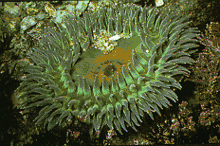
刺胞動物門の動物は、刺胞で食物を捕捉する。イソギンチャクは主に魚、サンゴはプランクトンを餌とする。造礁サンゴなどのように藻類や渦鞭毛藻と共生する種もいる。褐虫藻はホストが排出する窒素化合物や二酸化炭素を得、その代わりにホストは褐虫藻の生産物を取り込み、炭酸カルシウムの生産量を増やすことができる[1]。
イソギンチャクやある種のサンゴは単独で生活するが、多くのサンゴは遺伝的に同一のポリプからなる群体を作る。そのようなポリプは形態的にはイソギンチャクによく似ているが、遙かに小さい。
分類
| |||||||||||||||||||||||||||||||||||||||||||||||||||||||||||||||||||
花虫綱は、八放サンゴ亜綱と六放サンゴ亜綱に分類される。これらは単系統群で、ポリプの構造が8軸または6軸で対称である[4]。かつてはハナギンチャク目も亜綱の1つだと考えられていたが、ハナギンチャク目とツノサンゴ目は、現在では六放サンゴ亜綱に含められている[5]。
- 六放サンゴ亜綱 Hexacorallia
- 八放サンゴ亜綱 Octocorallia
- ウミトサカ目 Alcyonacea
- ウミエラ目 Pennatulacea
- アオサンゴ目 Helioporacea
化石分類群
古生代に広く生息した群として、次の2グループがある[7]。
多くの絶滅したサンゴは、カルシウムの殻の化石によって分類される。現在のイシサンゴ目と似た祖先を持っていると考えられ、5億7000万年前から2億4500万年前の古生代の頃から生息していた[8][9]。 他には次のような分類群がある。
出典
- Contribution to the BUFUS Newsletter, Field excursion to Milne Bay Province - Papua New Guinea, Madl and Yip 2000
- McFadden, Catherine S and France, Scott C and Sánchez, Juan A and Alderslade, Phil (2006). “A molecular phylogenetic analysis of the Octocorallia (Cnidaria: Anthozoa) based on mitochondrial protein-coding sequences”. Molecular phylogenetics and evolution 41 (3): 513-527. doi:10.1016/j.ympev.2006.06.010.
- Rodríguez, Estefanía and Barbeitos, Marcos S and Brugler, Mercer R and Crowley, Louise M and Grajales, Alejandro and Gusmão, Luciana and Häussermann, Verena and Reft, Abigail and Daly, Marymegan (2014). “Hidden among Sea Anemones: The First Comprehensive Phylogenetic Reconstruction of the Order Actiniaria (Cnidaria, Anthozoa, Hexacorallia) Reveals a Novel Group of Hexacorals”. PloS one 9 (5): e96998. doi:10.1371/journal.pone.0096998.
- France, S. C., P. E. Rosel, J. E. Agenbroad, L. S. Mullineaux, and T. D. Kocher (1996). “DNA sequence variation of mitochondrial large-subunit rRNA provides support for a two subclass organization of the Anthozoa (Cnidaria)”. Molecular Marine Biology and Biotechnology 5 (1): 15–28. PMID 8869515.
- Chen, C. A., D. M. Odorico, M. ten Lohuis, J. E. N. Veron, and D. J. Miller (June 1995). “Systematic relationships within the Anthozoa (Cnidaria: Anthozoa) using the 5'-end of the 28S rDNA”. Molecular Phylogeny and Evolution 4 (2): 175–183. doi:10.1006/mpev.1995.1017. PMID 7663762.
- Daly, M.; Brugler, M.P., Cartwright, P., Collins, A.G., Dawson, M.N., Fautin, D.G., France, S.C., McFadden, C.S., Opresko, D.M., Rogriguez, E., Romano, S.L. & Stake, J.L. (2007). “The phylum Cnidaria: A review of phylogenetic patterns and diversity 300 years after Linnaeus”. Zootaxa 1668: 1-766. ISSN 1175-5326.
- http://paleo.cortland.edu/tutorial/Cnidarians/cnidarians.htm
- Oliver, W. A., Jr. (1996). “Origins and relationships of Paleozoic coral groups and the origin of the Scleractinia”. In G. D. J. Stanley (ed.). Paleobiology and Biology of Corals. Columbus, Ohio: The Paleontological Society. pp. 107–134
- Ben Kotrc (2005年). “Anthozoa: Subgroups”. Fossil Groups. University of Bristol. 2009年3月23日閲覧。
This article is issued from Wikipedia. The text is licensed under Creative Commons - Attribution - Sharealike. Additional terms may apply for the media files.