金属水素化物燃料電池
金属水素化物燃料電池とは、金属水素化物を利用した水素貯蔵能力を利用した燃料電池である。
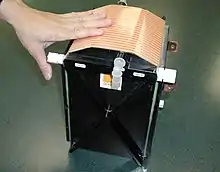
研究開発が進められているアルカリ燃料電池のサブクラスであり[1][2][3][4][5]、稼働中のシステムでのスケールアップに成功した[6][7]。注目すべき特徴は、燃料電池自体の中で化学的に結合して水素を貯蔵する能力である。
類似の事例にニッケル水素電池がある。
反応
充放電の反応式は以下のように表される。
- 正極 :
- 負極 :


負極の反応はニッケル水素電池Ni-MHと全く同じである。一方正極はニッケル水素電池は水酸化ニッケルを含む多孔質ニッケル酸化物を利用するのに対し金属水素化物燃料電池では空気中の酸素を利用する。これにより1000Wh/kgを超える大幅な軽量化・容量増加が期待される[8]。
特性
性能
金属水素化物燃料電池の電極活性領域が60cm2から250cm2にスケールアップされ、システムを500ワットまでスケールアップできるようになった[12]。電極活性領域のスケールアップは、それぞれが1500ワットの出力を持つ、より高出力の燃料電池スタックを開発する能力も提供した[6]。金属水素化物燃料電池は、250mA/cm2の電流密度を達成している[13]。耐久性をテストし、燃料電池スタックは7000時間以上正常に動作した[13]。
稼働中のシステムおよびアプリケーション

製品開発の初期段階では、単一の燃料電池と、複数の電池で構成される燃料電池スタックに焦点が当てられていた。ターゲット アプリケーションには、軍事および商用アプリケーションの重要なバックアップ電源が含まれていた[14]。次の段階は、実験室の外に持ち出せる完全な燃料電池システムを設計および構築することであった。最初の50ワットの実験室ベースのデモンストレーション システムは、より堅牢なパッケージングとインターフェイスを備えた50ワットのポータブル システムに統合された[13]。燃料電池スタックとシステム統合の両方における追加開発は、(インバーターおよび金属水素化物貯蔵キャニスターを使用したオンボード水素貯蔵完備の)1.0kWシステムの運用と公開デモンストレーションを可能にした[6][15]。金属水素化物燃料電池システムのさらなる開発が、兵士の現場での電力需要のために追求され、その結果、配備要件を満たすプロトタイプ システムが完成した[16]。製品開発と並行して、製造およびテスト機能の開発にも重点が置かれた[17]。金属水素化物燃料電池システムは、テストと評価のために軍事基地のマイクログリッド(en)システムに統合されている[18]。挑戦にもかかわらず[19]、軍は、無人航空機、自律型無人潜水機、小型トラック、バス、ウェアラブル技術(en)システムなど、幅広い用途で燃料電池に積極的な関心を維持している[20][21][22][23]。金属水素化物燃料電池システムの開発は、軍用アプリケーション向けに継続されており、オンボード水素生成と最大5.0kWの燃料電池を備えている[24][25]。
脚注
- Chartouni, D.; Kuriyama, N.; Kiyobayashi, T.; Chen, J. (2002-09-01). “Metal hydride fuel cell with intrinsic capacity” (英語). International Journal of Hydrogen Energy 27 (9): 945–952. doi:10.1016/S0360-3199(01)00186-0. ISSN 0360-3199.
- Wang, Chunsheng; Appleby, A. John; Cocke, David L. (2004). “Alkaline Fuel Cell with Intrinsic Energy Storage”. Journal of the Electrochemical Society 151 (2): A260. Bibcode: 2004JElS..151A.260W. doi:10.1149/1.1640627.
- Wang, X.H.; Chen, Y.; Pan, H.G.; Xu, R.G.; Li, S.Q.; L.X., Chen; Chen, C.P.; Wang, Q.D. (20 December 1999). “Electrochemical properties of Ml(NiCoMnCu)5 used as an alkaline fuel cell anode”. Journal of Alloys and Compounds 293-295: 833–837. doi:10.1016/S0925-8388(99)00367-9.
- Tanaka, H.; Kaneki, N.; Hara, H.; Shimada, K.; Takeuchi, T. (April 1986). “La—Ni system porous anode in an alkaline fuel cell”. The Canadian Journal of Chemical Engineering 64 (2): 267–271. doi:10.1002/cjce.5450640216.
- Lee, S.; Kim, J.; Lee, H.; Lee, P.; Lee, J. (29 March 2002). “The Characterization of an Alkaline Fuel Cell That Uses Hydrogen Storage Alloys”. Journal of the Electrochemical Society 149 (5): A603. Bibcode: 2002JElS..149A.603L. doi:10.1149/1.1467365.
- Fok, Kevin; English, Nathan; Privette, Robert; Wang, Hong; Wong, Diana; Lowe, Timothy; Madden, Paul (October 2008). “Powering Up Metal Hydride Fuel Cells for Military Applications”. Fuel Cell Seminar & Exposition 2008 2020年3月22日閲覧。.
- Lototskyy, Mykhaylo; Tolj, Ivan; Pickering, Lydia; Sita, Cordellia; Barbir, Frano; Yartys, Volodymyr (February 2017). “The use of metal hydrides in fuel cell applications”. Progress in Natural Science: Materials International 27 (1): 3–20. doi:10.1016/j.pnsc.2017.01.008.
- 英紀, 射場 (2012). “革新電池における金属水素化物への期待”. 水素エネルギーシステム 37 (4): 354–359. doi:10.50988/hess.37.4_354.
- Ovshinsky, Stanford; Fok, Kevin; Venkatesan, Srinivasan; Corrigan, Dennis (May 2–4, 2005). “Metal Hydride Fuel Cells For UPS And Emergency Power Applications”. BATTCON 2005 International Battery Conference and Trade Show.
- Schwartz, Brian; Fritzsche, Hellmut (28 February 2009). The Science and Technology of an American Genius: Stanford R Ovshinsky. World Scientific Pub Co Inc. ISBN 978-9812818393
- Encyclopedia of electrochemical power sources. Garche, Jürgen., Dyer, Chris K.. Amsterdam: Academic Press. (2009). ISBN 9780444527455. OCLC 656362152
- Fok, Kevin (4 December 2006). “Metal Hydride Fuel Cells, A New and Practical Approach for Backup and Emergency Power Applications”. INTELEC 06 - Twenty-Eighth International Telecommunications Energy Conference: 1–6. doi:10.1109/INTLEC.2006.251656. ISBN 1-4244-0430-4.
- Fok, Kevin (May 2007). “Recent Advances in Metal Hydride Fuel Cell Technology for UPS/Emergency Power Applications”. Battcon Stationary Battery Conference 2020年3月22日閲覧。.
- Materials for fuel cells. Gasik, Michael, 1962-, Institute of Materials, Minerals, and Mining.. Boca Raton: CRC Press. (2008). ISBN 978-1-84569-483-8. OCLC 424570885
- Godula-Jopek, Agata; Jehle, Walter; Wellnitz, Jorg (November 2012). Hydrogen Storage Technologies: New Materials, Transport and Infrastructure. Wiley‐VCH Verlag GmbH & Co. KGaA. doi:10.1002/9783527649921. ISBN 9783527649921
- Lowe, T. D. (2008). “Mobile Fuel Cell Configurations for the U.S. Military”. Ohio Fuel Cell Symposium 2008.
- Energy Technologies, Inc. (2009年12月17日). “Energy Technologies Awarded Third Ohio Third Frontier Fuel Cell Grant for Advanced Research, Development & Commercialization”. Energy Technologies, Inc.. 2020年6月14日閲覧。
- Madden, P. D. (March 23, 2016). “Modular, Scalable, Micro Grid Incorporating Traditional and Renewable Energy Systems”. Microgrid Global Summit 2016.
- “Fuel Cells Fail to Make Inroads With the Military” (英語). www.nationaldefensemagazine.org. 2020年3月24日閲覧。
- “4 Ways Fuel Cells Power Up the U.S. Military” (英語). Energy.gov. 2020年3月24日閲覧。
- “Chevrolet Silverado ZH2 is a Fuel Cell-Powered Heavy-Duty Military Truck” (英語). Automobile (2018年11月7日). 2020年3月25日閲覧。
- Judson, Jen (2017年8月8日). “Hydrogen fuel cell technology could bring stealth to Army vehicles” (英語). Defense News. 2020年3月25日閲覧。
- “Air Force demonstrating hydrogen as alternate fuel source” (英語). U.S. Air Force. 2020年3月25日閲覧。
- “Energy Technologies Inc. - Onsite Hydrogen”. www.onsitehydrogen.com. 2020年6月3日閲覧。
- “Ultimate Fuel Cells”. Ultimate Fuel Cells. Energy Technologies Inc.. 2020年3月22日閲覧。