枝角
枝角(えだつの、Antler)またはアントラーは、シカ科の角である。骨、軟骨、線維組織、皮膚、神経、血管で構成される単一の構造で、一般的にオスにのみに見られる(トナカイ [1]を除く)。枝角は毎年落ちて再成長し、主に性的ディスプレイとして、またハーレムを制御するためのオス間の戦いの武器として用いられる。

構造

枝角はシカに固有のものである。枝角は、角座骨(pedicle)と呼ばれる頭蓋骨の先端から成長する。枝角が成長している間、それはベルベットと呼ばれる血管の多い皮膚で覆われ、成長している骨に酸素と栄養素を供給する[2]。枝角は、動物界で雄の第二次性徴の最も誇張されたケースの1つと見なされており[3]、他の哺乳類の骨よりも速く成長する[4]。成長は先端で起こり、最初は軟骨であり、後に骨組織に置き換わる。枝角がフルサイズに達すると、ベルベットが失われ、枝角の骨が死ぬ。この死んだ骨の構造が成熟した枝角である。ほとんどの場合、根元の骨は破骨細胞によって破壊され、枝角はある時点で脱落する[2]。ほとんどの北極および温帯の種では、枝角の成長と脱落は一年生であり、日光の長さによって制御される。枝角は毎年再成長するが、そのサイズは多くの種で、齢によって異なり、最大サイズに達するまでは数年にわたって毎年増加する。熱帯の種では、枝角は一年中生え換わる可能性があり、サンバーなどの一部の種では、枝角は複数の要因に応じて一年の異なる時期に生え換わる。赤道域に分布する一部のシカは、枝角が生え換わらない。枝角は、支配と性的ディスプレイとして機能し、オス間の闘争の武器として、時には相手に深刻な傷を負わせることもある[4]。
機能
多様性
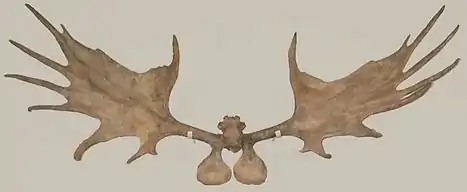
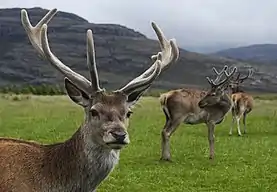
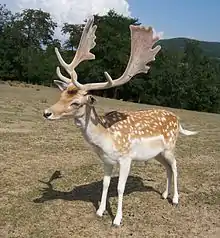
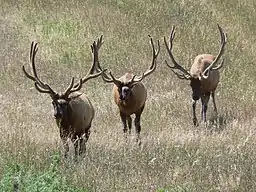
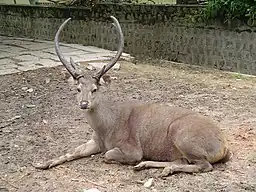
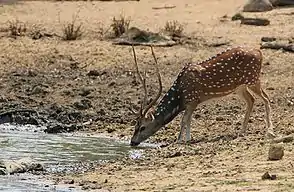
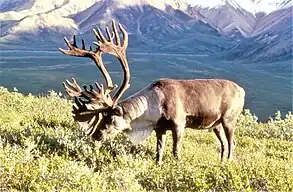
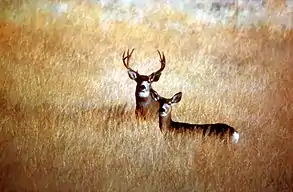
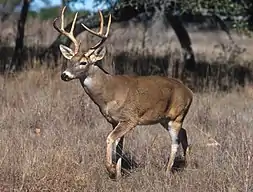
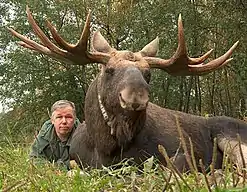
枝の相同性と進化
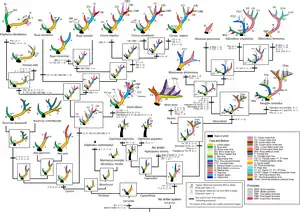
現在発見されている最古の枝角の化石記録は、約1,700万年前の中新世初期である。初期の枝角は小さく、2分岐であった[8] 。枝角が進化するにつれて、長くなり、多くの枝を獲得し、より複雑になっていった[8]。枝の相同性は1900年代以前から議論されている[9][10][11]が、最近、枝の分岐構造と相同性を記述する新たな方法が考案された[12]。
枝角と動物や人間の関わり
- 動物
- 生え落ちた角にはカルシウム、リン、その他のミネラルが含まれているため、リス、ヤマアラシ、ウサギ、マウスなどの小動物が摂取する。特にミネラルが土壌に少ない場所では顕著である[13]。
- 人間
- 生え落ちる角を犬を使って探索したり、餌と網などを使った罠で収集したりする[14]。また、奈良公園では人間や他の鹿に怪我をさせないよう、一年に一度切り落としを行う[15]。それとは別に、トロフィーハンティングとして鹿を仕留めた景品として切り落とされる。
- 人間が手に入れた角は、道具、武器、装飾品、おもちゃを作るための材料とされる[18]。ヨーロッパの後期旧石器時代の歴史資料として発見され、後の時代には象牙の代替品として利用された。
脚注
- “Arctic Wildlife - Arctic Studies Center”. naturalhistory.si.edu. 2018年5月1日時点のオリジナルよりアーカイブ。2018年5月1日閲覧。
- Hall, Brian K. (2005). “Antlers”. Bones and Cartilage: Developmental and Evolutionary Skeletal Biology. Academic Press. pp. 103–114. ISBN 0-12-319060-6 2010年11月8日閲覧。
- Malo, A. F.; Roldan, E. R. S.; Garde, J.; Soler, A. J.; Gomendio, M. (2005). “Antlers honestly advertise sperm production and quality”. Proceedings of the Royal Society B: Biological Sciences 272 (1559): 149–57. doi:10.1098/rspb.2004.2933. PMC 1634960. PMID 15695205.
- Whitaker, John O.; Hamilton, William J., Jr. (1998). Mammals of the Eastern United States. Cornell University Press. p. 517. ISBN 0-8014-3475-0 2010年11月8日閲覧。
- Metz, Matthew C.; Emlen, Douglas J.; Stahler, Daniel R.; MacNulty, Daniel R.; Smith, Douglas W. (2018-09-03). “Predation shapes the evolutionary traits of cervid weapons”. Nature Ecology & Evolution 2 (10): 1619–1625. doi:10.1038/s41559-018-0657-5. PMID 30177803.
- Bubenik, George A.; Bubenik, Peter G. (2008). “Palmated antlers of moose may serve as a parabolic reflector of sounds”. European Journal of Wildlife Research 54 (3): 533–5. doi:10.1007/s10344-007-0165-4.
- Gilbert, Clément; Ropiquet, Anne; Hassanin, Alexandre (2006). “Mitochondrial and nuclear phylogenies of Cervidae (Mammalia, Ruminantia): Systematics, morphology, and biogeography”. Molecular Phylogenetics and Evolution 40 (1): 101–17. doi:10.1016/j.ympev.2006.02.017. PMID 16584894.
- Heckeberg, Nicola S. (2020-02-18). “The systematics of the Cervidae: a total evidence approach” (英語). PeerJ 8: e8114. doi:10.7717/peerj.8114. ISSN 2167-8359. PMC 7034380. PMID 32110477.
- Garrod, A. Notes on the visceral anatomy and osteology of the ruminants, with a suggestion regarding a method of expressing the relations of species by means of formulae. Proceedings of the Zoological Society of London, 2–18 (1877).
- Brooke, V. On the classification of the Cervidæ, with a synopsis of the existing Species. Journal of Zoology 46, 883–928 (1878).
- Pocock, R. The Homologies between the Branches of the Antlers of the Cervidae based on the Theory of Dichotomous Growth. Journal of Zoology 103, 377–406 (1933).
- Samejima, Y., Matsuoka, H. A new viewpoint on antlers reveals the evolutionary history of deer (Cervidae, Mammalia). Sci Rep 10, 8910 (2020). https://doi.org/10.1038/s41598-020-64555-7
- Dennis Walrod (2010). Antlers: A Guide to Collecting, Scoring, Mounting, and Carving. Stackpole Books. p. 46. ISBN 978-0-8117-0596-7
- Dennis Walrod (2010). Antlers: A Guide to Collecting, Scoring, Mounting, and Carving. Stackpole Books. pp. 44–52. ISBN 978-0-8117-0596-7
- 奈良)鹿の角きり始まる 追い込む姿に歓声も 朝日新聞 更新日:2018年10月7日
- Dennis Walrod (2010). Antlers: A Guide to Collecting, Scoring, Mounting, and Carving. Stackpole Books. pp. 46–47. ISBN 978-0-8117-0596-7
- Susan Quinlan (2011年11月18日). “Parks Canada reminds visitors you can look, but don't touch”. Prairie Post West: p. 3. オリジナルの2015年2月6日時点におけるアーカイブ。 2011年12月5日閲覧。
- Bauer, Erwin A.; Bauer, Peggy (2000). Antlers: Nature's Majestic Crown. Voyageur Press. p. 7. ISBN 978-1-61060-343-0
- “Velvet Antler - Research Summary”. www.vitaminsinamerica.com. 2017年10月18日時点のオリジナルよりアーカイブ。2018年5月1日閲覧。
- McCrory, P (2006). “Smelling Salts”. British Journal of Sports Medicine 40 (8): 659–660. doi:10.1136/bjsm.2006.029710. PMC 2579444. PMID 16864561 2009年1月3日閲覧。.