R136
R136はタランチュラ星雲の中心付近にある散開星団である[2]。約100万歳から200万歳と若い星団で[2]、巨星と超巨星から構成されている。その多くはスペクトル型がO3で[2]、39個のO3星が確認されている[2][3]。さらに、ウォルフ・ライエ星もいくつか確認されている[3][4]。
| R136 | ||
|---|---|---|
.jpg.webp) | ||
ハッブル宇宙望遠鏡によるR136 | ||
| 星座 | かじき座 | |
| 見かけの等級 (mv) | 9.50 | |
| 分類 | 散開星団 | |
| 位置 元期:J2000.0 | ||
| 赤経 (RA, α) | 05h 38m 42.396s | |
| 赤緯 (Dec, δ) | −69° 06′ 03.36″ | |
| 距離 | 157 kly 48.5 kpc | |
| 他のカタログでの名称 | ||
| [1] UCAC2 1803442, SAO 249329, HD 38268, TYC 9163-1014-1, CD-69 324, GC 7114 | ||
| ■Template (■ノート ■解説) ■Project | ||
R136星団はいくつかの部分に分けられる[1]。中央部のR136aはかつて太陽の約1500倍の質量、3000万倍の光度を持ち、温度は55000Kから60000K、直径5000万マイルの超巨星であると考えられていた。R136aの真の姿はスペックル・イメージングによって解明され[5]、中心に12個の大質量で高光度の星を含む、濃い密度の星団であることが明らかとなった[6]。これらの恒星の質量は太陽質量の37倍から76倍と計算されている[6]。また3つの非常に明るい恒星(R136a1、R136a2、R136a3)が離角0.10秒、0.48秒で存在する。このうちR136a1は、265太陽質量であると、既知の恒星としては最も重い質量を持つ[7]。また光度は太陽の1000万倍と最も明るい恒星でもある[8]。R136は、タランチュラ星雲のエネルギーのほぼ全てを生産する。星団の質量は推定45万太陽質量で、将来は球状星団になると推測されている[9]。
構成
| 名前 | 赤経 | 赤緯 | 視等級 (V) | 分類 | データベース |
|---|---|---|---|---|---|
| R136a | 05h 38m 43.3s | −69° 06′ 08″ | 星団 | SIMBAD | |
| R136a1 (BAT99 108) | 05h 38m 42.43s | −69° 06′ 02.2″ | 12.77 | WN | SIMBAD |
| R136a2 (BAT99 109) | 05h 38m 42.45s | −69° 06′ 02.2″ | 13.38 | WN | SIMBAD |
| R136a3 (BAT99 106) | 05h 38m 42.291s | −69° 06′ 03.45″ | 12.93 | WN | SIMBAD |
| R136 Ab (SNR B0538-69.2) | 05h 37m 51.6s | −69° 10′ 23″ | 9.59 | SNR | SIMBAD |
| R136 Ac (PSR J0537-6910) | 05h 37m 47.6s | −69° 10′ 20″ | パルサー | SIMBAD | |
| R136b (BAT99 111) | 05h 38m 42.78s | −69° 06′ 03.1″ | 13.66 | WN | SIMBAD |
| R136c (BAT99 112) | 05h 38m 42.896s | −69° 06′ 04.92″ | 12.86 | WN | SIMBAD |
ギャラリー
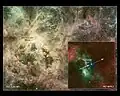 R136からのランナウェイ・スター
関連項目
- ホッジ301, タランチュラ星雲の別の星団
出典
- Simbad data for RMC 136
- Massey, P ; Hunter, D. (January 1998). “Star Formation in R136: A Cluster of O3 Stars Revealed by Hubble Space Telescope Spectroscopy”. The Astrophysical Journal 493 (1): 180. doi:10.1086/306503
- Lebouteiller, V.; Bernard-Salas, J.; Brandl, B.; Whelan, D. G.; Wu, Yanling; Charmandaris, V.; Devost, D.; Houck, J. R. (June 2008). “Chemical Composition and Mixing in Giant H II Regions: NGC 3603, 30 Doradus, and N66”. The Astrophysical Journal 680 (1): 398–419. doi:10.1086/587503
- Melnick, J. (December 1985,). “The 30 Doradus nebula. I - Spectral classification of 69 stars in the central cluster”. Astronomy and Astrophysics 153 (1): 235–244.
- Weigelt, G.; Baier, G. (September 1985). “R136a in the 30 Doradus nebula resolved by holographic speckle interferometry”. Astronomy and Astrophysics 150: L18–L20.
- Koter, Heap, and Hubeny, Alex; Heap, Sara R.; Hubeny, Ivan (1998). “An Empirical Isochrone of Very Massive Stars in R136A”. The Astrophysical Journal 509: 879–896. doi:10.1086/306503.
- Amos, Jonathan (2010年7月21日). “Astronomers detect 'monster star'”. BBC News 2010年7月21日閲覧。
- Chow, Denise (2010年7月21日). “Heftiest Star Discovery Shatters Cosmic Record”. SPACE.com 2010年7月21日閲覧。
- Bosch, Guillermo; Terlevich, Elena; Terlevich, Roberto (2009). “Gemini/GMOS Search for Massive Binaries in the Ionizing Cluster of 30 Dor”. Astronomical Journal 137 (2): 3437–3441. doi:10.1088/0004-6256/137/2/3437.
参考文献
- ESA Hubble, Symphony of colours in the Tarantula, 15 December 2004
- Crowther, P.A.; L.J. Smith (1997). “Fundamental parameters of Wolf-Rayet stars / VI. Large Magellanic Cloud WNL stars”. Astronomy and Astrophysics (Gower Street, London, WC1E 6BT, UK: Department of Physics and Astronomy, University College London) 320: 500–524.
- R 136 in the Aladin previewer
This article is issued from Wikipedia. The text is licensed under Creative Commons - Attribution - Sharealike. Additional terms may apply for the media files.