おうし座10番星
おうし座10番星(おうしざ10ばんせい、10 Tauri、10 Tau)は、おうし座にある恒星である。太陽からの距離が近く、遠赤外線での超過が検出されているので、「系外黄道光」を調べる上で重要な目標天体の一つとなっている[8]。
| おうし座10番星 10 Tauri | ||
|---|---|---|
| 星座 | おうし座 | |
| 見かけの等級 (mv) | 4.29[1] | |
| 位置 元期:J2000.0 | ||
| 赤経 (RA, α) | 03h 36m 52.1448022536s[2] | |
| 赤緯 (Dec, δ) | +00° 23′ 58.536917738″[2] | |
| 視線速度 (Rv) | 27.87 ± 0.09 km/s[2] | |
| 固有運動 (μ) | 赤経: -232.60 ± 0.59 ミリ秒/年[2] 赤緯: -481.92 ± 0.54 ミリ秒/年[2] | |
| 年周視差 (π) | 71.62 ± 0.54ミリ秒[2] (誤差0.8%) | |
| 距離 | 45.5 ± 0.3 光年[注 1] (14 ± 0.1 パーセク[注 1]) | |
| 絶対等級 (MV) | 3.7[注 2] | |
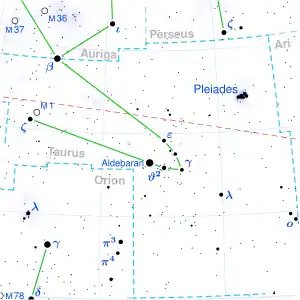  | ||
おうし座10番星の位置(丸印)
| ||
| 物理的性質 | ||
| 半径 | 1.622 ± 0.024 R☉[3] | |
| 質量 | 1.139 ± 0.016 M☉[3] | |
| 表面重力 | 16 G[4][注 3] | |
| 自転速度 | 4.4 km/s[5] | |
| 自転周期 | 18.0 日[6] | |
| スペクトル分類 | F9 IV-V[2] | |
| 光度 | 3.042 ± 0.042 L☉[3] | |
| 表面温度 | 5,997 ± 44 K[3] | |
| 色指数 (B-V) | 0.575[1] | |
| 色指数 (V-I) | 0.66[1] | |
| 金属量[Fe/H] | -0.09[3] | |
| 年齢 | 6.7 ×10⁹ 年[7] | |
| 他のカタログでの名称 | ||
| LHS 1569, BD-00 572, FK5 1101, GJ 147, HD 22484, HIP 16852, HR 1101, IRC +00047, SAO 111292[2] | ||
| ■Template (■ノート ■解説) ■Project | ||
特徴
おうし座10番星は、見かけの等級が4.29で、肉眼でみることができる[1]。年周視差の測定から計算した太陽からの距離は、約45.5光年である。視線速度は約28km/sで、太陽からは遠ざかっており、距離が近いこともあって固有運動は大きい[2]。
| 太陽 | おうし座10番星 |
|---|---|
 |
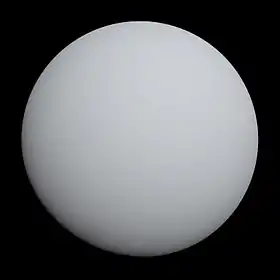 |
おうし座10番星は、F型の主系列星または準巨星で、スペクトル型はF9 IV-Vと分類される[2]。質量は太陽の1.14倍、半径は太陽の1.6倍と推定される。光度は太陽の3倍程度で、表面温度は約5,997Kと推定される[3]。年齢はおよそ67億年、自転周期は18日とみられる[7][6]。
おうし座10番星では、IRAS、赤外線宇宙天文台、スピッツァー宇宙望遠鏡、ハーシェル宇宙天文台の観測で、遠赤外線での赤外超過が検出されている[9][7]。視線速度の安定性から、赤外線源は低温の伴天体とは考えられず、周囲に残骸円盤が存在するものと考えられる[10][11]。
その他
おうし座10番星は、現存しない星座のジョージのこと座に含まれており、ジョージのこと座を設定したヘルやボーデは、ジョージのこと座γ星としていた。おうし座10番星は、ジョージのこと座中で最も明るく見える恒星だった[12]。
日本ではおうし座10番星は、渋川春海が設定した「大炊」という星座を、くじら座94番星、エリダヌス座17番星、エリダヌス座22番星、エリダヌス座30番星、エリダヌス座32番星、おうし座ν星、おうし座30番星と共に形成する[13]。
脚注
注釈
- パーセクは1 ÷ 年周視差(秒)より計算、光年は1÷年周視差(秒)×3.2615638より計算
- 視等級 + 5 + 5×log(年周視差(秒))より計算。小数第1位まで表記
- 出典での表記は、
![{\displaystyle \log g[{\mbox{cgs}}]=4.19}](../I/020c9b72292a73fe51d7fec6c18c0d754379d3ad.svg)
出典
- ESA (1997), The HIPPARCOS and TYCHO catalogues. Astrometric and photometric star catalogues derived from the ESA HIPPARCOS Space Astrometry Mission, ESA SP Series, 1200, Noordwijk, Netherlands: ESA Publications Division, Bibcode: 1997ESASP1200.....E, ISBN 9290923997
- “10 Tau -- High proper-motion Star”. SIMBAD. CDS. 2019年8月21日閲覧。
- Boyajian, Tabetha S.; et al. (2012-02), “Stellar Diameters and Temperatures. I. Main-sequence A, F, and G Stars”, Astrophysical Journal 746 (1): 101, arXiv:1112.3316, Bibcode: 2012ApJ...746..101B, doi:10.1088/0004-637X/746/1/101
- Schröder, C.; Reiners, A.; Schmitt, J. H. M. M. (2009-01), “Ca II HK emission in rapidly rotating stars. Evidence for an onset of the solar-type dynamo”, Astronomy & Astrophysics 493 (3): 1099-1107, Bibcode: 2009A&A...493.1099S, doi:10.1051/0004-6361:200810377
- Vican, Laura (2012-06), “Age Determination for 346 Nearby Stars in the Herschel DEBRIS Survey”, Astronomical Journal 143 (6): 135, Bibcode: 2012AJ....143..135V, doi:10.1088/0004-6256/143/6/135
- Wright, J. T.; et al. (2004-06), “Chromospheric Ca II Emission in Nearby F, G, K, and M Stars”, Astrophysical Journal Supplement Series 152 (2): 261-295, Bibcode: 2004ApJS..152..261W, doi:10.1086/386283
- Gáspár, András; Rieke, George H.; Balog, Zoltán (2013-05), “The Collisional Evolution of Debris Disks”, Astrophysical Journal 768 (1): 25, Bibcode: 2013ApJ...768...25G, doi:10.1088/0004-637X/768/1/25
- “Exo-zodiacal Key Science Targets”. NExScI. ipac. 2019年8月31日閲覧。
- Greaves, J. S.; Fischer, D. A.; Wyatt, M. C. (2006-02), “Metallicity, debris discs and planets”, Monthly Notices of the Royal Astronomical Society 366 (1): 283-286, Bibcode: 2006MNRAS.366..283G, doi:10.1111/j.1365-2966.2005.09848.x
- Absil, O.; et al. (2013-07), “A near-infrared interferometric survey of debris-disc stars. III. First statistics based on 42 stars observed with CHARA/FLUOR”, Astronomy & Astrophysics 555: A104, Bibcode: 2013A&A...555A.104A, doi:10.1051/0004-6361/201321673
- Rojas, Madelaine; et al. (2013-12), “Analysis of the Chemical Composition of the Atmospheres of Stars with Debris Disks and Planetary Systems”, Astrophysics 56 (4): 461-471, Bibcode: 2013Ap.....56..461R, doi:10.1007/s10511-013-9300-y
- Ridpath, Ian. “Harpa Georgii”. Star Tales. 2019年8月31日閲覧。
- 鈴木, 駿太郎『新装版 星の事典』恒星社厚生閣、1988年12月5日、226-227,244-245頁。ISBN 4-7699-0631-5。
関連項目
外部リンク
This article is issued from Wikipedia. The text is licensed under Creative Commons - Attribution - Sharealike. Additional terms may apply for the media files.