さいだん座イータ星
さいだん座η星(さいだんざイータせい、η Arae、η Ara)は、さいだん座の恒星である。太陽系からはおよそ300光年の距離にあり、見かけの等級は肉眼でみえる3.77等である[2][1]。
| さいだん座η星 η Arae | ||
|---|---|---|
| 星座 | さいだん座 | |
| 見かけの等級 (mv) | 3.77[1] | |
| 位置 元期:J2000.0 | ||
| 赤経 (RA, α) | 16h 49m 47.1565275s[2] | |
| 赤緯 (Dec, δ) | −59° 02′ 28.957499″[2] | |
| 視線速度 (Rv) | 9.00 km/s[3] | |
| 固有運動 (μ) | 赤経: 39.73 ミリ秒/年[2] 赤緯: -24.91 ミリ秒/年[2] | |
| 年周視差 (π) | 10.90 ± 0.20ミリ秒[2] (誤差1.8%) | |
| 距離 | 299 ± 5 光年[注 1] (92 ± 2 パーセク[注 1]) | |
| 絶対等級 (MV) | -1.0[注 2] | |
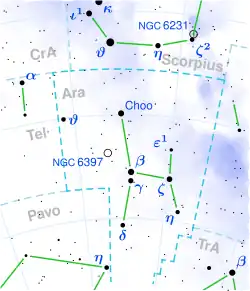  | ||
さいだん座η星の位置(丸印)
| ||
| 物理的性質 | ||
| 半径 | 40.44 ± 2.62 R☉[3] | |
| 質量 | 1.12 ± 0.16 M☉[3] | |
| 表面重力 | 0.011 G[3][注 3] | |
| 自転速度 | 1.55 ± 0.55 km/s[3] | |
| スペクトル分類 | K5 III[1] | |
| 光度 | 575 +133 −107 L☉[3] | |
| 表面温度 | 4,147 ± 29 K[3] | |
| 色指数 (B-V) | 1.562[1] | |
| 色指数 (V-I) | 1.67[1] | |
| 金属量[Fe/H] | -0.47 ± 0.03(太陽比)[3] | |
| 年齢 | 4.98 ± 1.86 ×10⁹ 年[3] | |
| 他のカタログでの名称 | ||
| CPD-58 6906, FK5 1435, HD 151249, HIP 82363, HR 6229, SAO 244168[2] | ||
| ■Template (■ノート ■解説) ■Project | ||
特徴
さいだん座η星は、スペクトル型がK5 IIIに分類される橙色巨星で、年齢はおよそ50億年と推定される[1][3]。質量は太陽の1.12倍程度だが、半径は太陽のおよそ40倍に達するとみられる。自転はとてもゆっくりで、自転速度は1-2km/s程度である[3]。光度は太陽の575倍程度、表面温度は4,147K程度で、橙色のK型星であることと合致する[3][4]。
さいだん座η星の視線速度は9km/sで、この速さで太陽から遠ざかっている[3]。一方で、さいだん座η星の視線速度は時間によって変動しており、その幅は300m/s近くと、とても大きい[5]。また、視線速度の変化と連動して、彩層の活動も変化する様子が捉えられている。そのため、さいだん座η星には伴星が存在し、その重力によって、視線速度はふらつき、彩層活動が誘発されているのではないかという説もあるが、他に伴星の存在を支持する証拠はなく、単独星とみなされている[6][5][7]。
名称
中国では、さいだん座η星は龜(拼音: )という星官を、さいだん座ε1星、さいだん座γ星、さいだん座δ星、さいだん座ζ星と共に形成する。さいだん座η星自身は龜四、つまり亀の4番星と呼ばれる[8]。
脚注
注釈
- パーセクは1 ÷ 年周視差(秒)より計算、光年は1÷年周視差(秒)×3.2615638より計算
- 視等級 + 5 + 5×log(年周視差(秒))より計算。小数第1位まで表記
- 出典での表記は、
![{\displaystyle \log g[{\mbox{cgs}}]=1.05}](../I/135b6523a07a2bc4e33a4c21c7d37b3d374f0005.svg)
出典
- ESA (1997), The HIPPARCOS and TYCHO catalogues. Astrometric and photometric star catalogues derived from the ESA HIPPARCOS Space Astrometry Mission, ESA SP Series, 1200, Noordwijk, Netherlands: ESA Publications Division, Bibcode: 1997ESASP1200.....E, ISBN 9290923997
- “eta Ara -- Star”. SIMBAD. CDS. 2020年4月7日閲覧。
- Jofré, E.; et al. (2015-02), “Stellar parameters and chemical abundances of 223 evolved stars with and without planets”, Astronomy & Astrophysics 574: A50, Bibcode: 2015A&A...574A..50J, doi:10.1051/0004-6361/201424474
- “The Colour of Stars”. Australia Telescope National Facility. Commonwealth Scientific and Industrial Research Organisation. 2020年4月9日閲覧。
- Setiawan, J.; et al. (2004-07), “Precise radial velocity measurements of G and K giants. Multiple systems and variability trend along the Red Giant Branch”, Astronomy & Astrophysics 421: 241-254, Bibcode: 2004A&A...421..241S, doi:10.1051/0004-6361:20041042-1
- Setiawan, J.; et al. (2005-03), “Chromospheric activity of red giants”, Proceedings of the 13th Cambridge Workshop on Cool Stars, Stellar Systems and the Sun, European Space Agency, pp. 963-966, Bibcode: 2005ESASP.560..963S
- Eggleton, P. P.; Tokovinin, A. A. (2008-09), “A catalogue of multiplicity among bright stellar systems”, Monthly Notices of the Royal Astronomical Society 389 (2): 869-879, Bibcode: 2008MNRAS.389..869E, doi:10.1111/j.1365-2966.2008.13596.x
- “中國古代的星象系統 (62): 尾宿天區與箕宿天區” (中国語). AEEA 天文教育資訊網. 國立自然科學博物館 (2006年7月1日). 2020年4月19日閲覧。
関連項目
外部リンク
This article is issued from Wikipedia. The text is licensed under Creative Commons - Attribution - Sharealike. Additional terms may apply for the media files.