ふうちょう座アルファ星
ふうちょう座α星(ふうちょうざアルファせい、α Apodis / α Aps)は、ふうちょう座で最も明るい恒星であり4等星[4]。
| ふうちょう座α星[1] Alpha Apodis | ||
|---|---|---|
| 星座 | ふうちょう座 | |
| 見かけの等級 (mv) | 3.798[1] | |
| 分類 | 橙色巨星[1] | |
| 位置 元期:J2000.0 | ||
| 赤経 (RA, α) | 14h 47m 51.7120247s[1] | |
| 赤緯 (Dec, δ) | −79° 02′ 41.103245″[1] | |
| 固有運動 (μ) | 赤経: -4.58 ± 0.11ミリ秒/年[1] 赤緯: -15.88 ± 0.14ミリ秒/年[1] | |
| 年周視差 (π) | 7.30 ± 0.13ミリ秒[1] (誤差1.8%) | |
| 距離 | 447 ± 8 光年[注 1] (137 ± 2 パーセク[注 1]) | |
| 絶対等級 (MV) | -1.9[注 2] | |
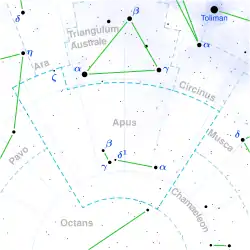  | ||
α星の位置
| ||
| 物理的性質 | ||
| 半径 | 48 R☉[2][3] | |
| スペクトル分類 | K3III [1] | |
| 光度 | 910 L☉[4] | |
| 表面温度 | 4,256 K[4] | |
| 色指数 (B-V) | +1.43[5] | |
| 色指数 (U-B) | +1.68[5] | |
| 色指数 (R-I) | +0.53[5] | |
| 他のカタログでの名称 | ||
| alf Aps, FK5 542[1], GSC 09436-02393, HD 129078[1], HIP 72370[1], HR 5470[1], SAO 257193[1], TYC 9436-2393-1[1] | ||
| ■Template (■ノート ■解説) ■Project | ||
名称
ふうちょう座という星座の名前はもともとApis Indica(インドのみつばち座)という名前だったが、誤植によりAvisやApusとなり、結果としてApusとなった[6]。αというのはバイエル命名法にもとづく名称である。
中国語ではふうちょう座α星は異雀(Yì Què)というアステリズムを形成している。ふうちょう座α星の他、ふうちょう座ζ星、ふうちょう座ι星、ふうちょう座β星、ふうちょう座γ星、はちぶんぎ座δ星、ふうちょう座δ1星、ふうちょう座η星、ふうちょう座ε星と共に形成している。ふうちょう座α星自身は異雀八 (Yì Què bā)といわれる[7]。
特徴
ふうちょう座α星は赤緯が約-79°であるため、南極の周極星である。天球ではケンタウルス座α星とコンパス座α星を結んだ直線上にある[8]。
ふうちょう座α星は巨星に分類され、スペクトル分類ではK3IIIで表される。つまり、この恒星は中心の核で水素の核融合反応を起こし、主系列星から進化したということである。推定ではこの恒星の半径は太陽の48倍、光度は太陽の980倍である。光球の有効温度は4256K(3983℃)でありウィーンの変位則からその放射する波長を求めると約680nmであり、オレンジ色で、スペクトルはK型を示す[9]。年周視差の測定によるとこの恒星は地球から約450光年ある[1]。今のところ伴星は見つかっていない[10]。
脚注
注釈
- パーセクは1 ÷ 年周視差(秒)より計算、光年は1÷年周視差(秒)×3.2615638より計算
- 視等級 + 5 + 5×log(年周視差(秒))より計算。小数第1位まで表記
出典
- “SIMBAD Astronomical Database”. Results for alf Aps. 2019年12月23日閲覧。
- HD 129078, database entry, Catalog of Apparent Diameters and Absolute Radii of Stars (CADARS), 3rd edition, L. E. Pasinetti-Fracassini, L. Pastori, S. Covino, and A. Pozzi, Centre de Données astronomiques de Strasbourg ID II/224. 2019年12月23日閲覧。
- Pasinetti Fracassini, L. E. et al. (February 2001), “Catalogue of Apparent Diameters and Absolute Radii of Stars (CADARS)”, Astronomy and Astrophysics 367: 521–524, arXiv:astro-ph/0012289, Bibcode: 2001A&A...367..521P, doi:10.1051/0004-6361:20000451
- Kaler, Jim. “Alpha Aps”. Stars. 2019年12月23日閲覧。
- HR 5470, database entry, 輝星星表第5版 (Preliminary Version), D. Hoffleit and W. H. Warren, Jr., Centre de Données astronomiques de Strasbourg ID V/50 2019年12月23日閲覧。
- Ridpath, Ian, “Apus, the bird of paradise”, Ian Ridpath's Star Tales 2019年12月23日閲覧。
- (中国語) AEEA (Activities of Exhibition and Education in Astronomy) 天文教育資訊網 2006年7月29日
- Moore, Patrick (2000), Exploring the night sky with binoculars (4th ed.), ケンブリッジ大学出版局, p. 113, ISBN 0-521-79390-4
- “The Colour of Stars”, Australia Telescope, Outreach and Education (Commonwealth Scientific and Industrial Research Organisation), (December 21, 2004), オリジナルの2012-02-22時点におけるアーカイブ。 2019年12月23日閲覧。.
- Eggleton, P. P.; Tokovinin, A. A. (September 2008), “A catalogue of multiplicity among bright stellar systems”, Monthly Notices of the Royal Astronomical Society 389 (2): 869–879, arXiv:0806.2878, Bibcode: 2008MNRAS.389..869E, doi:10.1111/j.1365-2966.2008.13596.x
外部リンク
This article is issued from Wikipedia. The text is licensed under Creative Commons - Attribution - Sharealike. Additional terms may apply for the media files.