エンテロバクチン
エンテロバクチン(Enterobactin、Enterochelin)とは、シデロホアの一種である有機化合物である。主にEscherichia coli やSalmonella typhimurium といったグラム陰性細菌から産生・分泌されることが見出される[1]。
| エンテロバクチン | |
|---|---|
 | |
N,N',N''-((3S,7S,11S)-2,6,10- trioxo-1,5,9-trioxacyclododecane- 3,7,11-triyl)tris(2,3-dihydroxybenzamide) | |
| 識別情報 | |
| CAS登録番号 | 28384-96-5  |
| PubChem | 34231 |
| ChemSpider | 31543 |
| ChEBI | |
| ChEMBL | CHEMBL432995 |
| |
| |
| 特性 | |
| 化学式 | C30H27N3O15 |
| モル質量 | 669.55 g/mol |
| 特記なき場合、データは常温 (25 °C)・常圧 (100 kPa) におけるものである。 | |
エンテロバクチンはシデロホアの中でも特に第三鉄(Fe3+)への化学親和性が強力であることが知られている(K = 1052 M−1)[2]。この解離定数の値は、EDTA (Kf,Fe3+ ~ 1025 M−1)のといった他の大多数の金属キレート剤のものより大きい[3]。このシデロホアを用いる病原菌は、たとえ低濃度であっても宿主細胞や環境中から生育に必須な鉄を獲得することができる。エンテロバクチンの鉄との錯体はFeEntと表記する。
生合成経路
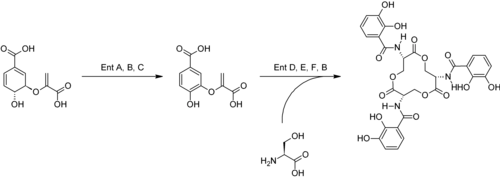
生合成経路としてまず、芳香族アミノ酸の前駆体であるコリスミ酸は一群の酵素(EntA、EntB、およびEntC)によって2,3-ジヒドロキシ安息香酸(DHB)に変換される。このとき、EntD、EntE、EntF、およびEntBによってDHBのアミド基でのL-セリンへの架橋は触媒される。3つのDHB-セリンはそれぞれ分子内環化され、エンテロバクチンとなる[4]。セリンのキラリティーによりエンテロバクチンには相当数の立体異性体が生まれるが、活性があるのはΔ-cis異性体のみである[3] 。
作用機序
エンテロバクチンは細胞中の鉄濃度が飢餓状態にまで下がった時に細胞外の環境中へと分泌される。そして、環境中で鉄と配位結合し、FeEntは細胞内へと戻り鉄を供給する。Escherichia coli においては、外膜上の輸送体FepAがFeEntを取り込む入り口となる。外膜からペリプラズムに渡ったFeEntは内膜上のABC輸送体のFepB、C、D、およびGを通して細胞質へと輸送される[4]。
エンテロバクチンと鉄との結合は非常に強固であるため、FeEntから鉄を取り出すためには鉄エンテロバクチンエステラーゼによってFeEntが切断される必要がある。分解産物は3個の2,3-ジヒドロキシベンゾイル-L-セリンである。この切断に伴って鉄の還元(Fe3+ → Fe2+)が起こる[5]。Fe3+/Fe2+–エンテロバクチン複合体の還元電位はpHに依存する。pH6で−0.57 V (vs NHE)、pH7.4で−0.79 V、pH10.4以上で−0.99 Vである[6]。
脚注
- Dertz, Emily A., Jide Xu, Alain Stintzi, and Kenneth N. Raymond (2006). “Bacillibactin-Mediated Iron Transport in Bacillus Subtilis”. J. Am. Chem. Soc. 128 (1): 22–23. doi:10.1021/ja055898c. PMID 16390102.CS1 maint: Multiple names: authors list (link)
- Carrano, Carl J. (1979). “Ferric Ion Sequestering Agents. 2. Kinetics and Mechanism of Iron Removal From Transferrin by Enterobactin and Synthetic Tricatechols”. J. Am. Chem. Soc. 101 (18): 5401–5404. doi:10.1021/ja00512a047.
- Walsh, Christopher T., Jun Liu, Frank Rusnak, and Masahiro Sakaitani (1990). “Molecular Studies on Enzymes in Chorismate Metabolism and the Enterobactin Biosynthetic Pathway”. Chemical Reviews 90 (7): 1105–1129. doi:10.1021/cr00105a003.
- Raymond, Kenneth N. (2003). “Enterobactin: An archetype for microbial iron transport”. Proc. Natl. Acad. Sci. 100 (7): 3584–3588. doi:10.1073/pnas.0630018100. PMC 152965. PMID 12655062.
- Ward, Thomas R. (1999). “An Iron-Based Molecular Redox Switch as a Model for Iron Release From Enterobactin Via the Salicylate Binding Mode”. Inorg. Chem. 38 (22): 5007–5017. doi:10.1021/ic990225e. PMID 11671244.
- Lee, Chi Woo (1985). “Coordination chemistry of microbial iron transport compounds. 34. The pH-dependent reduction of ferric enterobactin probed by electrochemical methods and its implications for microbial iron transport”. J. Am. Chem. Soc. 107 (24): 6920–6923. doi:10.1021/ja00310a030.
- I. G. O'Brien (1970). “Biologically active compounds containing 2,3-dihydroxybenzoic acid and serine formed by Escherichia coli”. Biochim Biophys Acta 201 (3): 453–60. doi:10.1016/0304-4165(70)90165-0. PMID 4908639.
- J.R. Pollack, J.B. Neilands, Enterobactin (12 March 1970). “an iron transport compound from Salmonella typhimurium”. Biochemical and Biophysical Research Communications 38 (5): 989-992. doi:10.1016/0006-291X(70)90819-3.