ギンピ・ギンピ
ギンピ・ギンピ(英語: Gympie gympie; 学名:Dendrocnide moroides)は、イラクサ科に属する被子植物の一種である。この他にも、ギンピ(英語: Gympie)[1]、スティンギング・ブラッシュ (英語: stinging brush)[1]、ギンピ・スティンガー(英語: Gympie stinger)[1]、マルベリー=リーヴド・スティンガー(英語: Mulberry-leaved stinger)[1]や、単にスティンガー(英語: Stinger)、ザ・スーサイド・プラント(英語: The suicide plant)、ムーンライター(英語: Moonlighter)とも呼ばれる。
| ギンピ・ギンピ | |||||||||||||||||||||
|---|---|---|---|---|---|---|---|---|---|---|---|---|---|---|---|---|---|---|---|---|---|
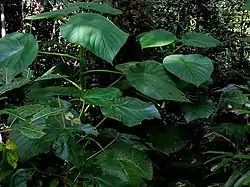 ギンピ・ギンピ | |||||||||||||||||||||
| 分類(APG III) | |||||||||||||||||||||
| |||||||||||||||||||||
| 学名 | |||||||||||||||||||||
| Dendrocnide moroides (Wedd.) Chew | |||||||||||||||||||||
| シノニム | |||||||||||||||||||||
| 英名 | |||||||||||||||||||||
| gympie gympie[1], stinging brush[1], gympie stinger[1], mulberry-leaved stinger[1], gympie[1] |
生態
オーストラリア北東部の熱帯雨林に自生する[2][3][4]。英名に含まれるスティンガー(英語: stinger、「刺すもの」の意)に表されているように全体を刺毛が覆っており、この刺毛に触れたものに人間にも有毒な神経毒を送り込む。オーストラリアに自生するイラノキ属(学名:Dendrocnide)の中で最も毒性の強い植物である[2][4]。ただし果実は表面の刺毛を除去すれば食用にできる[5]。
ギンピ・ギンピが、イラノキ属(学名:Dendrocnide)の中で特異なのは、雌雄同株の花序を持つ点であり、少数の雄花とそれを取り囲むように雌花が生える[4]。花は小さく、受粉すると果実をつけるために膨らむ。
ギンピ・ギンピは、熱帯雨林の境界部分で早くから群落形成を行う種である。これはギンピ・ギンピの種が土壌撹拌の後、太陽光を浴びる場所で発芽するためである[6]。クイーンズランド州(オーストラリア)では比較的一般的な種であるが、オーストラリア南部では希であり、ニューサウスウェールズ州では絶滅危惧種に指定されている[3][7]。
Dendrocnide excelsaとDendrocnide photinophyllaは、本種と同じ、もしくは似た名前で呼ばれる[注釈 1][注釈 2]。これらは本種と同じオーストラリアに自生し同じイラクサ科に属するが、本種と異なり高木となる。
毒性

葉や枝に触れると、中空の二酸化ケイ素の尖端を持つ毛が皮膚を突き刺す。この刺毛は忌まわしい程の苦痛を与える。アーニー・ライダー (Ernie Rider)は、1963年にこの植物の葉で顔と胴を負傷したが、その苦しみについて、彼は「2から3日間、その痛みはほぼ耐えられないほどのものであった。私は働くことも眠ることもできず、2週間かそれ以上もひどい痛みに襲われた。この苦痛は2年間もの間続き、冷たいシャワーを浴びた時には、いまだに毎回痛みに襲われる。これに匹敵するものはない。他の痛みと比べても10倍以上は酷いものだ」と述べている[8]。
初期の研究では、ヒスタミン、アセチルコリン、5-ヒドロキシトリプタミン、ギ酸といった様々な化合物が原因物質であることが示唆された。しかしながら、これらの化合物はいずれも植物の刺毛によって引き起こされるのと同等の強さや長さの痛みを生み出さないことが分かった[9][10][11][12]。1970年頃、新規化合物が同定され、モロイジンと命名された。モロイジンはトリプトファンとヒスチジンが希なC-N結合で繋がった二環式オクタペプチドである。しばらくの間はモロイジンが痛みの原因物質であるだろうと考えられていた。しかし、後の研究で、純粋なモロイジンの痛み誘導効果はそれほど強烈ではないことが示された[13][10][14]。むしろモロジンはチューブリンの重合を阻害して有糸分裂阻害活性を示す。
2020年に刺毛に特異的に局在する主要な痛み誘導物質として、クモやイモガイの毒素に似た分子量約4 kDaの小タンパク質が発見され、ギンピエチド(gympietide)類と命名された[10][15][14]。ギンピエチド類はジスルフィドに富む構造を持つ。これらの小タンパク質は実験室での試験において著しい痛み応答を生み出すことが示された。ギンピエチド類はインヒビターシスチンノットに似た複雑な構造を持ち安定性が高く、このことが痛みが長時間持続する理由と考えられる[10][15][14]。
刺毛はアカアシヤブワラビーを含む数種類の小型有袋類や、虫、鳥類には効果を発揮せず、葉を食べられてしまう[16]。
2006年には、刺毛は持つものの触っても痛みをもたらさない個体が発見された[12]。
逸話
有名なものとしては葉をトイレットペーパー代わりに利用するものがあるが、そもそも手で取った時点で刺されており、意図的に用いることはなかったであろうということから単なるほら話として扱われる[17]。しかしながら、馬が刺された後に休む必要があった、さらには暴れまわり射殺する必要があったというような記録は残っている[9]。ギンピ・ギンピ自体による死亡例は知られておらず、同属のD. cordataによる死亡例が1922年のニューギニアから知られるのみである[17]。
治療
刺毛に触れてしまった場合の推奨される治療法として、10倍に希釈した塩酸の塗布[18]とワックス脱毛による刺毛の除去が挙げられる[19][20]。もしそれらが不可能であれば、粘着テープかピンセット、もしくはその両方による刺毛の除去が行われる。この際に刺毛を破壊しないよう注意が必要で、もし刺毛の破片が体内に残った場合、激痛のさらなる悪化を招いてしまう。
ギャラリー
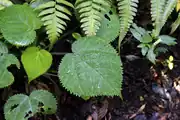 ギンピ・ギンピの葉
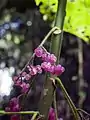 ギンピ・ギンピの実
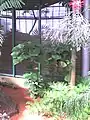 ギンピ・ギンピの全体写真
注釈
- Dendrocnide excelsaは、ギンピ・ギンピ(英語: Gimpi gimpi:本種とは綴りが異なる)、ギンピ(英語: Gympie)と呼ばれる。この他にもオーストラリアン・ネトルツリー(英語: Australian nettle tree)、ファイバーウッド(英語: Fibrewood)、ジャイアント・スティンギング・ツリー(英語: Giant stinging tree)とも呼ばれる。
- Dendrocnide photinophyllaは、ギンピ(英語: Gympie)、マルベリー=リーヴド・スティンガー(英語: Mulberry-leaved stinger)と呼ばれる。この他にも、シャイニング=リーヴド・スティンギング・ツリー(英語: Shining-leaved stinging tree)、ファイバーウッド(英語: Fibrewood)、スモール=リーヴド・ネトル(英語: Small-leaved nettle)とも呼ばれる。
脚注
- "Dendrocnide moroides (Wedd.) Chew". Australian Plant Name Index (APNI), IBIS database. Centre for Plant Biodiversity Research, Australian Government. 2013年11月7日閲覧。
- Hyland, B. P. M. [in 英語]; Whiffin, T.; Zich, F. A.; et al. (December 2010). "Factsheet – Dendrocnide moroides". Australian Tropical Rainforest Plants. Edition 6.1, online version [RFK 6.1]. Cairns, Australia: Commonwealth Scientific and Industrial Research Organisation (CSIRO), through its Division of Plant Industry; the Centre for Australian National Biodiversity Research; the Australian Tropical Herbarium, James Cook University. 2013年7月23日閲覧。
- “Dendrocnide moroides (Wedd.) Chew – New South Wales Flora Online”. PlantNET – The Plant Information Network System. Sydney, Australia: The Royal Botanic Gardens and Domain Trust (2001年). 2013年11月26日閲覧。
- Chew, Wee-Lek (1989). “Dendrocnide moroides (Wedd.) Chew” (online version). Flora of Australia: Volume 3:. Flora of Australia series. CSIRO Publishing / Australian Biological Resources Study. p. 76; figs 12, 36; map 84. ISBN 978-0-644-08499-4 2013年7月23日閲覧。
- “IS IT EDIBLE? - An introduction to Australian Bush Tucker”. ACS Distance Education. 2014年3月15日時点のオリジナルよりアーカイブ。2014年3月15日閲覧。
- If You Touch This Plant It Will Make You Vomit In Pure Agony
- “Gympie Stinger – profile”. Threatened Species. New South Wales, Australia: Department of Environment and Heritage. 2013年11月26日閲覧。
- "Once Stung, never Forgotten", Australian Geographic
- Robertson, P.A.; Macfarlane, W.V. (1957). “Pain-Producing Substances From The Stinging Bush Laportea Moroides”. Australian Journal of Experimental Biology and Medical Science 35 (4): 381–393. doi:10.1038/icb.1957.41. PMID 13471452.
- “Neurotoxic peptides from the venom of the giant Australian stinging tree”. Science Advances (American Association for the Advancement of Science) 6 (38): eabb8828. (16 September 2020). Bibcode: 2020SciA....6.8828G. doi:10.1126/sciadv.abb8828. PMC 7494335. PMID 32938666.
- Fu, Han-Yi; Chen, Shiang-Jiuun; Chen, Ruei-Feng; Kuo-Huang, L.; Huang, Rong-Nan (2007). “Why do Nettles Sting ? About Stinging Hairs Looking Simple but Acting Complex”. Functional Plant Science and Biotechnology.
- “Gympie-Gympie losing its sting?”. Australian Geographic (2014年2月6日). 2016年4月2日時点のオリジナルよりアーカイブ。2023年10月30日閲覧。
- Schmitt, C.; Parola, P.; de Haro, L. (1 December 2013). “Painful Sting After Exposure to Dendrocnide sp: Two Case Reports”. Wilderness and Environmental Medicine 24 (4): 471–473. doi:10.1016/j.wem.2013.03.021. PMID 23870765.
- “Australian stinging trees inject scorpion-like venom. The pain lasts for days”. The Conversation (2020年9月16日). 2023年10月30日閲覧。
- “The Gympie-Gympie stinging tree contains the same toxins as that of spiders and scorpions, scientists find”. Australian Geographic (2020年9月17日). 2023年10月30日閲覧。
- Hurley, M. (2000). “Growth dynamics and leaf quality of the stinging trees Dendrocnide moroides and Dendrocnide cordifolia (Family Urticaceae) in Australian tropical rainforest: implications for herbivores”. Australian Journal of Botany 48: 109–201 2013年11月26日閲覧。.
- “Selective Stingers”. ECOS. CSIRO (October–December 2000). 2023年10月30日閲覧。
- "Gympie-Gympie Factsheet", Australian Geographic
- "Stinging Trees", Karl S. Kruszelnicki, ABS Science, abc.net.au
- "Stinging Trees - and a NEW Treatment for stings", Cape Tribulation Tropical Research Station
解説本
- Stewart, Amy (2009). Wicked Plants: The Weed that Killed Lincoln's Mother and Other Botanical Atrocities. Etchings by Briony Morrow-Cribbs. Illustrations by Jonathon Rosen. Algonquin Books of Chapel Hill. ISBN 978-1-56512-683-1
外部リンク
- Dendrocnide at Department of Biology, Davidson College
- Being Stung by the Gympie Gympie Tree Is One of the Worst Kinds of Pain You Can Imagine (2015-01-23), Oddity Central