ケフェウス座イプシロン星
ケフェウス座ε星(英語: Epsilon Cephei)は、ケフェウス座の方向にある4等級の恒星である。
| ケフェウス座ε星[1] Epsilon Cephei | ||
|---|---|---|
| 星座 | ケフェウス座 | |
| 見かけの等級 (mv) | 4.19[2] 4.15 - 4.21(変光)[3] | |
| 変光星型 | δ Sct[3] | |
| 分類 | F型主系列星またはF型準巨星 | |
| 位置 元期:J2000.0[1] | ||
| 赤経 (RA, α) | 22h 15m 02.2114686271s[1] | |
| 赤緯 (Dec, δ) | +57° 02′ 36.835994498″[1] | |
| 赤方偏移 | -0.000016[1] | |
| 視線速度 (Rv) | -4.70 ± 0.8 km/s[1][4] | |
| 固有運動 (μ) | 赤経: 415.734 ミリ秒/年[1] 赤緯: 53.391 ミリ秒/年[1] | |
| 年周視差 (π) | 38.0277 ± 0.2630ミリ秒[1] (誤差0.7%) | |
| 距離 | 85.8 ± 0.6 光年[注 1] (26.3 ± 0.2 パーセク[注 1]) | |
| 絶対等級 (MV) | 2.1[注 2] | |
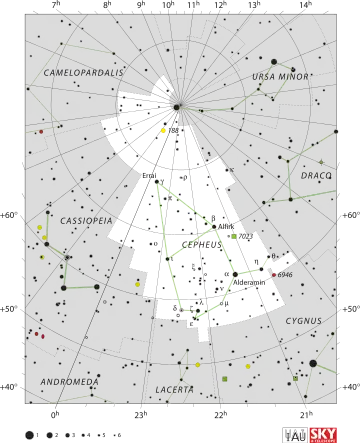  | ||
ε星の位置
| ||
| 物理的性質 | ||
| 半径 | 1.86 R☉[5] | |
| 質量 | 1.64[6] / 0.57[7] M☉ | |
| 表面重力 | 4.11 ± 0.14 (log g)[6] | |
| 自転速度 | 86 km/s[2] | |
| 自転周期 | 91 日[8] | |
| スペクトル分類 | F0V (Sr II)[9] または F0IV[10] | |
| 光度 | 11.65 L☉[11] | |
| 表面温度 | 7,514 ± 255 K[6] | |
| 色指数 (B-V) | +0.277[12] | |
| 色指数 (U-B) | +0.073[12] | |
| 金属量[Fe/H] | 0.08[11] | |
| 年齢 | 10.97 億年[6] | |
| 他のカタログでの名称 | ||
| ケフェウス座23番星[1] BD+56 2741[1] Gaia DR2 2198483880674251136[1] GSC 03990-02431[1] GJ 4266[1] HD 211336[1] HIP 109857[1] HR 8494[1] SAO 34227[1] TYC 3990-2431-1[1] 2MASS J22150213+5702367[1] |
||
| ■Template (■ノート ■解説) ■Project | ||
特徴
ガイア計画によって算出された年周視差の値に基づくと、地球からは約86光年離れている。視等級は4.19等級で、裸眼で観測することができる[2]。
黄白色に光るF型の恒星で、スペクトル分類ではF0V (Sr II)型[9]またはF0IV型[10]に分類される。これらのスペクトル分類は、ケフェウス座ε星が過剰なストロンチウムを含んでいるF型主系列星、もしくは主系列星の段階ヵら進化したF型準巨星であることを意味している。また、59.388分の周期で4.15等級から4.21等級まで視等級が変化するたて座デルタ型変光星でもある[3]。赤外線の過剰な放射が観測されており、ケフェウス座ε星から62 au離れた位置に温度65 Kの塵円盤が存在することが示されている。この塵円盤の合計質量は、地球質量の6.6%になるとされている[5]。
ケフェウス座ε星は位置角90 ± 10°の方向に330 ± 50 ミリ秒離れた位置に暗い伴星を持つ。この距離を天文単位に換算すると、伴星は見かけ上主星から8.6 ± 1.4 au離れた位置に見えることになる。このようにとても接近した距離に別の恒星が偶然位置する確率は100万分の1程度なので、この2つの恒星は恐らく物理的に関連している連星系と考えられている。もしそうであれば、塵円盤は周連星円盤ということになる。この伴星がヒッパルコスの観測で検出されなかったという事実は、伴星に軌道離心率が非常に高いことを示している。伴星のKバンドでの視等級が7.8等級で、スペクトル分類は恐らくK8 - M2型である[10]。
命名
ケフェウス座ε星はとかげ座α星、4番星、9番星、はくちょう座π1星、π2星、HD 206267、とかげ座β星、カシオペヤ座σ星、ρ星、τ星、AR星、アンドロメダ座3番星、7番星、8番星、λ星、κ星、ι星及びψ星と共に中国語で「飛行するヘビ」を意味する騰蛇(Téng Shé)と呼ばれる星官を形成している。ケフェウス座ε星はこの星官の9番目の星とされているので、騰蛇九と呼ばれる[13]。
脚注
注釈
- パーセクは1 ÷ 年周視差(秒)より計算、光年は1÷年周視差(秒)×3.2615638より計算
- 視等級 + 5 + 5×log(年周視差(秒))より計算。小数第1位まで表記
出典
- “Results for eps Cep”. SIMBAD Astronomical Database. CDS. 2019年12月7日閲覧。
- “Results for HR 8494”. VizieR. CDS. 2019年12月7日閲覧。
- “eps Cep”. AAVSO Website. American Association of Variable Star Observers. 2019年12月7日閲覧。
- Gontcharov, G. A. (2006). “Pulkovo Compilation of Radial Velocities for 35 495 Hipparcos stars in a common system”. Astronomy Letters 32 (11): 759. arXiv:1606.08053. Bibcode: 2006AstL...32..759G. doi:10.1134/S1063773706110065.
- Rhee, Joseph H. et al. (2007). “Characterization of Dusty Debris Disks: The IRAS and Hipparcos Catalogs”. The Astrophysical Journal 660 (2): 1556-1571. arXiv:astro-ph/0609555. Bibcode: 2007ApJ...660.1556R. doi:10.1086/509912.
- David, Trevor J.; Hillenbrand, Lynne A. (2015). “The Ages of Early-Type Stars: Stromgren Photometric Methods Calibrated, Validated, Tested, and Applied to Hosts and Prospective Hosts of Directly Imaged Exoplanets”. The Astrophysical Journal 804 (2): 146. arXiv:1501.03154. Bibcode: 2015ApJ...804..146D. doi:10.1088/0004-637X/804/2/146.
- De Rosa, R. J.; Patience, J.; Wilson, P. A.; Schneider, A.; Wiktorowicz, S. J.; Vigan, A.; Marois, C.; Song, I. et al. (2013). “The VAST Survey - III. The multiplicity of A-type stars within 75 pc”. Monthly Notices of the Royal Astronomical Society 437 (2): 1216. arXiv:1311.7141. Bibcode: 2014MNRAS.437.1216D. doi:10.1093/mnras/stt1932.
- Royer, F.; Zorec, J.; Gomez, A. E. (2007). “Rotational velocities of A-type stars. III. Velocity distributions”. Astronomy and Astrophysics 463 (2): 671-682. arXiv:astro-ph/0610785. Bibcode: 2007A&A...463..671R. doi:10.1051/0004-6361:20065224.
- Gray, R. O.; Napier, M. G.; Winkler, L. I. (2001). “The Physical Basis of Luminosity Classification in the Late A-, F-, and Early G-Type Stars. I. Precise Spectral Types for 372 Stars”. The Astronomical Journal 121 (4): 2148-2158. Bibcode: 2001AJ....121.2148G. doi:10.1086/319956.
- Mawet, D.; Mennesson, B.; Serabyn, E.; Stapelfeldt, K.; Absil, O. (2011). “A Dim Candidate Companion to epsilon Cephei”. The Astrophysical Journal Letters 738 (1): 5. arXiv:1107.3872. Bibcode: 2011ApJ...738L..12M. doi:10.1088/2041-8205/738/1/L12. L12.
- Anderson, E.; Francis, Ch. (2012). “XHIP: An extended hipparcos compilation”. Astronomy Letters 38 (5): 331. arXiv:1108.4971. Bibcode: 2012AstL...38..331A. doi:10.1134/S1063773712050015.
- Breger, M. (1968). “UBV and narrow-band UVBY photometry of bright stars”. Astronomical Journal 73: 84-85. Bibcode: 1968AJ.....73...84B. doi:10.1086/110602.
- (中国語) AEEA (Activities of Exhibition and Education in Astronomy) 天文教育資訊網 2006 年 7 月 7 日