ケフェウス座ゼータ星
ケフェウス座ζ星(英語: Zeta Cephei)は、ケフェウス座にある3等級の恒星である。
| ケフェウス座ζ星[1] Zeta Cephei | ||
|---|---|---|
| 星座 | ケフェウス座 | |
| 見かけの等級 (mv) | 3.35[1] 3.50 - 3.54(変光)[2] | |
| 変光星型 | Eと推測 [2] | |
| 分類 | 橙色超巨星 | |
| 位置 元期:J2000.0[1] | ||
| 赤経 (RA, α) | 22h 10m 51.27691s[1] | |
| 赤緯 (Dec, δ) | +58° 12′ 04.5456″[1] | |
| 赤方偏移 | -0.000059[1] | |
| 視線速度 (Rv) | -17.83 km/s[1] | |
| 固有運動 (μ) | 赤経: 13.52 ミリ秒/年[1] 赤緯: 5.24 ミリ秒/年[1] | |
| 年周視差 (π) | 3.90 ± 0.10ミリ秒[1] (誤差2.6%) | |
| 距離 | 840 ± 20 光年[注 1] (256 ± 7 パーセク[注 1]) | |
| 絶対等級 (MV) | -3.7[注 2] | |
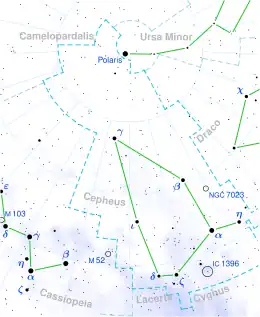  | ||
ζ星の位置
| ||
| 物理的性質 | ||
| 半径 | 230 R☉[3] | |
| 表面重力 | 0.75 (log g)[4] | |
| 自転速度 | 10.64 km/s[5] | |
| スペクトル分類 | K1.5Ib[1] | |
| 光度 | 5,660 L☉[4] | |
| 表面温度 | 4,000 K[6] | |
| 色指数 (B-V) | +1.57[7]、+1.55[6] | |
| 色指数 (U-B) | +1.71[7] | |
| 色指数 (R-I) | +0.78[7] | |
| 金属量[Fe/H] | 0.22[4] | |
| 他のカタログでの名称 | ||
| ケフェウス座21番星[1] BD+57 2475[1] FK5 836[1] HD 210745[1] HIP 109492[1] HR 8465[1] SAO 34137[1] NSV 14066[1] GSC 03981-01590[1] TYC 3981-1590-1[1] 2MASS J22105129+5812041[1] |
||
| ■Template (■ノート ■解説) ■Project | ||
特徴
MKスペクトル分類の基本的な恒星の一つで、スペクトル型はK1.5Ib型とされている。
ケフェウス座ζ星は、太陽の230倍の半径を持ち、表面温度は4,000K、光度は太陽の5,660倍にもなる。地球からは約840光年離れている[8]。見かけの明るさは3.4等級で、絶対等級は-3.7等級となる。金属量は太陽の約1.6倍とされている。
2008年のHekkerらの研究グループは、ケフェウス座ζ星に公転周期533日の伴星が存在している可能性があると発表した[9]。また、それにより、わずかに変光する食変光星である可能性もある[10]。
ケフェウス座ζ星は、中心部に鉄の核が形成されて、超新星爆発を起こす恒星の質量との境界付近にある。ケフェウス座ζ星は、おそらく寿命を迎えると、超新星爆発を起こさずに、大きな白色矮星を残してその一生を終えるとされている。仮に、伴星が存在しているとすると、白色矮星へガスなどが流入して、Ia型超新星を起こす可能性がある。
脚注
注釈
- パーセクは1 ÷ 年周視差(秒)より計算、光年は1÷年周視差(秒)×3.2615638より計算
- 視等級 + 5 + 5×log(年周視差(秒))より計算。小数第1位まで表記
出典
- “SIMBAD Astronomical Database”. Result for zet Cep. 2017年8月29日閲覧。
- “GCVS”. Result for HD 210745. 2017年8月29日閲覧。
- Wesselink, A. J.; Paranya, K.; Devorkin, K. (1972). “Catalogue of stellar dimensions”. Astronomy and Astrophysics Supplement 7: 257. Bibcode: 1972A&AS....7..257W.
- Mallik, Sushma V. (December 1999), “Lithium abundance and mass”, Astronomy and Astrophysics 352: 495–507, Bibcode: 1999A&A...352..495M
- Hekker, S.; Meléndez, J. (2007). “Precise radial velocities of giant stars. III. Spectroscopic stellar parameters”. Astronomy and Astrophysics 475 (3): 1003. arXiv:0709.1145. Bibcode: 2007A&A...475.1003H. doi:10.1051/0004-6361:20078233.
- Levesque, Emily M.; Massey, Philip; Olsen, K. A. G.; Plez, Bertrand; Josselin, Eric; Maeder, Andre; Meynet, Georges (2005). “The Effective Temperature Scale of Galactic Red Supergiants: Cool, but Not As Cool As We Thought”. The Astrophysical Journal 628 (2): 973. arXiv:astro-ph/0504337. Bibcode: 2005ApJ...628..973L. doi:10.1086/430901.
- 輝星星表第5版
- van Leeuwen, F. (2007). “Validation of the new Hipparcos reduction”. Astronomy and Astrophysics 474 (2): 653–664. arXiv:0708.1752. Bibcode: 2007A&A...474..653V. doi:10.1051/0004-6361:20078357.Vizier catalog entry
- Hekker (2008). “Precise radial velocities of giant stars. IV. A correlation between surface gravity and radial velocity variation and a statistical investigation of companion properties”. Astronomy and Astrophysics 480 (1): 215–222. arXiv:0801.0741. Bibcode: 2008A&A...480..215H. doi:10.1051/0004-6361:20078321.
- Samus, N. N.; Durlevich, O. V. (2009). “VizieR Online Data Catalog: General Catalogue of Variable Stars (Samus+ 2007–2013)”. VizieR On-line Data Catalog: B/gcvs. Originally published in: 2009yCat....102025S 1: 02025. Bibcode: 2009yCat....102025S.
This article is issued from Wikipedia. The text is licensed under Creative Commons - Attribution - Sharealike. Additional terms may apply for the media files.