スティックニー (クレーター)
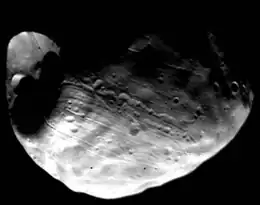
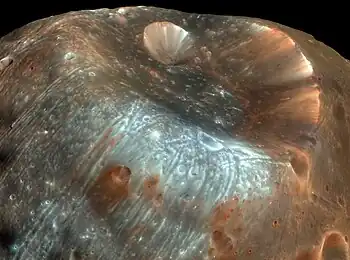
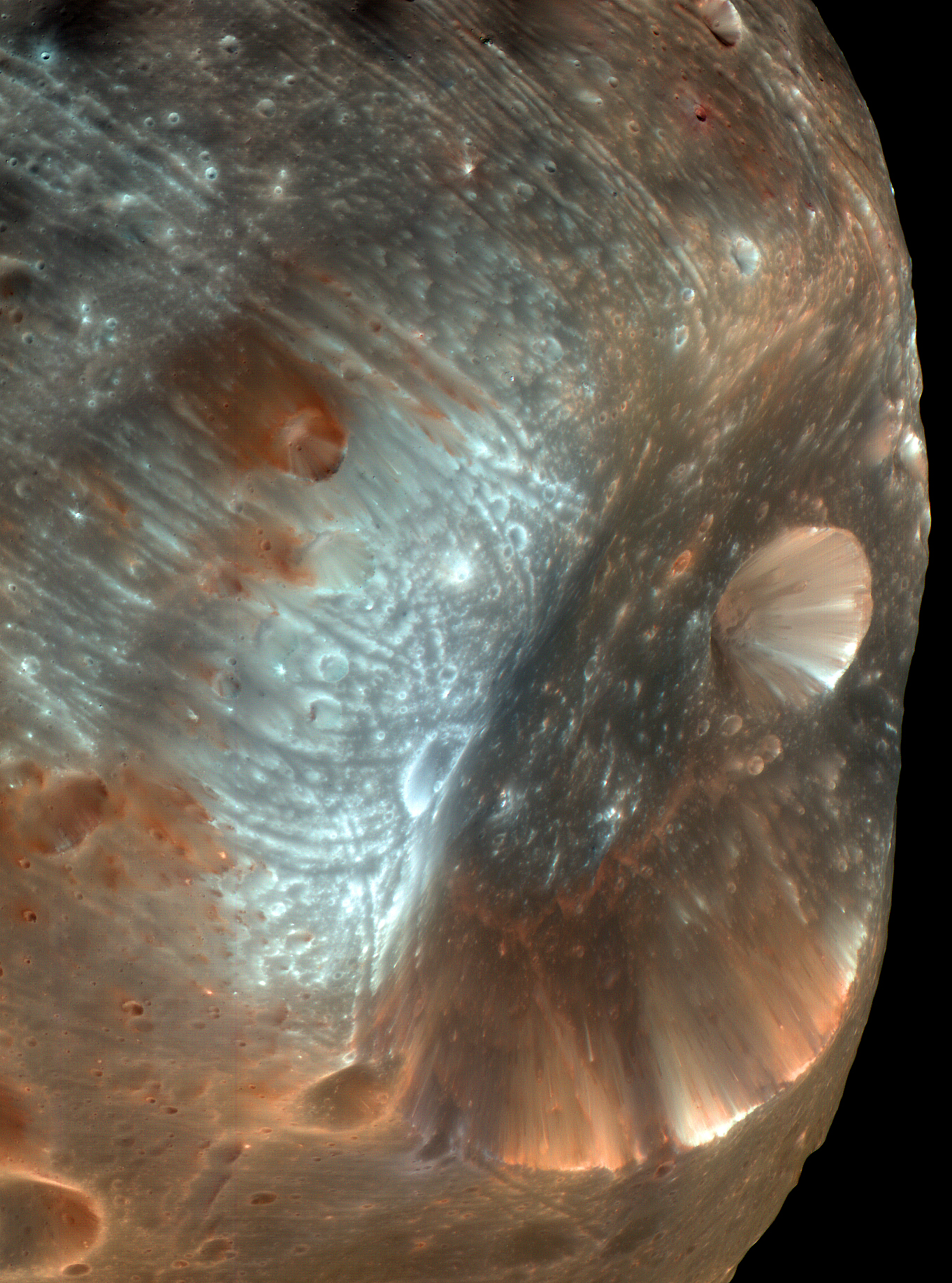
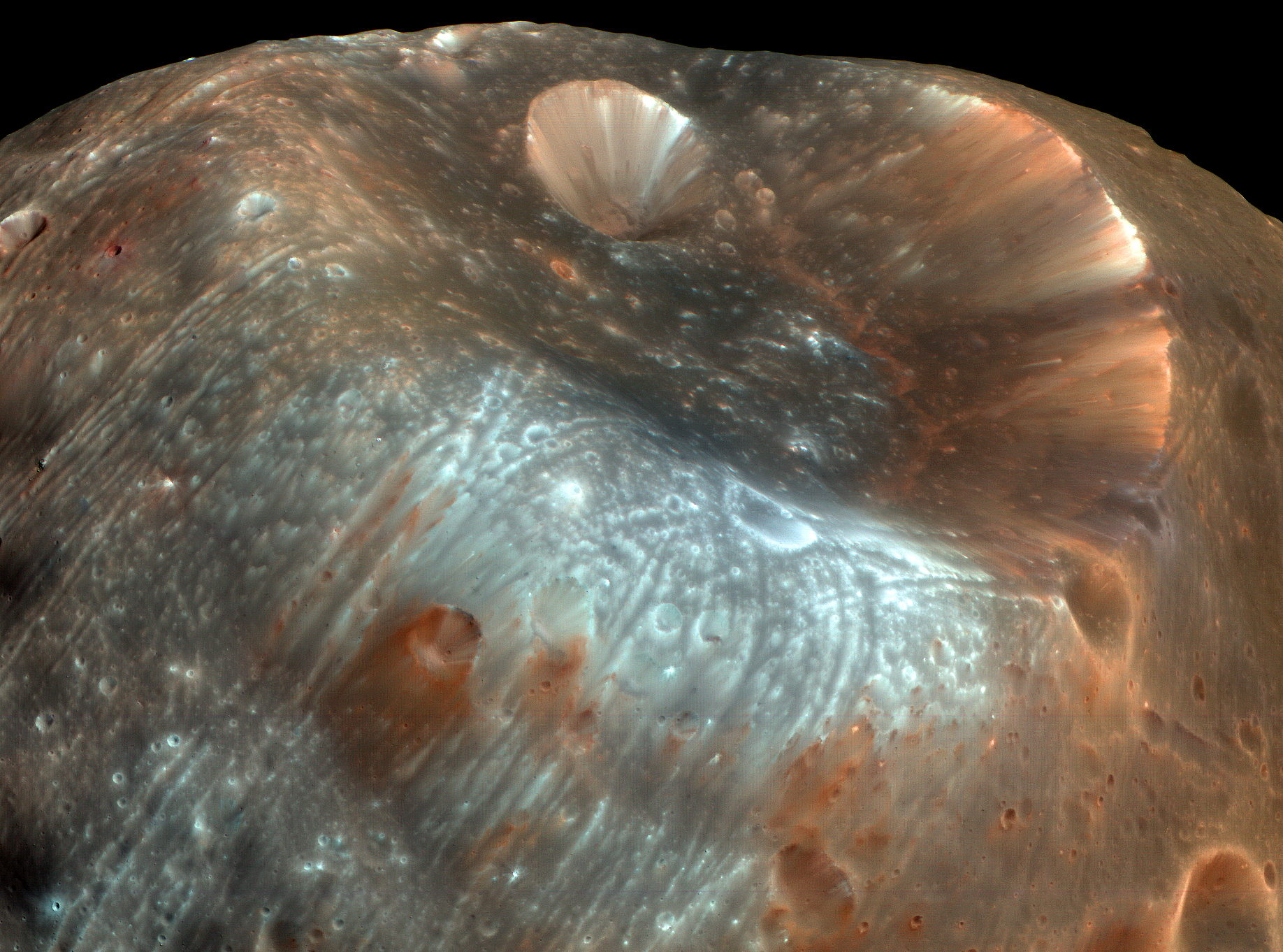
スティックニー(Stickney)は火星の衛星であるフォボス最大のクレーターである。直径は約9kmであり、フォボスが直径約22kmであるため、地面の大部分をスティックニーが占めている。火星からならフォボスは太陽面通過が容易に観測できるほど大きいため、スティックニーは肉眼で見ることが出来る。クレーターの壁には線状の肌理があり、地すべりにより起こったと思われている[2]。
 | |
| 種類 | クレーター |
|---|---|
| 場所 | 北緯1度 西経49度[1] |
| 直径 | 9km |
| 発見者 | アサフ・ホール |
| 命名 | アンジェリン・スティックニー(発見者の妻) |
概要
スティックニーは内部に後の天体衝突によってできたと思われる直径約2kmのクレーターがある。2006年にはガリバー旅行記の登場人物にちなみ、Limtocという名前がつけられた[3]。
クレーターにある溝やクレーターチェーンはスティックニーを中心にして放射状に伸びている。この事実からスティックニーを形成した衝突は元あったフォボスの大部分を破壊したという仮説が出た。しかし、マーズ・エクスプレスの調査ではクレーターチェーンなどはスティックニーとは無関係であることが分かっており、火星と他の天体の衝突で飛び散ったものから偶然近くに形成されたと考えられている[4]。理論モデルによりクレーターチェーンなどが潮汐力により変形したという仮説もある[5]。2018年11月、小惑星の衝突がスティックニーを作り、そのとき噴出した巨石により多くの溝のようなものができたと結論づけられた[6][7]。
名称
このクレーターはフォボスの発見者であるアサフ・ホールの妻、アンジェリン・スティックニーの名前に因む[1]。1878年、アサフ・ホール自身は妻の応援なしでは火星の衛星捜索は諦めていただろうと書き記している[8]。マリナー9号の撮影画像を元に1973年、IAUによって正式に名称が認可された[9]。
脚注
- “Planetary Names: Crater, craters: Stickney on Phobos”. Gazetteer of Planetary Nomenclature (2006年11月29日). 2019年7月21日閲覧。
- “Phobos from 6,800 Kilometers (Color)”. NASA/JPL-Caltech/University of Arizona (2008年4月9日). 2019年7月21日閲覧。
- “Planetary Names: Crater, craters: Limtoc on Phobos”. Gazetteer of Planetary Nomenclature (2007年3月1日). 2019年7月21日閲覧。
- Murray, John B. et al. "New evidence on the origin of Phobos' parallel grooves from HRSC Mars Express," Lunar and Planetary Science XXXVII (2006).
- “Mars' Moon Phobos is Slowly Falling Apart”. NASA's Goddard Space Flight Center (2015年11月10日). 2019年7月21日閲覧。
- Gough, Evan (2018年11月20日). “Strange Grooves on Phobos Were Caused by Boulders Rolling Around on its Surface”. Universe Today. 2018年11月21日閲覧。
- Ramsley, Kenneth R.; Head, James W. (16 November 2018). “Origin of Phobos grooves: Testing the Stickney Crater ejecta model”. Planetary and Space Science 165: 137–147. doi:10.1016/j.pss.2018.11.004.
- Hall, Asaph, Observations and orbits of the satellites of Mars, Washington: Government Printing Office, 1878 (quoted in Hall, Angelo, An astronomer's wife, Baltimore: Nunn and Company, 1908, p. 112).
- Veverka, Joseph; Noland, Michael; Sagan, Carl; Pollack, James; Quam, Lynn; Tucker, Robert; Eross, Botand; Duxbury, Thomas et al. (1974). “A Mariner 9 atlas of the moons of Mars”. Icarus 23 (2): 206–289. Bibcode: 1974Icar...23..206V. doi:10.1016/0019-1035(74)90006-2..
外部リンク
- Flight around Phobos (動画)
- Stickney in High Resolution
- Stickney at APOD, 2018年5月5日
- Creation of Stickney Crater on Phobos (VIDEO)--どのようにしてスティックニーができたかのシミュレーション再現動画。


This article is issued from Wikipedia. The text is licensed under Creative Commons - Attribution - Sharealike. Additional terms may apply for the media files.