スー・サベージ=ランボー
スー・サベージ=ランボー(Sue Savage-Rumbaugh、1946年8月16日 - )は、アメリカ合衆国の心理学者・霊長類学者である。コンピュータのキーボードを使用した言語・ヤーキッシュを使って、2頭のボノボ、カンジとパンバニーシャの言語能力と認知能力を調査した研究で知られている。
スー・サベージ=ランボー | |
|---|---|
| Sue Savage-Rumbaugh | |
 2011年のタイム100ガラに参加したサベージ=ランボー | |
| 生誕 | 1946年8月16日(77歳) |
| 公式サイト | http://iowaprimatelearning.org/ |
研究
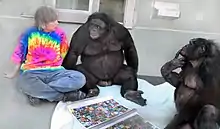

サベージ=ランボーは、ボノボを使って言語研究を行った最初の科学者である。ジョージア州アトランタにあるジョージア州立大学言語研究センター(LRC)で23年間研究した後、2005年にアイオワ州デモインのアイオワ霊長類学習サンクチュアリに参加し、2013年11月に退職するまで勤務した。2011年には、『タイム』誌の「世界で最も影響力のある100人」の1人に選ばれた[1]。退職後は、ボノボ・ホープの理事を務めている。
LRCでは、霊長類を研究するための多くの新技術を開発した。その中には、音声合成が可能なキーボードがあり、動物が言語を使ってコミュニケーションをとることができるようにした。また、非ヒト霊長類が扱いやすいようなコンピュータベースのジョイスティック端末を開発し、さまざまなコンピュータによるタスクを自動で提示できるようにした。このセンターで開発された、記号の獲得、話し言葉の理解、簡単な構文構造の解読、数と量の概念の学習、複雑な知覚運動タスクの実行など、非ヒト霊長類の能力に関する情報は、ヒトの非ヒト霊長類に対する見方を変えた。
ヒトの子供と同様に自発的に言葉を獲得した最初の類人猿であるカンジとの研究は、1993年に"Monographs of Society for Research in Child Development"(子供発達研究学会の論文誌)で発表された"Language Comprehension in Ape and Child"(類人猿と子供の言語理解)に詳述されている。この論文は、1991年にミネソタ大学認知科学センターが発表した「ミレニアム・プロジェクト」で、20世紀の認知科学の中で最も影響力のある研究トップ100に選ばれた。
「言語はヒトに限られたものではなく、他の類人猿でも学習可能である」というサベージ=ランボーの言語に対する見方は、言語学、心理学、その他の脳や精神に関する科学の研究者からは一般的に批判されており、受け入れられていない。例えば、認知科学者のスティーブン・ピンカーは"The Language Instinct"(日本語訳『言語を生みだす本能』)の中でサベージ=ランボーらの立場を強く批判し、カンジを始めとする非ヒト霊長類は言語の基礎を把握できていないと主張した。
『フィナンシャル・タイムズ』紙の取材で2001年にサベージ=ランボーの元を訪れたアレクサンダー・フィスク=ハリソンによれば、サベージ=ランボーの研究手法は、フランス・ドゥ・ヴァールら他の研究者が取る臨床的な手法とは異なり、類人猿を生まれた時から飼育し、「言語的な世界」に没頭させるというホリスティックなアプローチを取っているという[2]。
Terrace et al (1979)の分析"Can An Ape Create a Sentence"(類人猿は文章を作れるか)によれば、類人猿は文章を作成しない。類人猿は模倣の段階から進んだり、平均文の長さが長くなるにつれて複雑さを増した文章を作り始めたりすることはない。意味があるように見える創造的な組み合わせも、分析すると、より単純な非言語的特性によって説明できる。ThompsonとChurchによる"An Explanation of the Language of a Chimpanzee" (1980)では、動物による文章様のものの生成の説明として、連想対学習とその後の強化を指摘している。
2012年9月、12人の元従業員らが、世話をしていたボノボをサベージ=ランボーが虐待していたと主張し、サベージ=ランボーは休職に追い込まれた[3]。しかし、その年の11月に復職した[4]。その後、アイオワ霊長類学習サンクチュアリを離れてニュージャージー州に移ったが、エイプ・コングニション・アンド・コンサーベーション・イニシアティブ(霊長類学習サンクチュアリの後継組織)との法的な争いに巻き込まれている[5][6]。
著作物
- Brakke, K. E. and Savage-Rumbaugh, E. S. (1995) The development of language skills in bonobo and chimpanzee: I. Comprehension. Language and Communication 2, 121-148.
- Savage-Rumbaugh, E.S. 1986. Ape Language: From Conditioned Response to Symbol. New York: Columbia University Press. ASIN B000OQ1WIY
- Savage-Rumbaugh, E.S., and Roger Lewin. 1996. Kanzi: The Ape at the Brink of the Human Mind. Wiley. ISBN 0-471-15959-X
- 日本語訳:人と話すサル「カンジ」 、石館康平訳、講談社、1997年 ISBN 9784061542419
- Savage-Rumbaugh, E.S., Stuart G. Shanker, and Talbot J. Taylor. 2001. Apes, Language, and the Human Mind. Oxford. ISBN 0-19-514712-X
- Lyn, H., Greenfield, P. M., Savage-Rumbaugh, S., Gillespie-Lynch, K., & Hopkins, W. D. (2011). Nonhuman primates do declare! A comparison of declarative symbol and gesture use in two children, two bonobos, and a chimpanzee. Language and Communication, 31, 63-74. doi:10.1016/j.langcom.2010.11.001
- "The Foundations of Primate Intelligence and Language," Duane M. Rumbaugh, E. Sue Savage-Rumbaugh, James E. King and Jared P. Taglialatela. The Human Brain Evolving: Paleoneurological Studies in Honor of Ralph L. Holloway, Stone Age Institute Press (2011).
- Gillespie-Lynch, K., Greenfield, P. M., Lyn, H., & Savage-Rumbaugh, S. (in press). The role of dialogue in the ontogeny and phylogeny of early word combinations. First Language.
- Savage-Rumbaugh, S. (2010) Human Language-Human Consciousness, On the Human, a project of the National Humanities Center
- Savage-Rumbaugh, E.S., Rumbaugh, D.M., & Fields, W.M. (2009) "Empirical Kanzi: The ape language debate revisited".The Skeptic.
- Lyn, H., Franks, B., and Savage-Rumbaugh, E. S. (2008) Precursors of morality in the use of the symbols "good" and "bad" in two bonobos (Pan paniscus) and a chimpanzee (Pan troglodytes). Language and Communication 28(3) 213-224 doi:10.1016/j.langcom.2008.01.006.
- Greenfield, P. M., Lyn, H., & Savage-Rumbaugh, E. S. (2008). Protolanguage in ontogeny and phylogeny: combining deixis and representation. Interaction Studies, 9(1), 34-50.
- Rumbaugh, D. M., Washburn, D. A., King, J. E., Beran, M. J. Gould, K., & Savage-Rumbaugh, E. S. (2008). Why some apes imitate and/or emulate observed behavior and others do not: Fact, theory, and implications for our kind. Journal of Cognitive Education and Psychology, 7, (1), 101 -110.
- Savage-Rumbaugh, S. & Fields, W.M. (2007) Rules and Tools: Beyond Anthropomorphism: A qualitative report on the stone tool manufacture and use by captive bonobos Kanzi and Panbanisha. In N. Toth's Craft Institute Oldowan Technologies 1(1).
- Fields, W.M., Segerdahl, P., & Savage-Rumbaugh, E.S. (2007) "The Material Practices of Ape Language." In J. Valsiner & Alberto Rosa (Eds.) The Cambridge Handbook of Socio-Cultural Psychology, Cambridge: Cambridge University Press.
- Rumbaugh, D. M., E. S. Savage-Rumbaugh, & Taglialatela, J. (2007). (L. Squire, ed.) Language Nonhuman Animals. The New Encyclopedia of Neuroscience. New York: Elsevier.
- Savage-Rumbaugh, S., Rumbaugh, D.M. & W.M. Fields. (2006) "Language as a Window on the Cultural Mind." In S. Hurley (Ed.) Rational Animals, Oxford: Oxford University Press.
- Lyn, H., Greenfield, P. G., and Savage-Rumbaugh, E. S. (2006) The development of pretend play in chimpanzees and bonobos: evolutionary implications, pretense, and the role of interspecies communication, Cognitive Development, 21, 199-213.
- Sue Savage-Rumbaugh, Kanzi Wamba, Panbanisha Wamba and Nyota Wamba. (2007) "Welfare of Apes in Captive Environments: Comments On, and By, a Specific Group of Apes." Journal of Applied Animal Welfare Science.
- Savage-Rumbaugh, S., Fields, W.M.,Segerdahl, P., & D.M. Rumbaugh. (2005) "Culture Prefigures Cognition in Pan/Homo Bonobos."Theoria 20(3).
- Savage-Rumbaugh, E.S., Segerdahl, P., Fields, W.M. (2005) "Individual Differences in Language Competencies in Apes Resulting from Unique Rearing Conditions Imposed by Different First Epistemologies."n L.L. Namy & S.R. Waxman (Eds.)
- Segerdahl, P., Fields, W.M., & Savage-Rumbaugh, E.S. (2005) Kanzi's Primal Language: The Cultural Initiation of Apes Into Language. London: Palgrave/Macmillan.
- Savage-Rumbaugh, S., Fields, W.M., & T. Spircu. (2004). The Emergence of Knapping and Vocal Expression Embedded in a Pan/Homo Culture. Journal of Biology and Philosophy (19).
- Fields, W.M., & Savage-Rumbaugh, S. (2003). [Review of the book A Mind So Rare: The Evolution of Human Consciousness]. Contemporary Psychology 48(8).
- Savage-Rumbaugh, S., Fields, W. (2002) "Hacias el control de nuevas realidades," Quark (25), 20-26.
- Savage-Rumbaugh, S., Fields, W.M. & Taglialetela, J. (2001) "Language, Speech, Tools and Writing: A cultural imperative." In Thompson, E. (Ed.), Between Ourselves: Second-person issues in the study of consciousness, (pp. 273–292) Exeter, UK: Imprint Academic.
- Savage-Rumbuagh, E.S. & Fields, W.M. (2000) "Linguistic, Cultural and Cognitive Capabilities of Bonobos (Pan paniscus)." Culture & Psychology 6(2), 131-153.
- "Perception of Personality Traits and Semantic Learning in Evolving Hominids." The Descent of Mind: Psychological Perspectives on Hominid Evolution" (pages 98–115), Oxford University Press, 1999.
- "Ape Communication: Between a Rock and a Hard Place." Origins of Language: What Non-Human Primates Can Tell Us" School of American Research Press, 1999.
- "Continuing Investigations into the Stone Tool-Making and Tool-Using Capabilities of Bonobo (Pan paniscus)" in Journal of Archaeological Science, 26 (pages 821-832), 1999.
- "Language, Comprehension in Ape and Child" (Monographs of the Society for Research in Child Development) Sue Savage-Rumbaugh, Jeannine Murphy, Rose A. Sevcik, Karen E. Brakke, Shelly L. Williams and Duane M. Rumbaugh; University Of Chicago Press (July 1993)
脚注
- “The 2011 Time 100”. Time. 2018年1月4日閲覧。
- Fiske-Harrison, Alexander. 'Talking With Apes', Financial Times, Weekend section, November 24–25, 2001
- Beeman, Perry. 'Ape scientist placed on leave after mental health is questioned' Archived 2014-02-06 at Archive.is, Des Moines Register, September 12, 2012
- Wong, Kate. 'Troubled Ape Facility Reinstates Controversial Researcher', Scientific American, November 21, 2012
- Meinch, Timothy. 'Iowa Primate Learning Sanctuary announces new lead scientists', Des Moines Register, January 30, 2014
- Hu, Jane C. (2014年8月20日). “What Do Talking Apes Really Tell Us?” (英語). Slate. ISSN 1091-2339 2016年8月31日閲覧。