トロピノン
トロピノン(Tropinone)は、第一次世界大戦の際に不足したアトロピンの前駆体として1917年にロバート・ロビンソンによって合成されたのが有名なアルカロイドである[1][2]。トロピノン、コカイン及びアトロピンは、全て同じトロパン骨格を持っている。
| トロピノン | |
|---|---|
 | |
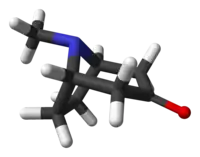 | |
8-Methyl-8-azabicyclo[3.2.1]octan-3-one | |
別称 3-Tropinone | |
| 識別情報 | |
| CAS登録番号 | 532-24-1  |
| PubChem | 446337 |
| ChemSpider | 393722  |
| DrugBank | DB01874 |
| ChEBI | |
| |
| |
| 特性 | |
| 化学式 | C8H13NO |
| モル質量 | 139.195 g/mol |
| 外観 | Brown solid |
| 融点 |
42.5 °C, 316 K, 109 °F |
| 沸点 |
(decomposes) |
| 危険性 | |
| NFPA 704 |
 1
2
0
|
| 特記なき場合、データは常温 (25 °C)・常圧 (100 kPa) におけるものである。 | |
合成
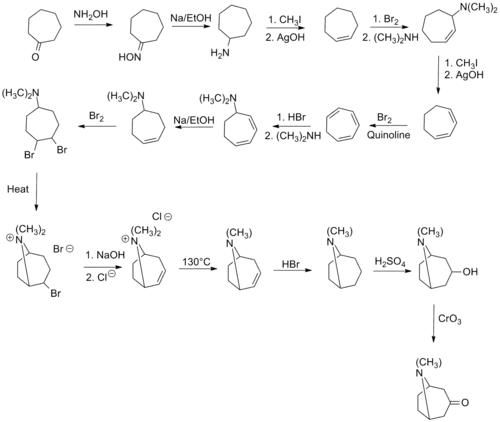
トロピノンの合成は、1901年にリヒャルト・ヴィルシュテッターによって初めて行われた。構造的に類似しているように見えるシクロヘプタノンを原料としたが、窒素を導入するのに多くの段階が必要であり、合成の全体の収率はわずか0.75%であった[3]。ヴィルシュテッターはかつてトロピノンからコカインを合成しており、これがコカインの最初の合成及び構造解明であった[4]。
 [5]
[5]
1917年のロビンソンによる合成は、古典的な全合成と見なされている[6]。トロピノンは二環分子であるが、反応に使われる試薬は、スクシンアルデヒド、メチルアミン、アセトンジカルボン酸とシンプルである。生合成でも同じ物質が材料として用いられるため、この合成は生体模倣の良い例である。また、ワンポット合成のタンデム反応でもある。さらに、合成の収量は17%に達し、その後の改良によって、90%にもなった[3]。
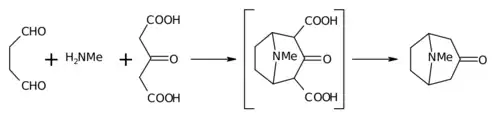
反応メカニズム
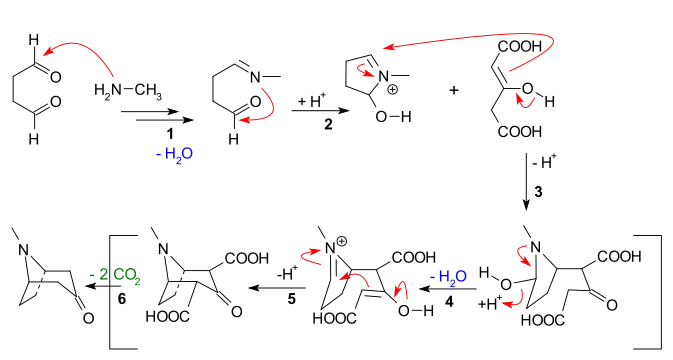
Tropinone synthesis
出典
- Robinson, Robert (1917). “LXIII.—A synthesis of tropinone”. J. Chem. Soc., Trans. 111 (0): 762–768. doi:10.1039/CT9171100762. ISSN 0368-1645.
- “The Art and Science of Total Synthesis at the Dawn of the Twenty-First Century”. Angew. Chem. Int. Ed. Engl. 39 (1): 44–122. (January 2000). PMID 10649349.
- . (1998). doi:10.1039/9781847551573.
- Humphrey, Andrew J.; O'Hagan, David (2001). “Tropane alkaloid biosynthesis. A century old problem unresolved”. Natural Product Reports 18 (5): 494–502. doi:10.1039/b001713m. ISSN 02650568.
- Green Chemistry and Engineering. Oxford [u.a.]: Elsevier inc. (2007). pp. 34. ISBN 978-0-12-372532-5
- Birch, Arthur John; King-Hele, Desmond George (1993). “Investigating a scientific legend: the tropinone synthesis of Sir Robert Robinson, F. R. S”. Notes and Records of the Royal Society of London 47 (2): 277–296. doi:10.1098/rsnr.1993.0034. ISSN 0035-9149.
- “Discovery of a novel dopamine transporter inhibitor, 4-hydroxy-1-methyl-4-(4-methylphenyl)-3-piperidyl 4-methylphenyl ketone, as a potential cocaine antagonist through 3D-database pharmacophore searching. Molecular modeling, structure-activity relationships, and behavioral pharmacological studies”. J. Med. Chem. 43 (3): 351–60. (February 2000). PMID 10669562.
- “Molecular modeling, structure--activity relationships and functional antagonism studies of 4-hydroxy-1-methyl-4-(4-methylphenyl)-3-piperidyl 4-methylphenyl ketones as a novel class of dopamine transporter inhibitors”. Bioorg. Med. Chem. 9 (7): 1753–64. (July 2001). PMID 11425577.
This article is issued from Wikipedia. The text is licensed under Creative Commons - Attribution - Sharealike. Additional terms may apply for the media files.