プレシオサウルス類
プレシオサウルス類(プレシオサウルスるい、プレシオサウルス亜目、学名:Plesiosauroidea )は肉食性の海生爬虫類の絶滅群。胴体長に対する比率が爬虫類の中で最大となるヘビのような長い首を持っていた。プレシオサウルス類はジュラ紀から白亜紀まで生息していた。その発見後、一部のプレシオサウルス類は「カメの甲羅に突き通されたヘビ」のような姿をしていると言及されてきたが[1]、彼らに甲羅はない。
| プレシオサウルス類 Plesiosauroidea | |||||||||||||||||||||||||||
|---|---|---|---|---|---|---|---|---|---|---|---|---|---|---|---|---|---|---|---|---|---|---|---|---|---|---|---|
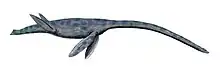
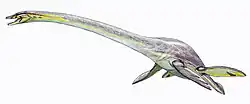 エラスモサウルス復元図 | |||||||||||||||||||||||||||
| 地質時代 | |||||||||||||||||||||||||||
| 後期三畳紀 - 後期白亜紀 | |||||||||||||||||||||||||||
| 分類 | |||||||||||||||||||||||||||
| |||||||||||||||||||||||||||
| 学名 | |||||||||||||||||||||||||||
| Plesiosauroidea Gray, 1825 | |||||||||||||||||||||||||||
| 和名 | |||||||||||||||||||||||||||
| プレシオサウルス類 | |||||||||||||||||||||||||||
| 下位分類群 | |||||||||||||||||||||||||||
プレシオサウルス類は前期ジュラ紀(前期シネムーリアン)に現れ、白亜紀末の大絶滅まで繁栄した。最近になってより新しいタクサが皆プリオサウルス類であったことが判明し、確認された中で最古のプレシオサウルス類はグループ名の元となっているプレシオサウルスそれ自身である[2]。中生代の双弓類という点では同時代に生きた恐竜と同じだが、彼らは恐竜ではない。胃石がしばしばプレシオサウルス類と共に発見される[3]。
歴史と発見
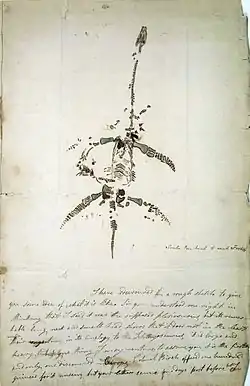
プレシオサウルス類の最初の全身骨格は19世紀初めのイングランドでメアリー・アニングによって発見され、科学界によって記載された最初の脊椎動物化石の一つとなった。スコットランドの地質学者ヒュー・ミラーによって1844年にスコットランド西部の Great Estuarine 層群(当時は Great Estuarine 統とされていた)からいくつかのプレシオサウルス類化石が発見されている[4]。他にも多くの化石が発見され、ほぼ完全な物もあり、新たな発見が頻繁に成された。最も保存状態のよい標本の一つは2002年にイングランド・サマセットの海岸で釣り人によって発見された。発見者にちなんでコラード標本 (Collard specimen) と呼ばれるこの標本は、2007年にトーントン博物館 (Taunton Museum) で展示された。他にも、比較して少し不完全な骨格が同じく2002年にアマチュア古生物学者によってイングランド・ヨークシャーのファイリ (Filey) の崖から発見されている。保存された骨格はスカーブラのロータンダ博物館 (Rotunda Museum) で展示されている。
"Plesiosauroidea" という分類名は1825年にジョン・エドワード・グレイによって命名された。これはこのグループを代表するプレシオサウルス ( Plesiosaurus ) の属名から作られた分類名であり、その属名はギリシャ語のπλησίος(plesios:近い・すぐ近く)とσαῦρος(sauros:トカゲ)から「トカゲに近い」を意味する。
記載
プレシオサウルス類は幅広い胴体と短い尾を持つ。祖先から受け継いだ2対の付属肢を保持しており、それらは大きな鰭に変化している。
歯のエナメル質に含まれるリン酸塩中の酸素安定同位体比 (18O/16O) を同緯度同時期の魚類化石中の酸素安定同位体比(外温性であるため海水温を反映していると考えられる)と比較することにより、プレシオサウルス類を含む数群の海棲爬虫類は哺乳類に似た恒温性の代謝を持っていたことが示唆されている。彼らは低温の生息環境で生存するために内温性の熱を発生させることができた[5]。
進化
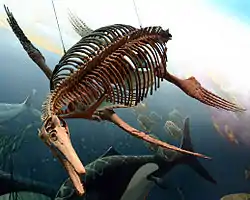
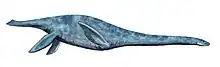
プレシオサウルス類は初めピストサウルス類のような形態から進化した。プレシオサウルス類にはいくつかの科が含まれ、それらは共通の一般的特徴を有しつつ様々な細部の特徴によって区別される。それらの科には、プレシオサウルス科(前期ジュラ紀のみに生息しており特殊化していない)、クリプトクリドゥス科(中程度の長さをした首を持ちいくぶんずんぐりした体つきをし、クリプトクリドゥスに代表される)、エラスモサウルス科(非常に長く柔軟な首と小さな頭部を持つ)、キモリアサウルス科(白亜紀産で余りよくわかっていない)などがある。伝統的な分類では全てのプレシオサウルス類は小さな頭部と長い首を持つことになっているが、近年の分類では、白亜紀の短い首と大きな頭部を持つポリコティルス科はプリオサウルス類ではなくプレシオサウルス類に含まれている。プレシオサウルス類内で異なるタクサ間の大きさの変異は著しく、トリナクロメルムの全長は 3 m と推定されている一方でマウイサウルスは 20 m にまで成長した。
首長竜の中には小型の頭部と長い頚部をもつ『長頚型』のものと大型の頭部と短い頚部をもつ『短頚型』の2つの型があり、旧来の分類では前者の型を持つものが「プレシオサウルス類」、後者の型が「プリオサウルス類」として、首長竜進化の初期から分化した2大系統として亜目や上科の分類階級を与えられていた[6]。しかし、近年の研究によって長頚型から短頚型が進化したり短頚型から長頚型が現れたりしたことが明らかとなり、これらの『型』が系統を直接現しているのではないことが判明している[7]。
系統関係
以下の分岐図は Benson & Druckenmiller (2014) に従う[8]。
| Plesiosauroidea |
| ||||||||||||||||||||||||||||||||||||||||||
行動
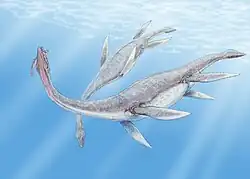
系統的には従兄弟にあたるプリオサウルス類とは異なり、プレシオサウルス類は(ポリコティルス科を除く)おそらく緩慢に泳ぐ動物だった[9]。彼らは水面下をゆったりと巡航し、警戒していない魚や頭足類をすばやく咥え上げるための頭部移動にその長く柔軟な首を用いたのだろう。4枚の鰭で遊泳するように適応したことにより、獲物を捕らえるために胴体を急速に回転させられるような卓越した機動性を得た可能性がある。
多くのプレシオサウルス類の復元図に反して、しばしば描かれる頭部と首を水面上に持ち上げた「白鳥のような」姿勢を取ることは不可能だった[1][10]。仮にそのように首を上方に曲げることが可能であった(実際にはできない)としても、その姿勢では重力により胴体は前方に傾き、重い首のほとんどの部分は水面下のままとなっただろう。
2011年8月12日、アメリカの研究者が1987年にカンザス州の農場で発見された妊娠中のプレシオサウルス類化石を記載した[11]。そのプレシオサウルス類 ( Polycotylus latippinus ) により、これらの捕食性海生爬虫類が1頭の大きく成長した子供を出産することが確認された(これは典型的な他の海生爬虫類の繁殖が、大量で小型の幼生を産み落とすのとは逆である)。この研究以前、時としてプレシオサウルス類はウミガメがするように海から這い上がって卵を産むように描かれていたが、専門家は長らくプレシオサウルス類の解剖学的特徴は陸上での移動に適していないと考えていた。母親の全長は 4 m 超と計測され、胎児の全長は 1.5 m ほどだった[12]。
出典
- Everhart, Mike (2005年10月14日). “A Snake Drawn Through the Shell of a Turtle”. Oceans of Kansas Paleontology. 2010年6月10日閲覧。
- Ketchum, Hilary F.; Benson, Roger B. J. (2011). “A new pliosaurid (Sauropterygia, Plesiosauria) from the Oxford Clay Formation (Middle Jurassic, Callovian) of England: evidence for a gracile, longirostrine grade of Early-Middle Jurassic pliosaurids”. Special Papers in Palaeontology 86: 109–129.
- "Occurrence of Gastroliths in Mesozoic Taxa," in Sanders et al. (2001). Page 168.
- Trewin, N. H., ed (2002). The Geology of Scotland. The Geological Society of London. pp. 339
- Bernard, A.; Lecuyer, C.; Vincent, P.; Amiot, R.; Bardet, N.; Buffetaut, E.; Cuny, G.; Fourel, F. et al. (2010-06-15). “Warm-blooded marine reptiles at the time of the dinosaurs”. Science (Sciencedaily.com) 328 (5984): 1379–1382. Bibcode: 2010Sci...328.1379B. doi:10.1126/science.1187443. PMID 20538946 2011年8月15日閲覧。.
- E.H.コルバート 『脊椎動物の進化』上 築地書館 1978 ISBN 4-8067-1095-4 p206
- 佐藤たまき「首長竜」『化石』第85巻、日本古生物学会、2009年、70頁、doi:10.14825/kaseki.85.0_69、ISSN 2424-2632。
- Benson, R. B. J.; Druckenmiller, P. S. (2013). “Faunal turnover of marine tetrapods during the Jurassic-Cretaceous transition”. Biological Reviews 89 (1): 1–23. doi:10.1111/brv.12038. PMID 23581455.
- Massare, J. A. (1988). “Swimming capabilities of Mesozoic marine reptiles: Implications for method of predation”. Paleobiology 14 (2): 187–205. Bibcode: 1988Pbio...14..187M. doi:10.1017/s009483730001191x.
- Henderson, D. M. (2006). “Floating point: a computational study of buoyancy, equilibrium, and gastroliths in plesiosaurs”. Lethaia 39 (3): 227–244. doi:10.1080/00241160600799846.
- F. R. O’Keefe1,*, L. M. Chiappe2 (2011). “Viviparity and K-Selected Life History in a Mesozoic Marine Plesiosaur (Reptilia, Sauropterygia)”. Science (Sciencemag.org) 333 (6044): 870–873. Bibcode: 2011Sci...333..870O. doi:10.1126/science.1205689. PMID 21836013 2011年8月15日閲覧。.
- Anthony King. “Ancient sea dragons had a caring side”. Cosmosmagazine.com. 2011年10月1日時点のオリジナルよりアーカイブ。2011年8月15日閲覧。
参考文献
- Carpenter, K (1996). “A review of short-necked plesiosaurs from the Cretaceous of the western interior, North America”. Neues Jahrbuch für Geologie und Paläontologie, Abhandlungen 201 (2): 259–287. doi:10.1127/njgpa/201/1996/259.
- Carpenter, K. 1997. "Comparative cranial anatomy of two North American Cretaceous plesiosaurs". Pp. 91–216, in Calloway J. M. and E. L. Nicholls, (eds.), Ancient Marine Reptiles, Academic Press, San Diego.
- Carpenter, K (1999). “Revision of North American elasmosaurs from the Cretaceous of the western interior”. Paludicola 2 (2): 148–173.
- Cicimurri, D. J.; Everhart, M. J. (2001). “An elasmosaur with stomach contents and gastroliths form the Pierre Shale (Late Cretaceous) of Kansas”. Transactions of the Kansas Academy of Science 104 (3–4): 129–143. doi:10.1660/0022-8443(2001)104[0129:aewsca]2.0.co;2.
- Cope, E. D. (1868). “Remarks on a new enaliosaurian, Elasmosaurus platyurus”. Proceedings of the Academy of Natural Sciences of Philadelphia 20: 92–93.
- Ellis, R. 2003. Sea Dragons' (Kansas University Press)
- Everhart, M. J. (2000). “Gastroliths associated with plesiosaur remains in the Sharon Springs Member of the Pierre Shale (Late Cretaceous), western Kansas”. Kansas Acad. Sci. Trans 103 (1–2): 58–69. doi:10.2307/3627940. JSTOR 3627940.
- Everhart, M. J. (2002). “Where the elasmosaurs roam...”. Prehistoric Times 53: 24–27.
- Everhart, M. J. (2004). “Plesiosaurs as the food of mosasaurs; new data on the stomach contents of a Tylosaurus proriger (Squamata; Mosasauridae) from the Niobrara Formation of western Kansas”. The Mosasaur 7: 41–46.
- Everhart, M. J. (2005). “Bite marks on an elasmosaur (Sauropterygia; Plesiosauria) paddle from the Niobrara Chalk (Upper Cretaceous) as probable evidence of feeding by the lamniform shark, Cretoxyrhina mantelli”. PalArch 2 (2): 14–24.
- Everhart, M. J. 2005. "Where the Elasmosaurs roamed", Chapter 7 in Oceans of Kansas: A Natural History of the Western Interior Sea, Indiana University Press, Bloomington, 322 p.
- Everhart, M. J. 2005. "Gastroliths associated with plesiosaur remains in the Sharon Springs Member (Late Cretaceous) of the Pierre Shale, Western Kansas" (on-line, updated from article in Kansas Acad. Sci. Trans. 103(1-2):58-69)
- Everhart, M. J. (2005). “Probable plesiosaur gastroliths from the basal Kiowa Shale (Early Cretaceous) of Kiowa County, Kansas”. Transactions of the Kansas Academy of Science 108 (3/4): 109–115. doi:10.1660/0022-8443(2005)108[0109:ppgftb]2.0.co;2.
- Everhart, M. J. (2005). “Elasmosaurid remains from the Pierre Shale (Upper Cretaceous) of western Kansas. Possible missing elements of the type specimen of Elasmosaurus platyurus Cope 1868?”. PalArch 4 (3): 19–32.
- Everhart, M. J. (2006). “The occurrence of elasmosaurids (Reptilia: Plesiosauria) in the Niobrara Chalk of Western Kansas”. Paludicola 5 (4): 170–183.
- Everhart, M. J. (2007). “Use of archival photographs to rediscover the locality of the Holyrood elasmosaur (Ellsworth County, Kansas)”. Transactions of the Kansas Academy of Science 110 (1/2): 135–143. doi:10.1660/0022-8443(2007)110[135:uoaptr]2.0.co;2.
- Everhart, M. J. 2007. Sea Monsters: Prehistoric Creatures of the Deep. National Geographic, 192 p. ISBN 978-1-4262-0085-4.
- Everhart, M. J. "Marine Reptile References" and scans of "Early papers on North American plesiosaurs"
- Hampe, O., 1992: Courier Forsch.-Inst. Senckenberg 145: 1-32.
- Lingham-Soliar, T (1995). “in”. Phil. Trans. R. Soc. Lond. 347: 155–180.
- O'Keefe, F. R. (2001). “A cladistic analysis and taxonomic revision of the Plesiosauria (Reptilia: Sauropterygia);”. Acta Zool. Fennica 213: 1–63.
- Massare, J. A. (1988). “Swimming capabilities of Mesozoic marine reptiles: Implications for method of predation”. Paleobiology 14 (2): 187–205. Bibcode: 1988Pbio...14..187M. doi:10.1017/s009483730001191x.
- Massare, J. A. 1994. Swimming capabilities of Mesozoic marine reptiles: a review. pp. 133–149 In Maddock, L., Bone, Q., and Rayner, J. M. V. (eds.), Mechanics and Physiology of Animal Swimming, Cambridge University Press.
- Smith, A. S. 2008. Fossils explained 54: plesiosaurs. Geology Today. 24, (2), 71-75 PDF document on the Plesiosaur Directory
- Storrs, G. W., 1999. An examination of Plesiosauria (Diapsida: Sauropterygia) from the Niobrara Chalk (Upper Cretaceous) of central North America, University of Kansas Paleontological Contributions, (N.S.), No. 11, 15 pp.
- Welles, S. P. 1943. Elasmosaurid plesiosaurs with a description of the new material from California and Colorado. University of California Memoirs 13:125-254. figs. 1-37., pls. 12–29.
- Welles, S. P. 1952. A review of the North American Cretaceous elasmosaurs. University of California Publications in Geological Science 29:46-144, figs. 1-25.
- Welles, S. P. 1962. A new species of elasmosaur from the Aptian of Columbia and a review of the Cretaceous plesiosaurs. University of California Publications in Geological Science 46, 96 pp.
- White, T (1935). “in”. Occasional Papers Boston Soc. Nat. Hist. 8: 219–228.
- Williston, S. W. (1890). “A new plesiosaur from the Niobrara Cretaceous of Kansas”. Transactions of the Kansas Academy of Science 12: 174–178. doi:10.2307/3623798. JSTOR 3623798., 2 fig.
- Williston, S. W. 1902. Restoration of Dolichorhynchops osborni, a new Cretaceous plesiosaur. Kansas University Science Bulletin, 1(9):241-244, 1 plate.
- Williston, S. W. 1903. North American plesiosaurs. Field Columbian Museum, Publication 73, Geology Series 2(1): 1-79, 29 pl.
- Williston, S. W. (1906). “North American plesiosaurs: Elasmosaurus, Cimoliasaurus, and Polycotylus”. American Journal of Science. 4 21 (123): 221–234. Bibcode: 1906AmJS...21..221W. doi:10.2475/ajs.s4-21.123.221., 4 pl.
- Williston, S. W. (1908). “North American plesiosaurs: Trinacromerum”. Journal of Geology 16 (8): 715–735. Bibcode: 1908JG.....16..715W. doi:10.1086/621573.
- ( ), 1997: in Reports of the National Center for Science Education, 17.3 (May/June 1997) pp 16–28.
外部リンク
- Fox News: Possibly Complete Plesiosaur Skeleton Found in Arctic
- The Plesiosaur Site. Richard Forrest.
- The Plesiosaur Directory. Dr Adam Stuart Smith.
- The name game: plesiosaur-ia, -oidea, -idae, or -us?.
- Oceans of Kansas Paleontology. Mike Everhart.
- Where the elasmosaurs roam: Separating fact from fiction. Mike Everhart.
- Triassic reptiles had live young
- The Filey (Yorkshire) Plesiosaur 2002 (part 1)
- The Filey (Yorkshire) Plesiosaur 2002 (part 2)
- Antarctic Researchers to Discuss Difficult Recovery of Unique Juvenile Plesiosaur Fossil, from the National Science Foundation, December 6, 2006.
- "Fossil hunters turn up 50-ton monster of prehistoric deep". Allan Hall and Mark Henderson. Times Online, December 30, 2002. (Monster of Aramberri)