モンテネグロ人
モンテネグロ人(モンテネグロじん)は、モンテネグロを主に構成する南スラヴ人である。
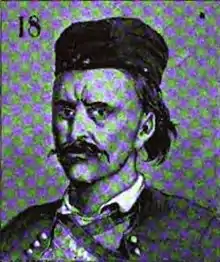 | |
| 総人口 | |
|---|---|
| c. 400,000–500,000[注釈 1][注釈 2] | |
| 居住地域 | |
 モンテネグロ 278,865[注釈 3][1] モンテネグロ 278,865[注釈 3][1] | |
 アメリカ アメリカ | 40,000 (2014)[2] |
 セルビア セルビア | 38,527 (2011)[2] |
 アルゼンチン アルゼンチン | 30,000 (2001)[2] |
 ドイツ ドイツ | 25–30,000[2] |
.svg.png.webp) フランス フランス | c. 30,000[3] |
 ルクセンブルク ルクセンブルク | 12,000 (2001)[2] |
 チリ チリ | 7,000 (2015)[4] |
 クロアチア クロアチア | 4,517 (2011)[5] |
 カナダ カナダ | 2,970 (2011)[6] |
 スロベニア スロベニア | 2,667 (2002)[7] |
 北マケドニア共和国 北マケドニア共和国 | 2,003 (2002)[8] |
.svg.png.webp) ボリビア ボリビア | 1,500–2,000 (2017)[9] |
 ボスニア・ヘルツェゴビナ ボスニア・ヘルツェゴビナ | 1,883 (2013)[10] |
 オーストラリア オーストラリア | 1,554 (2013)[11] |
 アルバニア アルバニア | 366 (2011)[12] |
| 言語 | |
| シュト方言[注釈 4] (モンテネグロ語 および セルビア語) | |
| 宗教 | |
| 多数派は 正教会[13] カソリック と イスラム は少数派 | |
| 関連する民族 | |
| 他の南スラヴ人, 特に en:Serbs of Montenegro.[注釈 5] | |
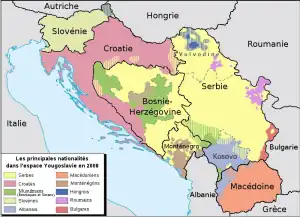
旧ユーゴスラビアの民族分布(2008年)。焦茶がモンテネグロ人。
概要
モンテネグロ人がセルビア人とは別の民族であるかどうかはしばしば論争の対象になっている。モンテネグロ人は、言語・歴史、文化、宗教、起源においてセルビア人にきわめて近しい存在であるといえるが、他の南スラブ諸民族とも密接な関係を有している。
宗教的には多数派が正教会であり、イスラム教がそれに次ぐ。ピュー研究所の2020年の推計では、76.6パーセントがキリスト教徒、20.3パーセントがイスラム教徒である[14]。
由来
「モンテネグロの歴史」も参照
その祖先は、バルカン半島の先住民族であるイリュリア人であると考えられている。
元々南部のアルバニア人とは古代同じ民族であるとされる。 ローマ人やスラヴ人、オスマン帝国の支配下に置かれ、モンテネグロは、次第にスラヴ化して行ったとされている。
こうした事もあってか近年モンテネグロ住民は、セルビアとの連邦関係に終止符を打ち、独立へ向かう動きが強まった。
注釈
- Note: The total figure is merely a sum of all the referenced populations listed.
- Note: The majority of people originating from within Montenegro's present borders declare ethnic affiliation in censuses as Serb. Thus, it is difficult to establish the exact numbers; up to few million people in Serbia and Bosnia and Herzegovina might have one or more ancestors from Montenegro.
- Note: The term "Montenegrins" in a wider sense can also be used to denote all the peoples from the Montenegro, regardless of their ethnic and religious affiliation.
- セルビア・クロアチア語参照 (主要言語) と en:Comparison of standard Bosnian, Croatian, Montenegrin and Serbian.
- en:Controversy over ethnic and linguistic identity in Montenegro参照
脚注
- “Census of Population, Households and Dwellings in Montenegro 2011”. Monstat.org (2011年7月12日). 2011年7月13日閲覧。
- Radio i Televizija Crne Gore
- “Présentation du Monténégro”. 2021年4月11日閲覧。
- “Stojović: U Čileu živi 7000 potomaka Crnogoraca”. Montengrina.net. 2017年8月19日閲覧。
- “Central Bureau of Statistics”. Dzs.hr. 2017年8月19日閲覧。
- “2011 National Household Survey: Data tables”. 12.statcan.gc.ca (2013年5月8日). 2015年3月18日閲覧。
- “Statistini urad RS - Popis 2002”. Stat.si. 2015年3月18日閲覧。
- “Official Results of Macedonia census 2002, State Staticistal Office of the Republic of Macedonia”. Stat.gov.mk. 2009年11月13日時点のオリジナルよりアーカイブ。2017年8月19日閲覧。
- “Bolivija: Po prvi put se okupili potomci iseljenika iz Crne Gore” (モンテネグロ語). cdm.me (2018年3月26日). 2018年4月12日閲覧。
- “1. Stanovništvo prema etničkoj/nacionalnoj pripadnosti - detaljna klasifikacija”. Popis.gov.ba. 2017年12月28日閲覧。
- “Montenegro Crna Gora Montenegro”. 2013 Census. 2021年4月11日閲覧。 Total responses: 25,451,383 for total count of persons: 19,855,288.
- “Census 2011 Data: Resident population by ethnic and cultural affiliation”. The Institute of Statistics of Republic of Albania. 2015年9月24日時点のオリジナルよりアーカイブ。2014年4月5日閲覧。
- “Census of Population, Households and Dwellings in Montenegro 2011”. Monstat. pp. 14, 15. 2011年7月12日閲覧。 For the purpose of the chart, the categories 'Islam' and 'Muslims' were merged; 'Buddhist' (.02) and Other Religions were merged; 'Atheist' (1.24) and 'Agnostic' (.07) were merged; and 'Adventist' (.14), 'Christians' (.24), 'Jehovah Witness' (.02), and 'Protestants' (.02) were merged under 'Other Christian'.
- “Religious Composition by Country, 2010-2050” (英語). Pew Research Center's Religion & Public Life Project (2015年4月2日). 2020年10月29日閲覧。
This article is issued from Wikipedia. The text is licensed under Creative Commons - Attribution - Sharealike. Additional terms may apply for the media files.