ルーシー (探査機)
ルーシー(Lucy)とは、5つの木星トロヤ群小惑星を探査する計画、あるいはその計画における探査機の名称である[1]。
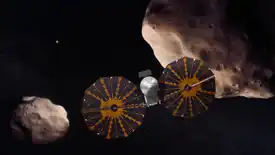 小惑星(617) パトロクルスとその衛星メノエティウスを探査するルーシーの想像図 | |
| 任務種別 | 複数フライバイミッション |
|---|---|
| 運用者 | NASA · SwRI |
| COSPAR ID | 2021-093A |
| 任務期間 | 12年(予定) |
| 任務開始 | |
| 打ち上げ日 | 2021年10月16日 09:34 (UTC) |
 ルーシー・ミッションの公式ロゴ | |
ルーシーは、M型小惑星プシケ(Psyche、ラテン語読み)探査計画のサイキ(Psyche、英語読み)と共に、2017年1月4日にNASAのディスカバリー・プログラムに選定された[2]。
ミッション名は、有名な類人猿化石、ルーシーに由来する。これは、探査対象であるトロヤ群小惑星が太陽系初期の歴史を保存する「惑星形成の化石」であると考えられているからである[3]。一方、類人猿化石のほうのルーシーは、ビートルズの楽曲「Lucy in the Sky with Diamonds」にちなんだものである[4]。
予定
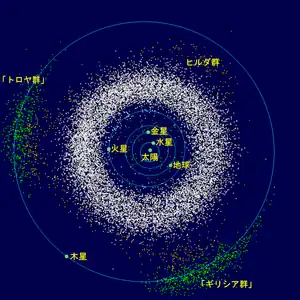
ルーシーは、2021年10月16日午前9時34分 (UTC) にケープカナベラル空軍基地から打ち上げられ[5]、2027年には木星L4トロヤ群に到達し、(3548) エウリバテス(Eurybates)、(15094) ポリメレ(Polymele)、(11351) レウクス(Leucus)、(21900) オルス(Orus)をフライバイする予定である。 これらのフライバイののち、ルーシーは重力アシストを受けるために地球近傍へ戻り、木星のL5点へ向かう。L5点では、(617) パトロクルス(Patroclus)とその衛星メノエティウス(Menoetius)を探査する。また、トロヤ群到達前の2025年には小惑星帯の内側にある(52246) ドナルド・ジョハンソン(Donaldjohanson)もフライバイする予定で、(52246) ドナルド・ジョハンソンは、ルーシー化石の発見者にちなんで2015年に名づけられた小惑星である[6]。
ルーシーには高解像度可視イメージャ、光学/近赤外分光器、熱赤外分光器の3つの機器が搭載される予定である[7]。
開発
ルーシーはNASAのディスカバリー・プログラムの次期ミッションとして提案されたミッションの1つである。次期ミッションは2021年末までの打ち上げを要求するものであった。この応募は2015年2月に締め切られ、総計28ミッションが提案された。
2015年9月30日、ルーシーは5つあるファイナリスト・ミッションの1つに選出され、計画の具体化のため300万ドルの資金を受けた[8][9][10]。ほかには、DAVINCI、NEOCam、サイキ、VERITASがファイナリスト・ミッションに選出されている。
2017年1月4日、ファイナリスト・ミッションからルーシーとサイキの2つが選定された。
科学搭載機器
以下の機器が搭載される予定である[7]:
- L'Ralph
- 可視全領域カラーイメージャ/赤外分光マッパ。 L'Ralphはニュー・ホライズンズのRalphを基にしていて、ゴダード宇宙飛行センターで開発される予定である。
- L'LORRI
- 高分解能可視イメージャ。L'LORRIはニュー・ホライズンズのLORRIから派生したもので、ジョンズ・ホプキンス大学応用物理研究所で開発される。
- L'TES
- 熱赤外分光装置。L'TESはオサイリス・レックスのOTESに類似の搭載機器である。アリゾナ州立大学で開発される予定。
これらのほかに、通信電波のドップラーシフトを用いた電波科学探査が小惑星の質量を決定するために行われる。
目標天体
目標天体とフライバイする予定日時は以下の通り[11][12]:
- 2025年4月20日:(52246) ドナルド・ジョハンソンをフライバイ。(52246) ドナルド・ジョハンソンは直径4 kmのC型小惑星でメインベルト内縁部に位置し、年代約1.3億年のエリゴネ族の小惑星である。
- 2027年8月12日:(3548) エウリバテスをフライバイ。(3548) エウリバテスは直径64 kmのC型小惑星で、木星トロヤ群のうち、L4周りのギリシア群に属する。トロヤ群で唯一確認されている衝突族の最大メンバー。2,000 km離れたところに直径1kmほどの衛星を有する[13]。
- 2027年9月15日:(15094) ポリメレをフライバイ。(15094) ポリメレは、直径21 kmのP型小惑星でL4トロヤ群内の衝突小惑星片である可能性がある。
- 2028年4月28日:(11351) レウクスをフライバイ。(11351) レウクスは直径34 kmのD型小惑星で、自転速度が遅い(自転周期466時間)L4トロヤ群小惑星である。
- 2028年11月11日:(21900) オルスをフライバイ。(21900) オルスは直径51 kmのD型小惑星でL4トロヤ群に位置する。
- 2033年3月2日:(617) パトロクルスをフライバイ。(617) パトロクルスは直径140 kmのP型二重小惑星で、680 km離れたところに直径104 kmの衛星メノエティウスがある。L5トロヤ群に属する。
脚注
- Chang, Kenneth (2017年1月6日). “A Metal Ball the Size of Massachusetts That NASA Wants to Explore”. New York Times 2017年1月7日閲覧。
- Northon, Karen (2017年1月4日). “NASA Selects Two Missions to Explore the Early Solar System”. 2017年7月22日閲覧。
- Witze, Alexandra (2015年3月16日). “Five Solar System sights NASA should visit”. Nature News 2015年10月2日閲覧。
- Johanson, Donald C.; Wong, Kate (2010). Lucy's Legacy: The Quest for Human Origins. Crown Publishing Group. pp. 8–9. ISBN 978-0307396402
- Fox, Karen; Johnson, Alana; Neal Jones, Nancy (2021年9月29日). “NASA’s Lucy Mission Prepares for Launch to Trojan Asteroids”. NASA News 2021年10月13日閲覧。
- Dreier, Casey; Lakdawalla, Emily (2015年9月30日). “NASA announces five Discovery proposals selected for further study”. The Planetary Society 2015年10月1日閲覧。
- “Southwest Research Institute (SwRI) 2015 News Release - SwRI awarded $3 million NASA contract to develop mission to Jupiter’s Trojan asteroids”. www.swri.org. 2015年10月5日閲覧。
- Brown, Dwayne C.; Cantillo, Laurie (2015年9月30日). “NASA Selects Investigations for Future Key Planetary Mission”. NASA News (Washington, D.C.) 2015年10月1日閲覧。
- Clark, Stephen (2014年2月24日). “NASA receives proposals for new planetary science mission”. Space Flight Now 2015年2月25日閲覧。
- Kane, Van (2014年12月2日). “Selecting the Next Creative Idea for Exploring the Solar System”. Planetary Society 2015年2月10日閲覧。
- “Lucy: Surveying the Diversity of Trojan Asteroids, the Fossils of Planet Formation”. Southwest Research Institute (2015年). 2017年7月11日閲覧。
- Levison, H. F.; Olkin, C.; Noll, K. S.; Marchi, S. (March 2017). Lucy: Surveying the Diversity of the Trojan Asteroids, the Fossils of Planet Formation (PDF). 48th Lunar and Planetary Science Conference. 20-24 March 2017. The Woodlands, Texas. Bibcode:2017LPI....48.2025L. LPI Contribution No. 1964, id. 2025。
- Noll, K. S.; Brown, M. E.; Weaver, H. A.; Grundy, W. M.; Porter, S. B.; Buie, M. W.; Levison, H. F.; Olkin, C. et al. (2020-09-04). “Detection of a Satellite of the Trojan Asteroid (3548) Eurybates—A Lucy Mission Target” (英語). The Planetary Science Journal 1 (2): 44. doi:10.3847/PSJ/abac54. ISSN 2632-3338.
関連項目
- トロヤ群
- ルーシー (アウストラロピテクス) - ミッション名の由来である
- JUICE - ESAの木星系探査計画
- OKEANOS
小惑星の探査・観測 | ||
|---|---|---|
| フライバイ |
|   |
| オービター・ ランデブー | ||
| ランダー | ||
| 計画・予定 |
| |
| 構想段階 | ||
| 関連項目 | ||
| 太字の下線 は現役の宇宙機を示す | ||