レントより遅く
『レントより遅く』(フランス語: La Plus que lente)は、1910年にクロード・ドビュッシーによって書かれたワルツである [1]。『前奏曲集 第1集』の出版直後に発表された[2]。この作品はパリのニューカールトンホテルで初演され、そこで弦楽器に編曲され、ドビュッシーが書いた(そして作曲家から原稿を渡された)ヴァイオリニスト、レオニによって演奏された[3]。 最終的には、作曲者はオリジナルのピアノ版と、編曲されたオーケストラ版の二つを残した。ヴァイオリンとピアノの版およびピアノ連弾版はレオン・ロケ (Léon Roques) によって編曲が行われた。
スタイル
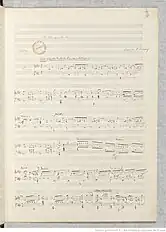
「レントより遅く」というタイトルであるが、ドビュッシーはゆっくりと演奏されることを意図されていなかった。この文脈での「レント」とは、ドビュッシーがエミュレートしようとしたヴァルス・レントのジャンルを指している[3]。ドビュッシーの作曲に名前を付けるための苛酷なアプローチの典型であり、それはフランスの社会的雰囲気における遅いワルツの広大な影響に対する彼の反応を表しています。しかし、フランク・ハウズが指摘したように、「『レントより遅く』は、ドビュッシーのとてもユーモラスな方法で、『他のすべてを凌駕するヴァルス・レント』 [遅いワルツ] です。」 [2]
この作品には「モルト・ルバート・コン・モルビデッツァ」と記されており、ドビュッシーが柔軟なテンポを奨励していたという裏付けとなる[4]。
歴史
| 音楽・音声外部リンク | |
|---|---|
| 全曲を試聴する | |
 Debussy:Valse « La plus que lente » - アラン・プラネス(P)による演奏。France Musique公式YouTube。《P-solo(Original)》 Debussy:Valse « La plus que lente » - アラン・プラネス(P)による演奏。France Musique公式YouTube。《P-solo(Original)》 | |
|
C. Debussy|La Plus que Lente - Jaehyuck Choi指揮大田市立交響楽団(Daejeon Philharmonic)による演奏。当該指揮者自身の公式YouTube。《Orch》 |
ドビュッシーは、マントルピースにあった小さな彫刻「ラヴァルス」から、『レントより遅く』のインスピレーションを受けたと言われている[2]。 しかし、様々な人物がその他のインスピレーションの源を指摘し、このワルツとドビュッシーの以前の作品である『バラード』との類似性を引用している人もいる [5]。
作曲の同じ年に、作品のオーケストレーションが考案されたが、ドビュッシーはスコアのパーカッションの多用に反対し、新しいものを提案し、出版社に次のようなものを書いている。
Examining the brassy score of La plus que lente, it appears to me to be uselessly ornamented with trombones, kettle drums, triangles, etc., and thus it addresses itself to a sort of de luxe saloon that I am accustomed to ignore!—there are certain clumsinesses that one can easily avoid! So I permitted myself to try another kind of arrangement which seems more practical. And it is impossible to begin the same way in a saloon as in a salon. There absolutely must be a few preparatory measures. But let's not limit ourselves to beer parlors. Let's think of the numberless five-o'-clock teas where assemble the beautiful audiences I've dreamed of.—Claude Debussy, 25 August 1910[6]
脚注
- Randel, Don Michael (1996). The Harvard Biographical Dictionary of Music. Harvard University Press. p. 204. ISBN 0-674-37299-9
- Woodstra, Chris; Brennan, Gerald; Schrott, Allen (2005). All Music Guide to Classical Music. CMP Media. pp. 353, 354. ISBN 0-87930-865-6
- Andres, Robert. An introduction to the solo piano music of Debussy and Ravel, BBC, retrieved 15 July 2018
- Smith, Richard Langham (1997). Debussy Studies. Cambridge University Press. p. 88. ISBN 0-521-46090-5
- Matthay, Tobias (1918). Musical Interpretation, Its Laws and Principles, and Their Application in Teaching and Performing. The Boston Music Co. (G. Schirmer, Inc.). p. 102. ISBN 9780836951912
- Arvey, Verna; Hsu, Samuel; Grolnic, Sidney; Peters, Mark A. (2007). Choreographic Music for the Dance. Read Books. p. 235. ISBN 1-4067-5847-7