二重連鎖木
二重連鎖木(にじゅうれんさぎ、英: doubly chained tree)や左-子,右-兄弟表現(英: left-child, right-sibling representation)[1]や子-兄弟表現(英: child-sibling representation)[2]や filial-heir chain[3] とは、多分木を、直接子ノードのポインタの集合で管理するのではなく、子ノード1つと兄弟ノード1つのポインタで管理する方法。つまり多分木を二分木に変換する。1963年に Edward H. Sussenguth が発表した[4]。
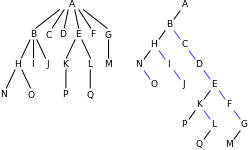
六分木を二重連鎖木で表現した物
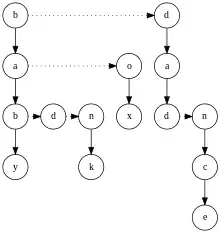
トライ木を二重連鎖木で実装した物。縦の矢印は子ポインタを表現し、横の点線の矢印は兄弟ポインタを表現する。
ノード n の k 番目の子供を取得するには、以下のように行う。ノードは child と next-sibling を保持している。
procedure kth-child(n, k):
    child ← n.child
    while k ≠ 0 and child ≠ nil:
        child ← child.next-sibling
        k ← k − 1
    return child  // nil を返す場合もある
参照
- T. コルメン; R. リベスト; C. シュタイン; C. ライザーソン (2013). アルゴリズムイントロダクション. ISBN 978-4764904088
- Fredman, Michael L.; Sedgewick, Robert; Sleator, Daniel D.; Tarjan, Robert E. (1986). “The pairing heap: a new form of self-adjusting heap”. Algorithmica 1 (1): 111–129. doi:10.1007/BF01840439.
- binary tree representation of trees
- Sussenguth, Edward H. (1963). “Use of tree structures for processing files”. Communications of the ACM 6 (5): 272–279. doi:10.1145/366552.366600.

This article is issued from Wikipedia. The text is licensed under Creative Commons - Attribution - Sharealike. Additional terms may apply for the media files.