カベオリン1
カベオリン1(英: caveolin 1)は、ヒトではCAV1遺伝子によってコードされるタンパク質である[5]。




機能
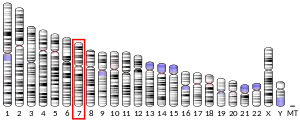
CAV1遺伝子にコードされるカベオリン1は足場タンパク質であり、大部分の細胞種における細胞膜のカベオラの主要な構成要素である。カベオリン1はインテグリンサブユニットとチロシンキナーゼFYNを連結し、インテグリンとRas-ERK経路の共役と細胞周期の進行の促進の開始段階となる。CAV1遺伝子はがん抑制遺伝子の候補であり、Ras-p42/44MAPキナーゼカスケードの負の調節因子である。CAV1とCAV2は7番染色体上に隣接して位置ており、安定なヘテロオリゴマー複合体を形成して共局在するタンパク質を発現する。同じリーディングフレームを利用する代替的開始コドンの存在によって、この遺伝子に由来する1つの転写産物には2つのアイソフォーム(αとβ)がコードされている[6]。
相互作用
カベオリン1は、ヘテロ三量体Gタンパク質[7]、Srcチロシンキナーゼ(Src、Lyn)[8]、H-Ras[8]、コレステロール[9]、TGF-β受容体1[10]、eNOS[11]、iNOS[12]、アンドロゲン受容体[13]、アミロイド前駆体タンパク質[14]、GJA1[15]、EGFR[16]、エンドセリンB型受容体[17]、PDGFRA[18]、PDGFRB[18]、PTGS2[19]、TRAF2[20][21]、エストロゲン受容体α[22]、カベオリン2[23][24]、PLD2[25][26]、ブルトン型チロシンキナーゼ[27]、SCP2[28]と相互作用することが示されている。これらの相互作用は全て、カベオリン足場ドメイン(caveolin-scaffolding domain、CSD)を介して行われる[8]。カベオリン1と相互作用する分子にはカベオリン結合モチーフ(caveolin-binding motif、CBM)が存在する[29]。
出典
- GRCh38: Ensembl release 89: ENSG00000105974 - Ensembl, May 2017
- GRCm38: Ensembl release 89: ENSMUSG00000007655 - Ensembl, May 2017
- Human PubMed Reference:
- Mouse PubMed Reference:
- “Human caveolin-1 and caveolin-2 are closely linked genes colocalized with WI-5336 in a region of 7q31 frequently deleted in tumors”. Genomics 56 (3): 355–6. (March 1999). doi:10.1006/geno.1998.5723. PMID 10087206.
- “Entrez Gene: CAV1 caveolin 1, caveolae protein, 22kDa”. 2021年10月16日閲覧。
- “Evidence for a regulated interaction between heterotrimeric G proteins and caveolin”. The Journal of Biological Chemistry 270 (26): 15693–701. (June 1995). doi:10.1074/jbc.270.26.15693. PMID 7797570.
- “Src tyrosine kinases, Galpha subunits, and H-Ras share a common membrane-anchored scaffolding protein, caveolin. Caveolin binding negatively regulates the auto-activation of Src tyrosine kinases”. The Journal of Biological Chemistry 271 (46): 29182–90. (November 1996). doi:10.1074/jbc.271.46.29182. PMC 6687395. PMID 8910575.
- “Expression and characterization of recombinant caveolin. Purification by polyhistidine tagging and cholesterol-dependent incorporation into defined lipid membranes”. The Journal of Biological Chemistry 271 (1): 568–73. (January 1996). doi:10.1074/jbc.271.1.568. PMID 8550621.
- “Caveolin-1 regulates transforming growth factor (TGF)-beta/SMAD signaling through an interaction with the TGF-beta type I receptor”. The Journal of Biological Chemistry 276 (9): 6727–38. (March 2001). doi:10.1074/jbc.M008340200. PMID 11102446.
- “Endothelial nitric oxide synthase is regulated by tyrosine phosphorylation and interacts with caveolin-1”. The Journal of Biological Chemistry 271 (44): 27237–40. (November 1996). doi:10.1074/jbc.271.44.27237. PMID 8910295.
- “Caveolin-1 down-regulates inducible nitric oxide synthase via the proteasome pathway in human colon carcinoma cells”. Proceedings of the National Academy of Sciences of the United States of America 97 (26): 14334–9. (December 2000). Bibcode: 2000PNAS...9714334F. doi:10.1073/pnas.250406797. PMC 18919. PMID 11114180.
- “Caveolin-1 interacts with androgen receptor. A positive modulator of androgen receptor mediated transactivation”. The Journal of Biological Chemistry 276 (16): 13442–51. (April 2001). doi:10.1074/jbc.M006598200. PMID 11278309.
- “Caveolae, plasma membrane microdomains for alpha-secretase-mediated processing of the amyloid precursor protein”. The Journal of Biological Chemistry 273 (17): 10485–95. (April 1998). doi:10.1074/jbc.273.17.10485. PMID 9553108.
- “Connexin family members target to lipid raft domains and interact with caveolin-1”. Biochemistry 41 (18): 5754–64. (May 2002). doi:10.1021/bi0121656. PMID 11980479.
- “Interaction of a receptor tyrosine kinase, EGF-R, with caveolins. Caveolin binding negatively regulates tyrosine and serine/threonine kinase activities”. The Journal of Biological Chemistry 272 (48): 30429–38. (November 1997). doi:10.1074/jbc.272.48.30429. PMID 9374534.
- “Regulated interaction of endothelin B receptor with caveolin-1”. European Journal of Biochemistry 270 (8): 1816–27. (April 2003). doi:10.1046/j.1432-1033.2003.03544.x. PMID 12694195.
- “Caveolin is an inhibitor of platelet-derived growth factor receptor signaling”. Experimental Cell Research 247 (2): 380–8. (March 1999). doi:10.1006/excr.1998.4379. PMID 10066366.
- “Colocalization and interaction of cyclooxygenase-2 with caveolin-1 in human fibroblasts”. The Journal of Biological Chemistry 276 (37): 34975–82. (September 2001). doi:10.1074/jbc.M105946200. PMID 11432874.
- “Caveolin-1 associates with TRAF2 to form a complex that is recruited to tumor necrosis factor receptors”. The Journal of Biological Chemistry 276 (11): 8341–9. (March 2001). doi:10.1074/jbc.M007116200. PMID 11112773.
- “A phosphotyrosine-dependent protein interaction screen reveals a role for phosphorylation of caveolin-1 on tyrosine 14: recruitment of C-terminal Src kinase”. The Journal of Biological Chemistry 277 (11): 8771–4. (March 2002). doi:10.1074/jbc.C100661200. PMID 11805080.
- “Ligand-independent activation of oestrogen receptor alpha by caveolin-1”. The Biochemical Journal 359 (Pt 1): 203–10. (October 2001). doi:10.1042/0264-6021:3590203. PMC 1222136. PMID 11563984.
- “The scaffolding domain of caveolin 2 is responsible for its Golgi localization in Caco-2 cells”. Journal of Cell Science 115 (Pt 23): 4457–67. (December 2002). doi:10.1242/jcs.00130. PMID 12414992.
- “Cell-type and tissue-specific expression of caveolin-2. Caveolins 1 and 2 co-localize and form a stable hetero-oligomeric complex in vivo”. The Journal of Biological Chemistry 272 (46): 29337–46. (November 1997). doi:10.1074/jbc.272.46.29337. PMID 9361015.
- “Aquaporin 3 colocates with phospholipase d2 in caveolin-rich membrane microdomains and is downregulated upon keratinocyte differentiation”. The Journal of Investigative Dermatology 121 (6): 1487–95. (December 2003). doi:10.1111/j.1523-1747.2003.12614.x. PMID 14675200.
- “Phospholipase D2: functional interaction with caveolin in low-density membrane microdomains”. FEBS Letters 467 (2–3): 326–32. (February 2000). doi:10.1016/S0014-5793(00)01174-1. PMID 10675563.
- “Functional interaction of caveolin-1 with Bruton's tyrosine kinase and Bmx”. The Journal of Biological Chemistry 277 (11): 9351–7. (March 2002). doi:10.1074/jbc.M108537200. PMID 11751885.
- “Sterol carrier protein-2 directly interacts with caveolin-1 in vitro and in vivo”. Biochemistry 43 (23): 7288–306. (June 2004). doi:10.1021/bi035914n. PMID 15182174.
- “Identification of peptide and protein ligands for the caveolin-scaffolding domain. Implications for the interaction of caveolin with caveolae-associated proteins”. The Journal of Biological Chemistry 272 (10): 6525–33. (March 1997). doi:10.1074/jbc.272.10.6525. PMID 9045678.
関連文献
- “Molecular genetics of the caveolin gene family: implications for human cancers, diabetes, Alzheimer disease, and muscular dystrophy”. American Journal of Human Genetics 63 (6): 1578–87. (December 1998). doi:10.1086/302172. PMC 1377628. PMID 9837809.
- “Caveolin-1, a putative tumour suppressor gene”. Biochemical Society Transactions 29 (Pt 4): 494–9. (August 2001). doi:10.1042/BST0290494. PMID 11498016.
- “[Microdomains and caveolin]”. Tanpakushitsu Kakusan Koso. Protein, Nucleic Acid, Enzyme 47 (4 Suppl): 326–32. (March 2002). PMID 11915322.
- “Caveolin-1 and cancer multidrug resistance: coordinate regulation of pro-survival proteins?”. Leukemia Research 28 (9): 907–8. (September 2004). doi:10.1016/j.leukres.2004.03.013. PMID 15234566.
- “Caveolin-1 and liver regeneration: role in proliferation and lipogenesis”. Cell Cycle 6 (2): 115–6. (January 2007). doi:10.4161/cc.6.2.3722. PMID 17314510.
関連項目
- カベオリン