うしかい座i星
うしかい座i星(うしかいざiせい、i Boötis、i Boo)またはうしかい座44番星は、うしかい座にある連星系である。地球からは、約40.8光年の距離にある。
| うしかい座i星 i Boötis | ||
|---|---|---|
 | ||
| 仮符号・別名 | うしかい座44番星 | |
| 星座 | うしかい座 | |
| 見かけの等級 (mv) | 4.83[2] | |
| 変光星型 | おおぐま座W型[3] | |
| 位置 元期:J2000.0 | ||
| 赤経 (RA, α) | 15h 03m 47.29565s[4] | |
| 赤緯 (Dec, δ) | +47° 39′ 14.6228″[4] | |
| 視線速度 (Rv) | -17.89 kms/[4] | |
| 固有運動 (μ) | 赤経: -445.84 ミリ秒/年[4] 赤緯: 19.86 ミリ秒/年[4] | |
| 年周視差 (π) | 79.95 ± 1.56ミリ秒[4] (誤差2%) | |
| 距離 | 40.8 ± 0.8 光年[注 1] (12.5 ± 0.2 パーセク[注 1]) | |
| 絶対等級 (MV) | 4.3[注 2] | |
| 物理的性質 | ||
| 色指数 (B-V) | 0.65[5] | |
| 色指数 (U-B) | 0.11[5] | |
| 色指数 (V-I) | 0.71[2] | |
| 年齢 | 1.4 - 1.5 ×10⁹ 年[6] | |
| A星 - B/C星系 | ||
| 軌道要素と性質 | ||
| 軌道長半径 (a) | 3.666 ± 0.021"[7] | |
| 離心率 (e) | 0.5111 ± 0.0065[7] | |
| 公転周期 (P) | 209.8 ± 3.3 年[7] | |
| 軌道傾斜角 (i) | 83.55 ± 0.05°[7] | |
| 近点引数 (ω) | 39.86 ± 0.68[7] | |
| 昇交点赤経 (Ω) | 57.14 ± 0.06°[7] | |
| 前回近点通過 | 2012.04 ± 0.26[7] | |
| B星 - C星系 | ||
| 軌道要素と性質 | ||
| 離心率 (e) | 0.0[8] | |
| 公転周期 (P) | 0.2678192 日[9] | |
| 軌道傾斜角 (i) | 72.8°[10] | |
| 他のカタログでの名称 | ||
| ADS 9494, CCDM 15038+4739, BD+48 2259, GJ 575, HD 133640, HIP 73695, HR 5618, SAO 45357[4] | ||
| ■Template (■ノート ■解説) ■Project | ||
特徴
星系
| 指標 | 構成要素 | ||
|---|---|---|---|
| うしかい座i星A | うしかい座i星 B | うしかい座i星C | |
| 視等級 | 5.136[11] | 6.004[11] | |
| 絶対等級 | 4.65[10] | 5.63[10] | 6.54[10] |
| スペクトル型 | G1 V[10] | G8 V[10] | K0 V[10] |
| 半径 (R☉) | 1.05[10] | 0.86[10] | 0.66[10] |
| 質量 (M☉) | 1.06[10] | 0.98[10] | 0.55[10] |
| 自転速度 (km/s) | 164[10] | 125[10] | |
| 光度 (L☉) | 1.1[10] | 0.51[10] | 0.24[10] |
| 表面温度 (K) | 5,900[10] | 5,300[10] | 5,035[10] |
| 色指数 B-V | 0.547[12] | 0.782[12] | |
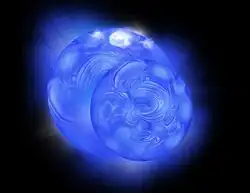
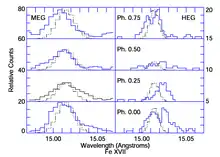
うしかい座i星は1781年8月17日、イギリスの天文学者ウィリアム・ハーシェルによって、重星であることが発見された[13]。主星のうしかい座i星Aは、黄白色のG型主系列星で、視等級は5.14である[10][11]。伴星のうしかい座i星Bは、ウィルソン山天文台の分光観測によっておおぐま座W星と似ていることが指摘され、その後1926年に変光特性が確認されて、視覚的に分離できない伴星うしかい座i星Cと、おおぐま座W型の連星を形成することがわかった[14][15]。B星とC星の連星は、分光連星でかつ食連星であり、食によって、明るさが5.8から6.4等級まで、6.43時間周期で変化する[16][9]。また、B星とC星は光球が接触するくらいに距離が近くなっており、地球から最も近い近接連星系である[17]。B-C星系は、A星の周りを細長い楕円軌道で、約209年周期で公転している[7]。
脚注
注釈
- パーセクは1 ÷ 年周視差(秒)より計算、光年は1÷年周視差(秒)×3.2615638より計算
- 視等級 + 5 + 5×log(年周視差(秒))より計算。小数第1位まで表記
出典
- “The Terrible Twos: What Might Happen If Our Sun Had A Twin”. Chandra X-ray Center (2001年11月21日). 2018年7月25日閲覧。
- ESA (1997), The HIPPARCOS and TYCHO catalogues. Astrometric and photometric star catalogues derived from the ESA HIPPARCOS Space Astrometry Mission, ESA SP Series, 1200, Noordwijk, Netherlands: ESA Publications Division, Bibcode: 1997ESASP1200.....E, ISBN 9290923997
- Samus, N. N.; et al. (2009-01), “General Catalogue of Variable Stars”, VizieR On-line Data Catalog: B/gcvs, Bibcode: 2009yCat....102025S
- “i Boo -- Eclipsing binary of W UMa type”. SIMBAD. CDS. 2018年7月24日閲覧。
- Hoffleit, D.; Warren, W. H., Jr. (1995-11), “Bright Star Catalogue, 5th Revised Ed.”, VizieR On-line Data Catalog: V/50, Bibcode: 1995yCat.5050....0H
- Mamajek, Eric E.; Hillenbrand, Lynne A. (2008-11), “Improved Age Estimation for Solar-Type Dwarfs Using Activity-Rotation Diagnostics”, Astrophysical Journal 687 (2): 1264-1293, Bibcode: 2008ApJ...687.1264M, doi:10.1086/591785
- Zirm, Henry (2011-01), “The Rapid Convergence of 44 Boötis with Revised Orbit and Updated Ephemerides” (PDF), Journal of Double Star Observations 7 (1): 24-36, Bibcode: 2011JDSO....7...24Z
- Orlov, V. V.; Petrova, A. V. (2000-04), “Dynamical Stability of Triple Stars”, Astronomy Letters 26 (4): 250-260, Bibcode: 2000AstL...26..250O, doi:10.1134/1.20389
- Kreiner, J. M. (2004-06), “Up-to-Date Linear Elements of Eclipsing Binaries”, Acta Astronomica 54: 207-210, Bibcode: 2004AcA....54..207K
- Hill, G.; Fisher, W. A.; Holmgren, D. (1989-02), “Studies of late-type binaries. I - The physical parameters of 44 i Bootis ABC”, Astronomy & Astrophysics 211 (1): 81-98, Bibcode: 1989A&A...211...81H
- Montesinos, B.; et al. (2016-09), “Incidence of debris discs around FGK stars in the solar neighbourhood”, Astronomy & Astrophysics 593: A51, arXiv:1605.05837, Bibcode: 2016A&A...593A..51M, doi:10.1051/0004-6361/201628329
- Høg, E.; et al. (2000-03), “The Tycho-2 catalogue of the 2.5 million brightest stars”, Astronomy & Astrophysics 355: L27-L30, Bibcode: 2000A&A...355L..27H
- Mr. Herschel; Dr. Watson (1782), “Catalogue of Double Stars. By Mr. Herschel, F. R. S. Communicated by Dr. Watson, Jun.”, Philosophical Transactions of the Royal Society of London 72: 112-162, Bibcode: 1782RSPT...72..112H
- Adams, W. S.; et al. (1921-01), “The parallaxes of 1646 stars derived by the spectroscopic method”, Astrophysical Journal 53: 13-94, Bibcode: 1921ApJ....53...13A, doi:10.1086/142584
- Schilt, J. (1926-11), “Two new variables stars of the type of W Ursae Majoris”, Astrophysical Journal 64: 215-224, Bibcode: 1926ApJ....64..215S, doi:10.1086/143006
- “VSX: Detail for i Boo”. AAVSO (2017年5月30日). 2018年7月25日閲覧。
- Kaler, Jim (2014年8月1日). “44 BOO (44 Bootis)”. 2018年7月25日閲覧。
関連項目
外部リンク
This article is issued from Wikipedia. The text is licensed under Creative Commons - Attribution - Sharealike. Additional terms may apply for the media files.