おおぐま座シータ星
おおぐま座θ星(英語: Theta Ursae Majoris)はおおぐま座にある恒星である。見かけの明るさは3.18等[1]で、おおぐま座の中では明るい恒星である。年周視差の値に基づくと、地球からの距離は43.96光年になる[8]。
| おおぐま座θ星[1] Theta Ursae Majoris | ||
|---|---|---|
| 星座 | おおぐま座 | |
| 見かけの等級 (mv) | 3.18[1] 3.16 - 3.20(変光)[2] | |
| 分類 | F型主系列星[1] | |
| 位置 元期:J2000.0[1] | ||
| 赤経 (RA, α) | 09h 32m 51.43390s[1] | |
| 赤緯 (Dec, δ) | +51° 40′ 38.2811″[1] | |
| 赤方偏移 | 0.000048[1] | |
| 視線速度 (Rv) | 14.40 km/s[1] | |
| 固有運動 (μ) | 赤経: -947.46 ミリ秒/年[1] 赤緯: -535.60 ミリ秒/年[1] | |
| 年周視差 (π) | 74.19 ± 0.14ミリ秒[1] (誤差0.2%) | |
| 距離 | 43.96 ± 0.08 光年[注 1] (13.48 ± 0.03 パーセク[注 1]) | |
| 絶対等級 (MV) | 2.5[注 2] | |
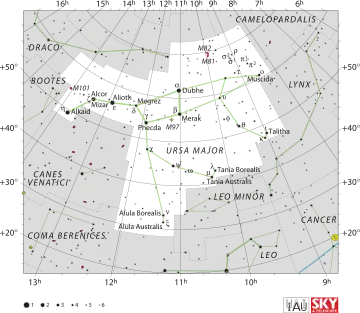  | ||
θ星の位置
| ||
| 物理的性質 | ||
| 半径 | 2.365 ± 0.008 R☉[3] | |
| 質量 | 1.41 M☉[4] | |
| 自転速度 | 6.8 km/s[4] | |
| スペクトル分類 | F7V[1] F6IV[2] | |
| 光度 | 7.871 ± 0.158 L☉[3] | |
| 表面温度 | 6,300 ± 33 K[3] | |
| 色指数 (B-V) | +0.46[5] | |
| 色指数 (U-B) | +0.03[6] | |
| 金属量[Fe/H] | –0.18 ± 0.07[4] | |
| 年齢 | 22億年[7] | |
| 他のカタログでの名称 | ||
| おおぐま座25番星[1] BD +52 1401[1] FK5 358[1], HD 82328[1] HIP 46853[1], HR 3775[1] SAO 27289[1], NSV 4519[1] LTT 12519[1] GJ 354 A/B[1] 2MASS J09325151+5140384[1] WISE J093250.11+514032.4[1] |
||
| ■Template (■ノート ■解説) ■Project | ||
1976年、Helmut A. AbtとSaul G. Levyは、おおぐま座θ星に、公転周期371日で主星を公転する伴星がある事を発表した[9]。しかし、1987年に、Christopher L. MorbeyとRoger F. Griffinは、これはデータの偶然だけで十分に説明出来るとして、伴星は存在しないと指摘した[10]。2009年にアリゾナ州にあるBok望遠鏡で観測が行われ180m/sの視線速度を検知したが、ケプラー軌道を裏付けるのにはっきりとした結果は得られなかった[11]。また、おおくま座θ星から約4.1度離れた位置には14等級の3重連星系があるが、これらは見かけの二重星とされている[12]。
おおぐま座θ星はスペクトル型F6IV[2]の準巨星とされてきた[5]。しかし、2009年にHelmut A. Abtは、おおぐま座θ星はまだ主系列星の段階にあると主張し[13]、それを踏まえて、スペクトル型をF7Vとしている場合もある。質量は太陽の1.41倍、半径は約2.5倍である。太陽よりも、光度は大きく、誕生から22億年が経過しているとされている。表面温度は約6,300Kである。おおぐま座θ星はF型主系列星なので、肉眼では、黄白色に光って見える[14]。
マクドナルド天文台の研究チームは0.05-5.2auの範囲に0.24-4.6木星質量の惑星が存在していると主張している[15]。
名称
脚注
注釈
- パーセクは1 ÷ 年周視差(秒)より計算、光年は1÷年周視差(秒)×3.2615638より計算
- 視等級 + 5 + 5×log(年周視差(秒))より計算。小数第1位まで表記
出典
- “SIMBAD Astronomical Database”. Result fortet UMa. 2016年11月28日閲覧。
- “GCVS”. Result for HD 82328. 2016年11月28日閲覧。
- Boyajian, Tabetha S. et al. (February 2012), “Stellar Diameters and Temperatures. I. Main-sequence A, F, and G Stars”, The Astrophysical Journal 746 (1): 101, arXiv:1112.3316, Bibcode: 2012ApJ...746..101B, doi:10.1088/0004-637X/746/1/101. See Table 10.
- Fuhrmann, Klaus (February 2008), “Nearby stars of the Galactic disc and halo - IV”, Monthly Notices of the Royal Astronomical Society 384 (1): 173–224, Bibcode: 2008MNRAS.384..173F, doi:10.1111/j.1365-2966.2007.12671.x
- Mallik, Sushma V. (December 1999), “Lithium abundance and mass”, Astronomy and Astrophysics 352: 495–507, Bibcode: 1999A&A...352..495M
- Johnson, H. L. et al. (1966), “UBVRIJKL photometry of the bright stars”, Communications of the Lunar and Planetary Laboratory 4 (99), Bibcode: 1966CoLPL...4...99J
- Nordström, B. et al. (May 2004), “The Geneva-Copenhagen survey of the Solar neighbourhood. Ages, metallicities, and kinematic properties of ˜14 000 F and G dwarfs”, Astronomy and Astrophysics 418: 989–1019, arXiv:astro-ph/0405198, Bibcode: 2004A&A...418..989N, doi:10.1051/0004-6361:20035959
- van Leeuwen, F. (November 2007), “Validation of the new Hipparcos reduction”, Astronomy and Astrophysics 474 (2): 653–664, arXiv:0708.1752, Bibcode: 2007A&A...474..653V, doi:10.1051/0004-6361:20078357
- Abt, H. A.; Levy, S. G. (March 1976), “Multiplicity among solar-type stars”, Astrophysical Journal Supplement Series 30: 273–306, Bibcode: 1976ApJS...30..273A, doi:10.1086/190363
- Morbey, C. L.; Griffin, R. F. (June 1987), “On the reality of certain spectroscopic orbits”, Astrophysical Journal, Part 1 317: 343–352, Bibcode: 1987ApJ...317..343M, doi:10.1086/165281
- Behr, Bradford B. et al. (November 2009), “Stellar Astrophysics with a Dispersed Fourier Transform Spectrograph. I. Instrument Description and Orbits of Single-lined Spectroscopic Binaries”, The Astrophysical Journal 705 (1): 543–553, arXiv:0909.3241, Bibcode: 2009ApJ...705..543B, doi:10.1088/0004-637X/705/1/543
- Kaler, James B., “THETA UMA (Theta Ursae Majoris)”, Stars (University of Illinois) 2016年11月28日閲覧。
- Abt, Helmut A. (January 2009), “MK Classifications of Spectroscopic Binaries”, The Astrophysical Journal Supplement 180 (1): 117–118, Bibcode: 2009ApJS..180..117A, doi:10.1088/0067-0049/180/1/117
- “The Colour of Stars”, Australia Telescope, Outreach and Education (Commonwealth Scientific and Industrial Research Organisation), (2004-12-21) 2016年11月28日閲覧。
- Wittenmeyer, R. A. (2006), “Detection Limits from the McDonald Observatory Planet Search Program”, The Astronomical Journal 132 (1): 177–188, arXiv:astro-ph/0604171, Bibcode: 2006AJ....132..177W, doi:10.1086/504942
- Allen, Richard Hinckley (1899), Star-Names and Their Meanings, New York: G. E. Stechert, p. 442
- (中国語) AEEA (Activities of Exhibition and Education in Astronomy) 天文教育資訊網 2006 年 6 月 16 日
This article is issued from Wikipedia. The text is licensed under Creative Commons - Attribution - Sharealike. Additional terms may apply for the media files.