たて座ガンマ星
たて座γ星(たてざガンマせい、γ Scuti、γ Sct)は、たて座にある白色に輝く恒星である[7]。見かけの等級は4.67と、暗いが肉眼でみえる明るさである[1]。年周視差に基づいて太陽からの距離を計算すると、およそ319光年となる[2]。たて座γ星は、高速で自転している恒星で、また運動が視線方向に偏り、高速で太陽に向かって接近しているため、将来かなり太陽系に近い距離まで来るとみられる[7]。
| たて座γ星 γ Scuti | ||
|---|---|---|
| 星座 | たて座 | |
| 見かけの等級 (mv) | 4.67[1] | |
| 位置 元期:J2000.0 | ||
| 赤経 (RA, α) | 18h 29m 11.8538827s[2] | |
| 赤緯 (Dec, δ) | −14° 33′ 56.931865″[2] | |
| 視線速度 (Rv) | -41.0 km/s[2] | |
| 固有運動 (μ) | 赤経: 3.22 ミリ秒/年[2] 赤緯: -4.02 ミリ秒/年[2] | |
| 年周視差 (π) | 10.21 ± 0.24ミリ秒[2] (誤差2.4%) | |
| 距離 | 319 ± 8 光年[注 1] (98 ± 2 パーセク[注 1]) | |
| 絶対等級 (MV) | -0.3[注 2] | |
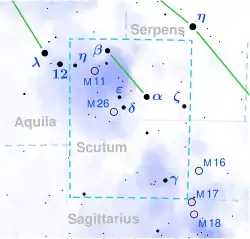  | ||
たて座γ星の位置(丸印)
| ||
| 物理的性質 | ||
| 半径 | 4.301 ± 0.205 R☉[3] | |
| 質量 | 2.784 ± 0.139 M☉[3] | |
| 表面重力 | 0.1 G[4][注 3] | |
| 自転速度 | 222 km/s[5] | |
| スペクトル分類 | A1 IV/V[1] | |
| 光度 | 149 ± 9 L☉[6] | |
| 表面温度 | 9,016 +156 −144 K[6] | |
| 色指数 (B-V) | 0.076[1] | |
| 色指数 (V-I) | 0.10[1] | |
| 年齢 | 2.37 ×10⁸ 年[4] | |
| 他のカタログでの名称 | ||
| BD-14 5071, FK5 696, HD 170296, HIP 90595, HR 6930, SAO 161520[2] | ||
| ■Template (■ノート ■解説) ■Project | ||
特徴
たて座γ星は、スペクトル型がA1 IV/Vに分類される、A型準巨星または主系列星である[1]。質量は太陽のおよそ2.8倍、半径は太陽のおよそ4.3倍、光度は太陽の約150倍、有効温度はおよそ9,016 Kと推定されている[3][6]。年齢は、2億年から4億年程度とみられ、質量からすると核での水素燃焼を終え、主系列から準巨星への進化が始まっている可能性がある[4][7]。自転速度は222 km/s以上とかなり速く、そのためたて座γ星は赤道方向が膨らんだ扁平な形をしており、赤道方向の半径は極方向の半径より2割程度長いという見積もりもある[5][8]。
EROS II
たて座γ星の名前は、恒星自身の特徴とは別の面でよく知られている[7]。フランスのMACHO探索計画EROS (Expérience de Recherche d'Objets Sombres) チームは、第2期の観測 (EROS II) として、ラ・シヤ天文台のMARLY望遠鏡を使い、銀河系の銀河面に沿ってバルジからは外れた領域の、特に恒星の密度が高い銀河の渦状腕の接線方向で、重力マイクロレンズ現象を監視した。観測領域は広い銀緯を網羅すべく4方向29区画あったが、その中で最もバルジに近い、たて・みなみじゅうじ腕の接線方向は、その領域の中心近くにたて座γ星があることから、たて座γ領域と呼ばれる[10][11]。
脚注
注釈
- パーセクは1 ÷ 年周視差(秒)より計算、光年は1÷年周視差(秒)×3.2615638より計算
- 視等級 + 5 + 5×log(年周視差(秒))より計算。小数第1位まで表記
- 出典での表記は、
![{\displaystyle \log g[{\mbox{cgs}}]=2.09}](../I/6285c5af398dc3f0a9a2c97b12b8a82af00e2d59.svg)
出典
- ESA (1997), The HIPPARCOS and TYCHO catalogues. Astrometric and photometric star catalogues derived from the ESA HIPPARCOS Space Astrometry Mission, ESA SP Series, 1200, Noordwijk, Netherlands: ESA Publications Division, Bibcode: 1997ESASP1200.....E, ISBN 9290923997
- “gam Sct -- Star”. SIMBAD. CDS. 2021年2月5日閲覧。
- Kervella, Pierre; et al. (2019-03), “Stellar and substellar companions of nearby stars from Gaia DR2. Binarity from proper motion anomaly”, Astronomy & Astrophysics 623: A72, Bibcode: 2019A&A...623A..72K, doi:10.1051/0004-6361/201834371
- David, Trevor J.; Hillenbrand, Lynne A. (2015-05), “The Ages of Early-Type Stars: Strömgren Photometric Methods Calibrated, Validated, Tested, and Applied to Hosts and Prospective Hosts of Directly Imaged Exoplanets”, Astrophysical Journal 804 (2): 146, Bibcode: 2015ApJ...804..146D, doi:10.1088/0004-637X/804/2/146
- Royer, F.; Zorec, J.; Gómez, A. E. (2007-02), “Rotational velocities of A-type stars. III. Velocity distributions”, Astronomy & Astrophysics 463 (2): 671-682, Bibcode: 2007A&A...463..671R, doi:10.1051/0004-6361:20065224
- Zorec, J.; Royer, F. (2012-01), “Rotational velocities of A-type stars. IV. Evolution of rotational velocities”, Astronomy & Astrophysics 537: A120, Bibcode: 2012A&A...537A.120Z, doi:10.1051/0004-6361/201117691
- Kaler, Jim. “GAMMA SCT (Gamma Scuti)”. Stars. 2021年2月5日閲覧。
- van Belle, Gerard T. (2012-03), “Interferometric observations of rapidly rotating stars”, Astronomy and Astrophysics Review 20 (1): 51, Bibcode: 2012A&ARv..20...51V, doi:10.1007/s00159-012-0051-2
- Bailer-Jones, C. A. L. (2015-03), “Close encounters of the stellar kind”, Astronomy & Astrophysics 575: A35, Bibcode: 2015A&A...575A..35B, doi:10.1051/0004-6361/201425221
- EROS Collaboration; et al. (1999-11), “Observation of microlensing towards the galactic spiral arms. EROS II. 2 year survey”, Astronomy & Astrophysics 351: 87-96, Bibcode: 1999A&A...351...87E
- Palanque-Delabrouille, N. (2002), “An updated review on microlensing experiments”, Memorie della Societa Astronomica Italiana 73: 363-371, Bibcode: 2002MmSAI..73..363P